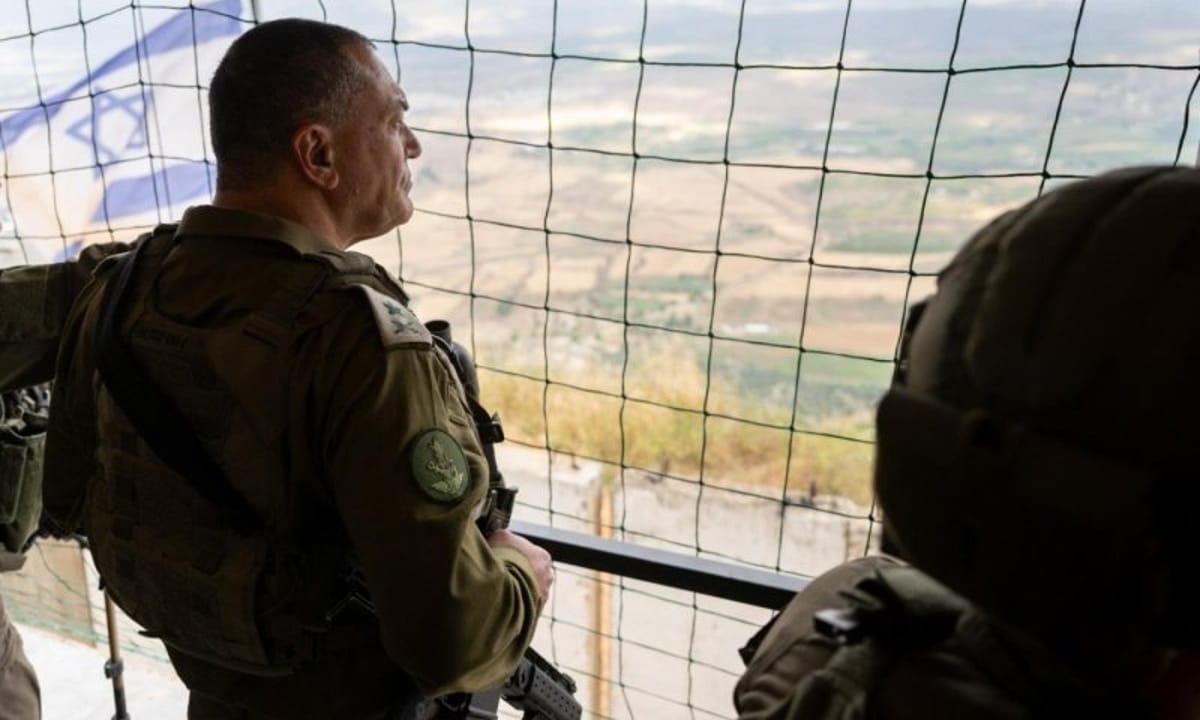
Israeli Chief of Staff Lieutenant General Eyal Zamir conducted a special assessment tour Friday at forward positions deep inside Lebanese territory along the Mount Dov ridge, alongside Northern Command chief Major General Rafi Milo and other senior commanders.
Zamir revealed that over 7,500 Hezbollah operatives have been eliminated since the start of the war, with 2,500 killed during Operation "Lion's Roar" alone, calling the cumulative damage to the organization "unprecedented."
A Grinding Drone War
The visit comes amid an intensifying drone crisis that has rattled both IDF forces and northern Israeli communities. Eight IDF soldiers have been killed by explosive drones since the April ceasefire went into effect, and senior IDF officials warn that without a policy change and expanded freedom of action, the price will continue to rise.
Two soldiers and a civilian were killed over the past week alone by Hezbollah's explosive-laden first-person-view (FPV) drones. The threat has proven particularly difficult to counter: Hezbollah's fiber-optic suicide drones are hardwired to operators via 15km cables, allowing them to bypass advanced electronic warfare systems.
Zamir's Response
Addressing the drone threat, Zamir struck a determined tone: "The battlefield is not sterile and never will be, but we are investing our best resources, minds, and capabilities." He held a comprehensive command-level discussion on fiber-optic drones and lethal racing drones, emphasizing the need for the IDF to unite forces with the Defense Ministry's Directorate of Defense Research & Development to accelerate solutions without resource constraints.
Zamir ordered the IDF to fast-track solutions with no budget ceiling, and instructed that any viable solution must be deployed to southern Lebanon and the border immediately. It was also decided to advance the integration of various types of radar and to create synergy between ground-force and air-force sensors to enhance detection and warning capabilities.
Zamir has also demanded that the security cabinet allow strikes on Hezbollah in Beirut, following rising IDF casualties and increased harm to northern Israeli towns from drone attacks.
Wider Context
Northern Command hopes to receive enough time to carry out approved operational plans, against the backdrop of a possible agreement with Iran that could also include a ceasefire in Lebanon. Israeli forces operating between the border and the Yellow Line continue to destroy Hezbollah infrastructure, though contractors have been instructed to carry out most heavy work at night because of the drone threat.
Prime Minister Netanyahu said on May 18 that "the best minds in the country" are working on the drone problem, with "no budget constraint."
On the broader strategic message to Hezbollah and Tehran, Zamir was unambiguous: "No location will provide sanctuary. The Yellow Line does not constrain us. Every strike against Hezbollah is also a strike against the Iranian axis."
The Chief of Staff closed by honoring Israel's reserve forces, acknowledging the heavy burden carried by tens of thousands of fighters and their families across many months of combat.