Get our mobile app
Download on the App StoreGet it on Google Play

Sukkot under fire

Anti-drone nets over sukkot are kosher

Protective netting already deployed over bases in the north and across Israel to stop enemy drones, but does it invalidate the mitzvah? Military rabbinate issues halachic ruling for soldiers building sukkot under the nets

IDF Rabbis Rule: Anti-Drone Nets over Sukkot are Kosher

As Sukkot approaches, the security situation has brought a novel halachic question to the military rabbinate: what is the status of a sukkah built under protective netting?

Across IDF bases in the north and throughout the country, anti-drone nets have been deployed over open areas to prevent enemy drones from penetrating and to save lives. These nets cover the spaces where soldiers erect sukkot during the festival.

The rabbinate emphasizes that where a genuine security or safety risk exists, one may not build a sukkah or sit or sleep in it. A soldier who insists on sitting in a sukkah in a dangerous location violates a Torah prohibition and transgresses the mitzvah of "venishmartem me'od lenafshoteichem", guarding one's life.

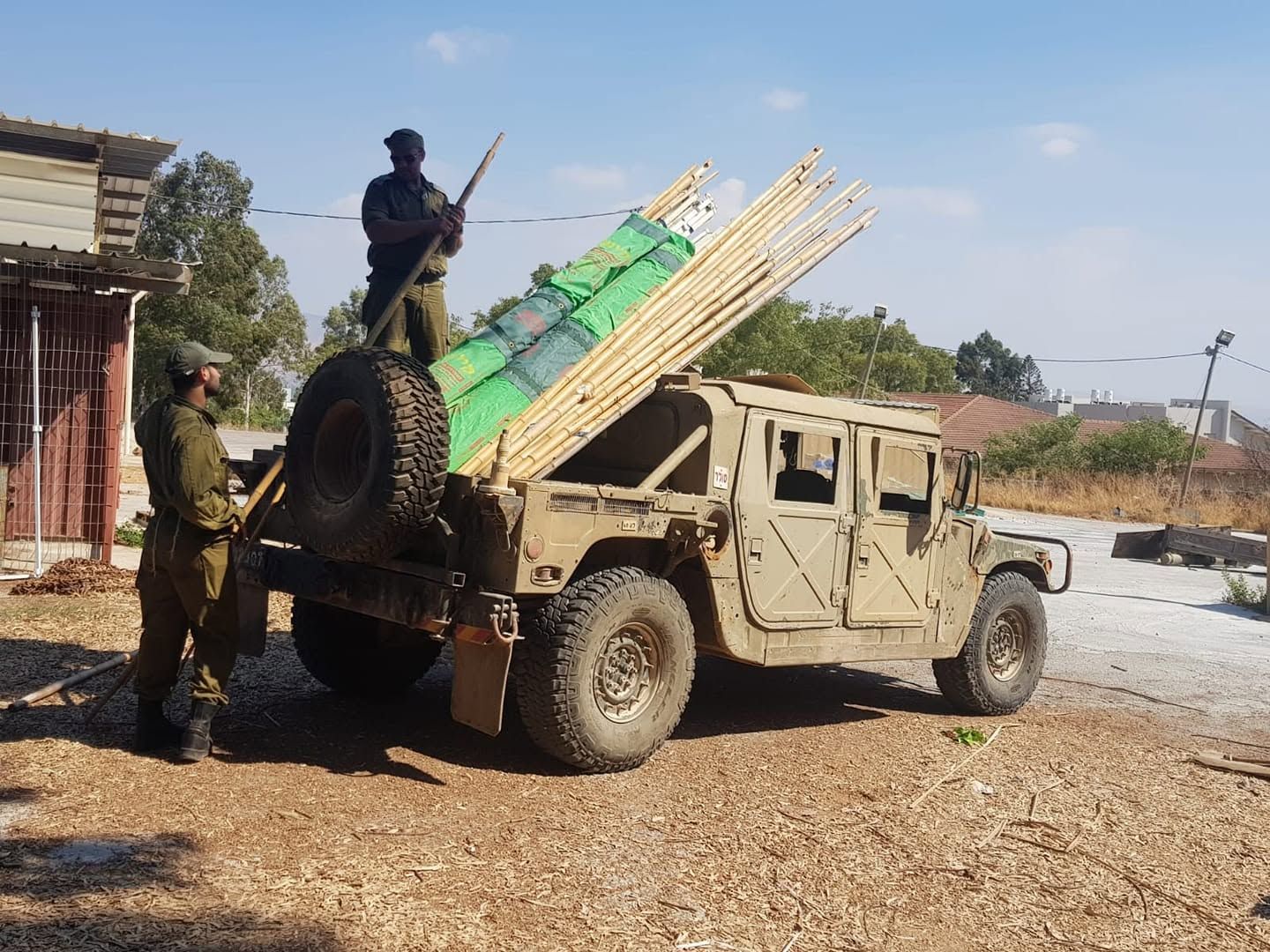
Halachic questions from soldiers
Halachic questions from soldiers (Photo: IDF Spokesperson)

When a covering is placed above a sukkah, a halachic concern arises. The Shulchan Aruch rules that spreading a sheet over the s'chach or beneath it, at a distance of more than four tefachim , invalidates the sukkah under the principle of "sukkah tachat sukkah," a sukkah beneath a sukkah.

However, anti-drone netting is not comparable to a sheet: it is not intended for shade, and because its holes are numerous, "its sun is greater than its shade" and "the open space exceeds the covered", so it does not itself constitute invalid s'chach.

The more complex question concerns the law of "lavud" and invalid s'chach:

The concern of lavud and the stringency of the Bach:

The Shulchan Aruch rules that if there are sections of invalid s'chach two tefachim wide and the distance between them is less than three tefachim, they combine through "lavud."

Building on this, the Beit Chadash (the Bach) innovated that even a sequence of thin boards or wires with gaps of less than three tefachim between them is considered a continuous covering that constitutes invalid s'chach. Since the holes in the anti-drone net are less than three tefachim apart, there would be grounds to worry that according to the Bach, the net invalidates the sukkah.

Sukkot in the IDF
Sukkot in the IDF (Photo: IDF Spokesperson)

Grounds for leniency:

Halachic authorities have ruled to be lenient and permit the sukkah, based on three central arguments:

The primary law: Most contemporary poskim, and many Acharonim, including Rav Yosef Shalom Elyashiv zt"l, Rav Ovadia Yosef zt"l, and Rav Avraham Yitzchak HaKohen Kook zt"l, do not rule according to the Bach's position, and according to the primary law, one need not be concerned for this stringency.

The distinction of Rav Shlomo Zalman Auerbach: Rav Shlomo Zalman Auerbach zt"l proved, based on the Ritva, that the Bach's stringency applies only to roof boards, not to thin wires or ropes, such as clotheslines or netting, that are made from the outset to be open to air, where "we do not apply lavud as a stringency."

No combination to the measure of invalidation: The thin wires do not combine to form a continuous measure of four tefachim of invalid s'chach.

The practical ruling: In a location where it is permitted to erect a sukkah according to security and safety instructions, anti-drone netting deployed above the sukkah does not invalidate it at all.

The sukkah is kosher lechatchilah, and one may fulfill the mitzvah of the festival in it as prescribed, eating, sleeping, and reciting the blessing "leishev basukkah" without any doubt.

Ready for more?

Join our newsletter to receive updates on new articles and exclusive content.

We respect your privacy and will never share your information.

Enjoyed this article?

Yes
No
Follow Us:

Unmissable content


Loading comments...

Also of Interest