
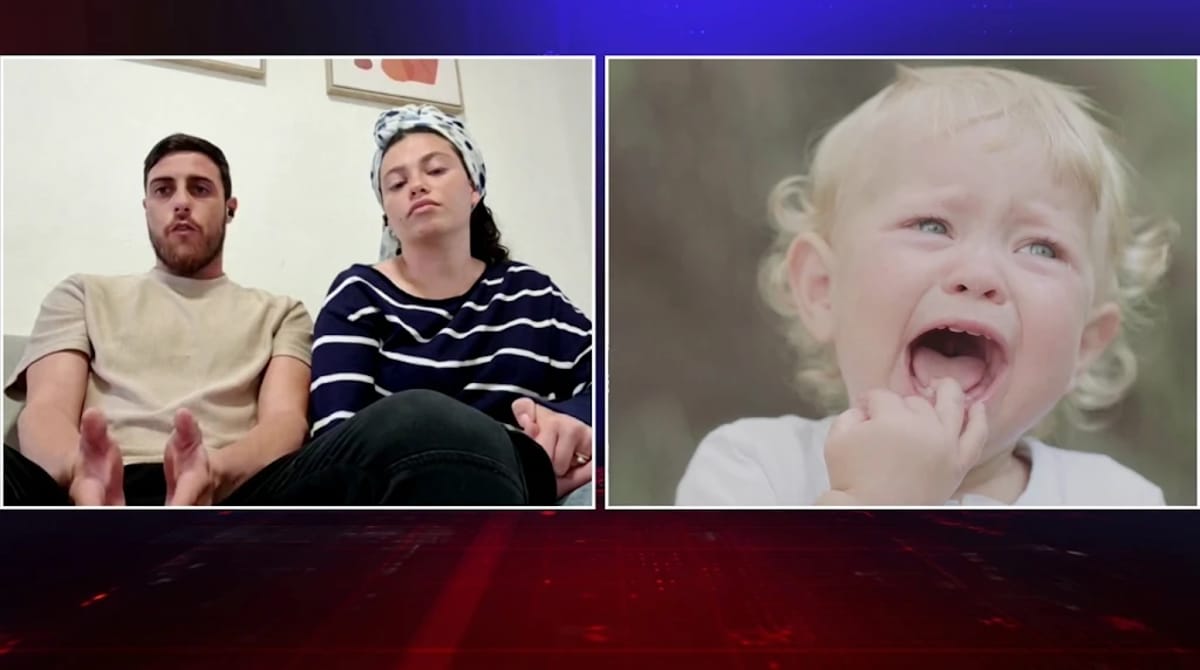
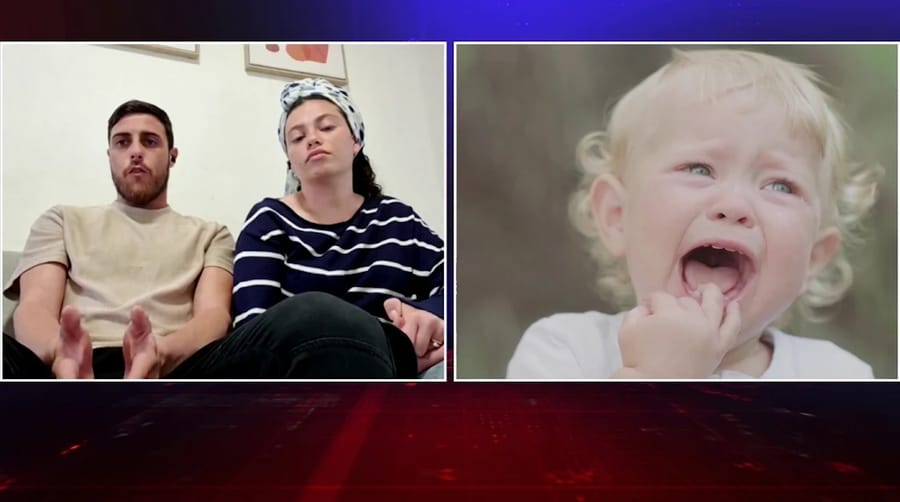
An indictment charging a daycare director and two caregivers with over 400 cases of assault and sadistic abuse of toddlers has left parents in Ariel reeling, and asking how a supervised facility could have hidden such systematic violence for so long. Shmuel and Chaya Gaver, whose toddler was among the victims, sat down with Yossi Sergobsky in the Kikar Hashabbat studio to describe what happened behind closed doors, and how the daycare staff managed to deceive them throughout.
"Our eyes went dark when we saw the descriptions"
"Until now we could only guess and try to understand the scale from the remand hearings," Chaya said, recalling the moment parents first saw the full indictment in court. "The second we received the indictment, which leaked before the hearing, every parent's eyes went dark. Anyone who had been in denial was confronted with detailed, horrifying descriptions of abuse. Parents could not stay calm and erupted, justifiably."
The current indictment, covering hundreds of abuse incidents, is based entirely on security-camera footage from a brief period starting only on 1 September. "We're talking about fewer than 40 actual operating days, because of the chagim and Shabbosos. A very short period in which over 400 incidents occurred. We don't want to imagine what happened there in the months and years before, and we hope the police will check the recordings from previous years as well."
The cover-up machine
One of the hardest questions for any parent is how such a severe pattern of abuse failed to raise red flags earlier. Shmuel described a well-oiled, methodical cover-up by the staff: "There was no way to understand what was happening inside. They operated in an organized, systematic way and made sure we would never need to talk among ourselves about any mark or bruise. Every parent received a detailed message from the ganenet, 'the child tried to take a book and fell,' 'he fell on his pacifier,' 'he got scratched by a friend.' Everything was explained, accompanied by a smile and reassurances."
"When a child didn't want to go to gan, you think to yourself that he's just having fun at home with Ima," Shmuel added. "Even when other parents placed recording devices, they did everything quietly and understood that someone was recording. The person who saved the children was an instructor who saw what was happening and reported it, only then did we start connecting the dots."
Chaya described the behavioral change in their son: "At first he would run to gan happily. Later he became a rag, came back from the chag break and already refused to go, stopped eating well and would wake up at night screaming. We attributed it to teething or ear infections. Only in the last few days did I think to place a recording device, and according to the indictment the assaults on him indeed occurred toward the end of that period."
Where was the supervision?
Beyond the personal trauma, the couple directs sharp accusations at the Education Ministry's supervision mechanisms: "This is a daycare that was defined as under supervision. I personally spoke on the phone with the supervisor and asked her how many times she visited this year, and she answered: 'The year hasn't started yet.' The year hasn't started yet, and there are already over 400 abuse cases! And when I asked about last year, she said she was there once or twice. Helpless children arrive day after day at a daycare considered 'supervised,' and in practice there is no supervision at all. Someone there must be held accountable."
Lessons for parents: Watch for changes and share information
At the end of the conversation, the couple asked to convey a clear message to all parents:
Listen to behavioral signals: "Children at this age don't lie. Even when the child doesn't speak, he tells what he's experiencing through his behavior, if he starts hitting, refusing to go to gan or waking up screaming, don't dismiss it and don't rationalize it. Check thoroughly."
Ongoing communication between parents: "Make sure to talk among yourselves in the parent groups. If we had shared with each other in real time about every bruise and explanation we received from the ganenet, we would have identified the recurring pattern and caught on much earlier."