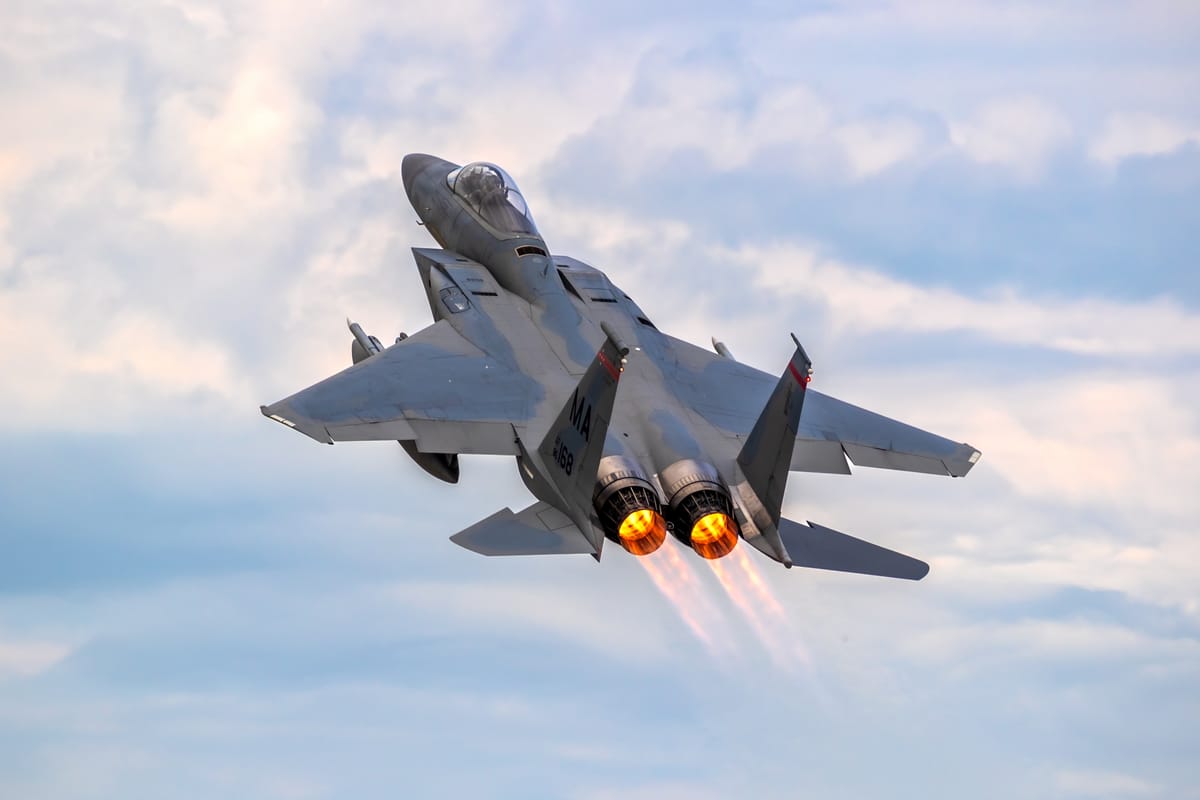
When the American F-15E Strike Eagle went down over Iranian territory on April 3, the pilot ejected into something he had never seen before: dozens of Iranian drones hovering in formation, moving together as a single coordinated mass, with larger drones above and smaller ones hanging beneath them like legs, a shape, he told debriefers, like a jellyfish.
"Real alien sh*t," one of the sources familiar with the pilot's account told CNN, which first reported the testimony Tuesday.
The account, shared during an intelligence debriefing after the incident, immediately set off a firestorm of debate within the U.S. intelligence community that has yet to be resolved. At the center of the dispute is a question that carries significant implications for American air power across the Middle East: has Iran developed a functional drone-swarming capability that U.S. intelligence agencies never knew existed?
The answer, two months later, remains contested.
The April 3 shootdown of call sign Dude 44 marked the first time a U.S. manned combat aircraft was lost over Iranian territory during the conflict. The F-15E carried a crew of two, a pilot and a weapons systems officer. The pilot was rescued hours after ejecting, while the weapons systems officer evaded Iranian capture in the mountains for more than a day before also being rescued by special operations forces. A second aircraft, an A-10, was downed during the rescue operation, though that pilot ejected safely outside Iranian airspace.
While the exact cause of the F-15 downing is still being investigated, initial reports indicated that it was possible the drone formation had in some way enabled Iran to shoot down the American jet, according to two sources familiar with the matter.
The capability the pilot described has a technical name: "one-to-many meshed networking," which allows an operator to command several drones simultaneously. If Iran has achieved it at operational scale, the implications for air operations in the region would be severe. Other countries, Russia and China, are believed to have the capability, and there is a trail of reports indicating that Iran had been receiving assistance in developing its drone technology from both, according to two sources familiar with the matter.
But intelligence officials conducting the debrief were not immediately persuaded by what they heard. The pilot was concussed in the crash. It was also his second time being shot out of the sky during the Iran war: he had previously been among the pilots downed in a friendly fire incident involving Kuwaiti forces early in the conflict. Officials asked him directly: "Are you sure you saw what you are saying you saw?"
The question was not rhetorical. US intelligence officials disagreed on how to interpret what the F-15 pilot described, and whether the pilot could recount the incident clearly. Had he witnessed a mature capability that U.S. intelligence wasn't aware of? A beta test? A mirage in the desert?
Outside analysts who reviewed the account were less equivocal about the stakes. "We will spend huge, huge dollars, like a lot of blood and treasure, protecting ourselves from something that can coordinate like that," said Emma Bates, a drone warfare and defense modernization expert who founded the company Cachai. "If it can coordinate itself into a recognizable shape and maintain that shape, and if it's got explosives on board, and if it is holding resources in reserve to attack whatever the first volley didn't destroy — that's a very capable approach."
Iran aggressively deployed attack drones as an asymmetric weapon throughout its conflict with U.S. and Israeli forces, as well as targeting Gulf states. The country has invested heavily in unmanned systems for years, in part as a hedge against conventional military inferiority. Whether it has now crossed into networked swarm capability, the domain previously reserved for the most advanced militaries in the world, is a question U.S. intelligence is now urgently trying to answer.
The U.S. Air Force directed queries to U.S. Central Command, which did not directly address questions from CNN.
The disclosure comes as U.S. and Iranian negotiators are in the early stages of a 60-day diplomatic window aimed at converting last week's ceasefire into a lasting agreement. Iran's drone program is not currently among the items on the formal negotiating agenda, though American officials have privately acknowledged that Tehran's asymmetric capabilities represent one of the most durable threats to U.S. and Israeli operations in the region, regardless of how the nuclear talks conclude.
For now, older footage of Iranian drone operations is being reviewed with new urgency. The pilot's account may or may not be confirmed. But the intelligence community is no longer certain it knows the ceiling of what Iran can put in the sky.