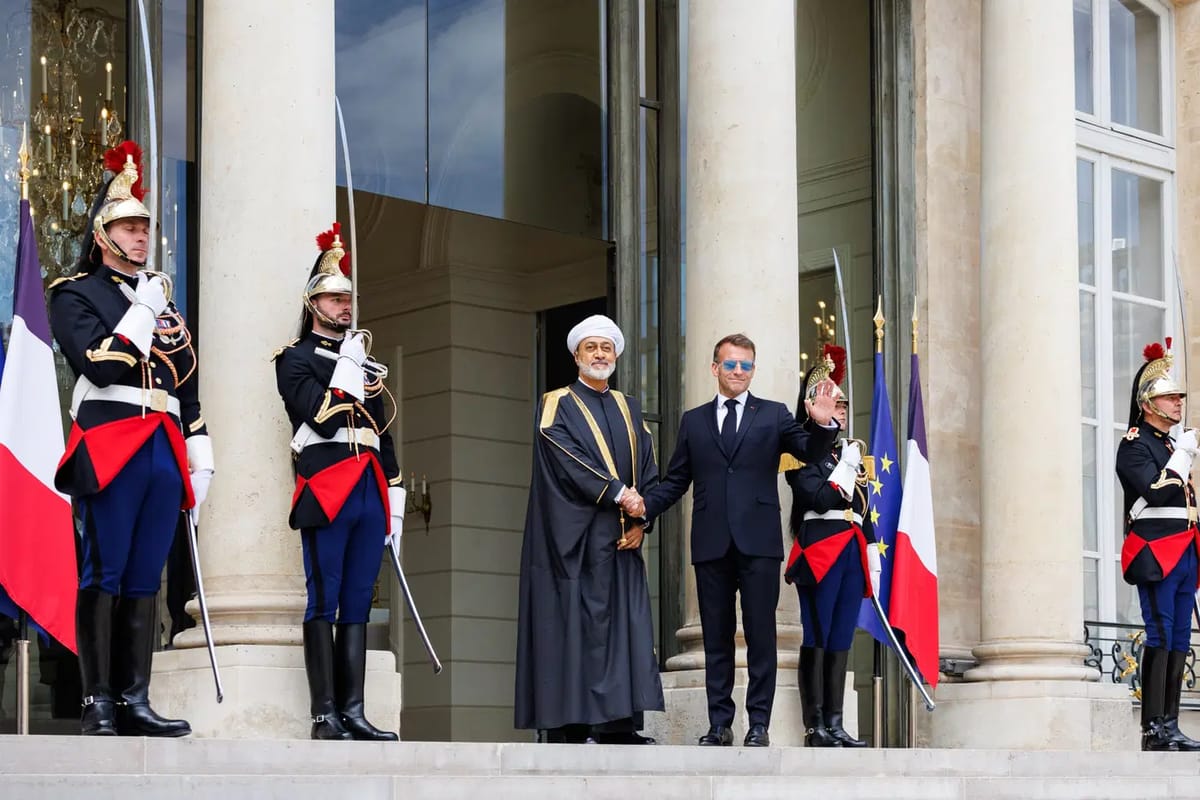
An unusual breach of traditional diplomatic etiquette has ignited a wave of domestic political scrutiny regarding the physical well-being and transparency of the French executive branch. The head of state has drawn intense criticism from opposition figures and social media networks after concealing his face during a crucial bilateral meeting with a prominent Middle Eastern sovereign. While the official summit yielded significant international maritime security pacts, the public focus has rapidly shifted toward the mysterious reappearance of a highly recognizable piece of eyewear.
French President Emmanuel Macron hosted Sultan Haitham bin Tariq of Oman at the Elysee Palace in Paris on Monday, June 29, 2026, marking the Omani ruler's first official state visit to the French capital. The high-level meeting occurred against the backdrop of highly sensitive backchannel nuclear negotiations between the United States and Iran, alongside unresolved security concerns regarding the Strait of Hormuz. Following the conclusion of the talks, the French president issued an official statement on social media networks to welcome the Gulf monarch and detail the strategic achievements of the summit.
The executive announcement highlighted several comprehensive agreements intended to bind the two nations into closer economic, scientific, cultural, and industrial cooperation. Macron stated, “Happy to receive His Majesty Haitham bin Tariq, the Sultan of Oman, on his first official visit to Paris. The Sultanate of Oman and France are strengthening their partnership today through historic agreements in the economic, scientific, cultural, and industrial fields.”
The diplomatic package also included an explicit military security mandate designed to address recent maritime escalations and maintain open sea routes in the Persian Gulf region. Macron clarified that both nations are working jointly to prevent further territorial escalation in the Middle East. He added, “We decided to cooperate jointly, in cooperation with our partners, in clearing mines in the strait to secure shipping lanes and ensure free and unconditional passage through the Strait of Hormuz.”
Despite the strategic importance of the maritime mine-clearing accord, French citizens and digital commentators instantly focused on the president’s choice to wear dark sunglasses indoors during the state ceremony. The specific eyewear has effectively become a personal trademark for the president, who previously used the exact same accessories to conceal a noticeable hematoma in his eye socket. During that previous incident, the president admitted that the glasses were necessary to hide a burst blood vessel that had pooled inside his eye area.
The sudden return of the dark shades prompted a barrage of sarcastic remarks from online critics, many of whom revived rumors regarding the president's domestic life. Multiple users openly wondered if the leader had once again sustained an injury from his wife, Brigitte Macron, referencing a past televised incident where she was seen striking her husband as they exited the presidential aircraft.
Far-right political opposition leader Florian Philippot quickly capitalized on the social media frenzy to mock the administration's public image. Philippot stated, “Macron brings out his sunglasses again! A new punishment from Brigitte or to be cool again?” He also noted that the domestic French manufacturing company that originally designed and produced the president's famous sunglasses has since declared bankruptcy.
Other political commentators expressed deeper concerns regarding the state of French leadership, arguing that wearing dark glasses during a major diplomatic event undermines international statecraft. One prominent online critic wrote, “Everything is a lie with Macron. You don’t wear sunglasses at such a level of state responsibility to speak face to face. The gaze is an essential matter. Therefore, he is hiding a problem again. In what mental, psychological, and physical health state is this man really, that is the main question.”