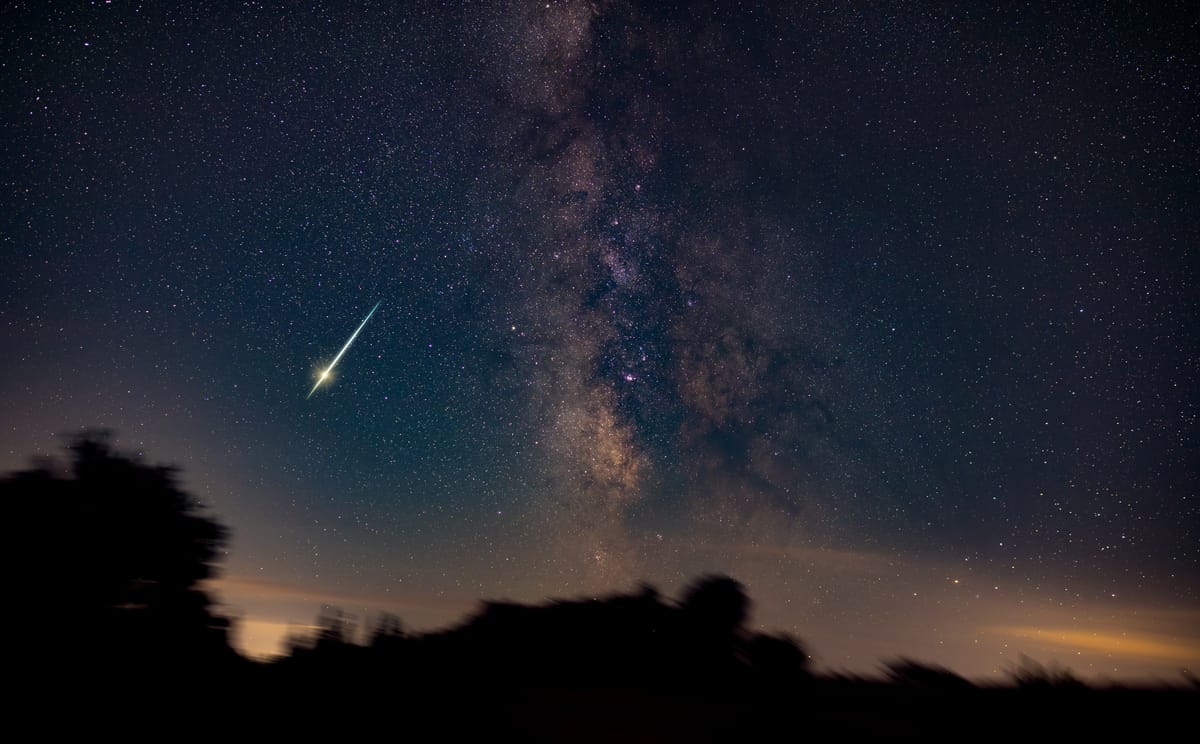
The annual Perseid meteor shower crosses Earth's skies tonight, Thursday to Friday, August 13-14, offering a final opportunity to witness one of the year's most spectacular celestial events. While the shower's peak occurred last night, observers can still expect to see dramatic light trails and bright fireballs streaking across the darkness.
The Perseids occur each summer between July 17 and August 24, when Earth passes through debris fields left behind by a comet—streams of dust, ice, and rock captured by our planet's gravitational pull. These particles enter the atmosphere at tremendous speeds, heating up from friction and burning up in the characteristic light trails commonly known as shooting stars.
The source of this annual display is Comet Swift-Tuttle, a frozen body that orbits the sun once every 133 years. The comet takes its name from an astronomer at Harvard Observatory who documented it in 1862, though records of the phenomenon date back much further. Historical observations of the Perseids extend more than 2,000 years into the past.
Swift-Tuttle once earned the ominous designation of "the most dangerous object to humanity" due to its orbital path bringing it relatively close to Earth. However, scientists have since dismissed collision concerns, calculating that the probability of an impact in the year 4479 stands at just 0.0001%.
Certain years have produced exceptional displays, including 1993 when the rate exceeded 300 meteors per hour, and 2016 with rates reaching 200 per hour. According to the Israeli Space Agency, this year's shower is particularly strong, with peak rates approaching 150 meteors per hour.
Viewing conditions tonight are considered ideal because the moon sets at 7:30 PM, eliminating light interference and leaving the sky completely dark. The recommended viewing window runs from 1:00 AM to 4:00 AM in dark locations away from urban light pollution.
To maximize the experience, observers should allow approximately 30 minutes in darkness for their eyes to adjust, and avoid looking at mobile phone screens, which disrupts the adaptation process.
For the best chance of seeing the greatest number of meteors, viewers should avoid focusing on a single point. Instead, look generally toward the northeast and upward (toward the center of the sky), or toward the darkest section of sky at your viewing location. While meteors can appear anywhere in the sky, their trails will seem to radiate from the northeastern region.