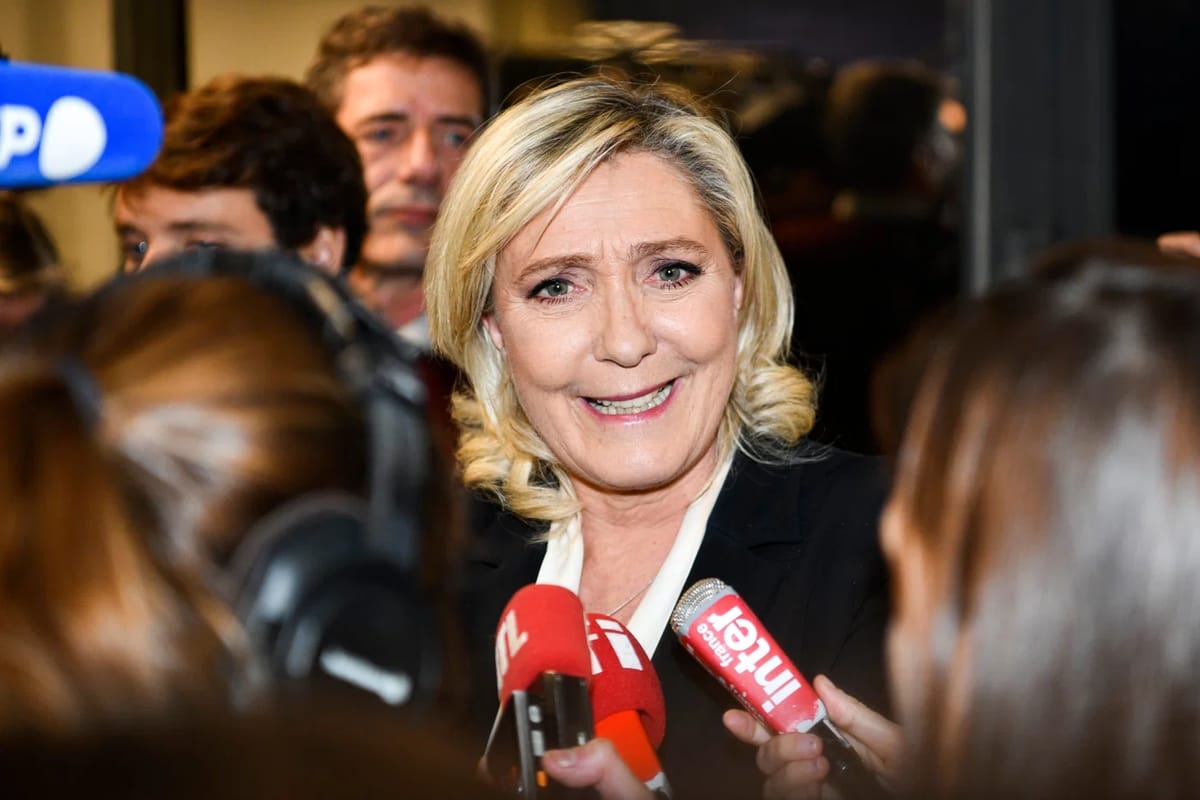
France's political and legal establishment was jolted this week by a sequence of events that has placed Marine Le Pen, the leader of the nationalist right and a longtime opponent of what she calls uncontrolled immigration, back at the center of the country's presidential race.
Le Pen appeared before judges on Tuesday to learn the outcome of her appeal in a long-running case concerning the misuse of European Union public funds. The Paris Court of Appeal upheld her criminal conviction but substantially altered her sentence in a way that, in practical terms, cleared her to run for president in next spring's election.
Under the new ruling, Le Pen was sentenced to three years in prison, two of them suspended. The remaining year is to be served under house arrest with an electronic monitoring bracelet, and she was also ordered to pay a fine of 100,000 euros. Michèle Ageon, the judge who presided over the appellate panel, said the decision to ease the political disqualification tied to the case reflected the need to weigh voters' freedom of choice, which she described as a precondition for the expression of democratic will.
Only days earlier, Le Pen had told French television audiences that campaigning while wearing an electronic bracelet would be impossible, since she was not prepared to depend on a judge's approval simply to attend a market visit or a rally. Had the appellate court preserved the original ban on public office, the widespread expectation in Paris was that she would be forced to withdraw from the race and hand the party's candidacy to Jordan Bardella, the president of her party, the National Rally.
Commentators aligned with the left had greeted the prospect of a mandated electronic bracelet with evident satisfaction. That reaction proved premature. Hours after the sentence was announced, Le Pen appeared for a previously scheduled interview on the 8 p.m. news broadcast of TF1, France's leading television network, and used the appearance to deliver a second, more consequential announcement.
She said she would immediately file an appeal with France's highest judicial body, the Court of Cassation, and declared on air that she was, as of that evening, a candidate for president. Under French law, an appeal to the Court of Cassation automatically and fully suspends the effects of the lower court's ruling. Le Pen explained the mechanism to viewers directly, saying that the appeal to the high court would suspend the effects of the sentence and that she would therefore run her campaign without an ankle monitor.
She framed the legal maneuver as a way of transferring the final judgment on her future from the judiciary to French voters at the ballot box, and she again rejected the accusations underlying her two convictions, arguing that the public should be the ones to decide who is right. "We are innocent of the acts attributed to us," she said. "These acts cannot be classified as embezzlement of public funds."
The case dates back to 2015, when the European Parliament opened a formal inquiry into her party, then known as the National Front. French prosecutors alleged that between 2004 and 2015, the party operated a scheme of fictitious contracts for parliamentary assistants in Brussels and Strasbourg, diverting European taxpayer funds meant to finance parliamentary work toward salaries for party operatives actually employed in France. The original trial found that the scheme had helped pay the salary of Le Pen's personal bodyguard and the private secretary of her father, Jean-Marie Le Pen, the party's co-founder, who was later expelled over antisemitic remarks. Prosecutors estimated the total sum fraudulently obtained from the European Union at more than 4 million euros, and the first court found that Marine Le Pen had played a central, dominant role in establishing and running the scheme.
In March of last year, the trial court convicted her of running an organized scheme to embezzle funds and imposed an immediate five year ban from holding public office, a ruling that stunned the French political establishment because it effectively barred her from running to succeed the sitting president. She and ten other senior party officials appealed that judgment, arguing through their lawyers that the party had acted in good faith and that its arrangements reflected a legitimate interpretation of how political assistants could be employed. The appellate judges rejected those arguments and upheld the underlying conviction, but this week's sentencing decision reduced the total disqualification period to 45 months, with 30 months of that suspended. The remaining 15 months were counted retroactively from the date of the original March verdict, meaning the effective disqualification period had already elapsed, leaving the door to the election open.
This marks the fourth time Le Pen has run for the French presidency. In her previous three attempts, she advanced to a runoff each time only to be defeated as rival parties from across the political spectrum united against her. After the trial court's original ruling, many in Paris assumed there would not be a fourth attempt, and her party had begun preparing Bardella to face voters instead.
Despite the legal maneuver clearing her path, Le Pen's strategy carries real risk. If the Court of Cassation decides to expedite proceedings given the case's public significance, it could issue a final ruling in the middle of the campaign itself. Should her appeal ultimately be rejected, Le Pen could find herself required to wear the monitoring bracelet and face significant restrictions on her movement in the crucial weeks before the vote.
The legal developments have already triggered a wave of reaction across the French political system. François Ruffin, a member of parliament aligned with the left, said Le Pen had now been found guilty twice of embezzling 4.1 million euros in public funds from French taxpayers. "She is a criminal," he said. "That is the only conclusion one can draw from this court's ruling. So logically, she should not be running for president."
Her supporters, and even some rival political camps, acknowledge that she remains the dominant force on the French right. President Emmanuel Macron is constitutionally barred from seeking a third consecutive term, leaving the field wide open. Associates of former prime minister Édouard Philippe have privately conceded that Le Pen will enter the race as its strongest candidate, and that no legal conviction is likely to weaken her standing with her base of support.
The outcome of France's next presidential election is being watched closely well beyond its borders. France is the European Union's second largest economy and a nuclear power with a major military role on the continent. Le Pen and her party have for years expressed open skepticism toward E.U. institutions and NATO, and they oppose continued large scale military funding for Ukraine. A Le Pen victory next year could significantly reshape French policy and the broader balance of power across Europe.