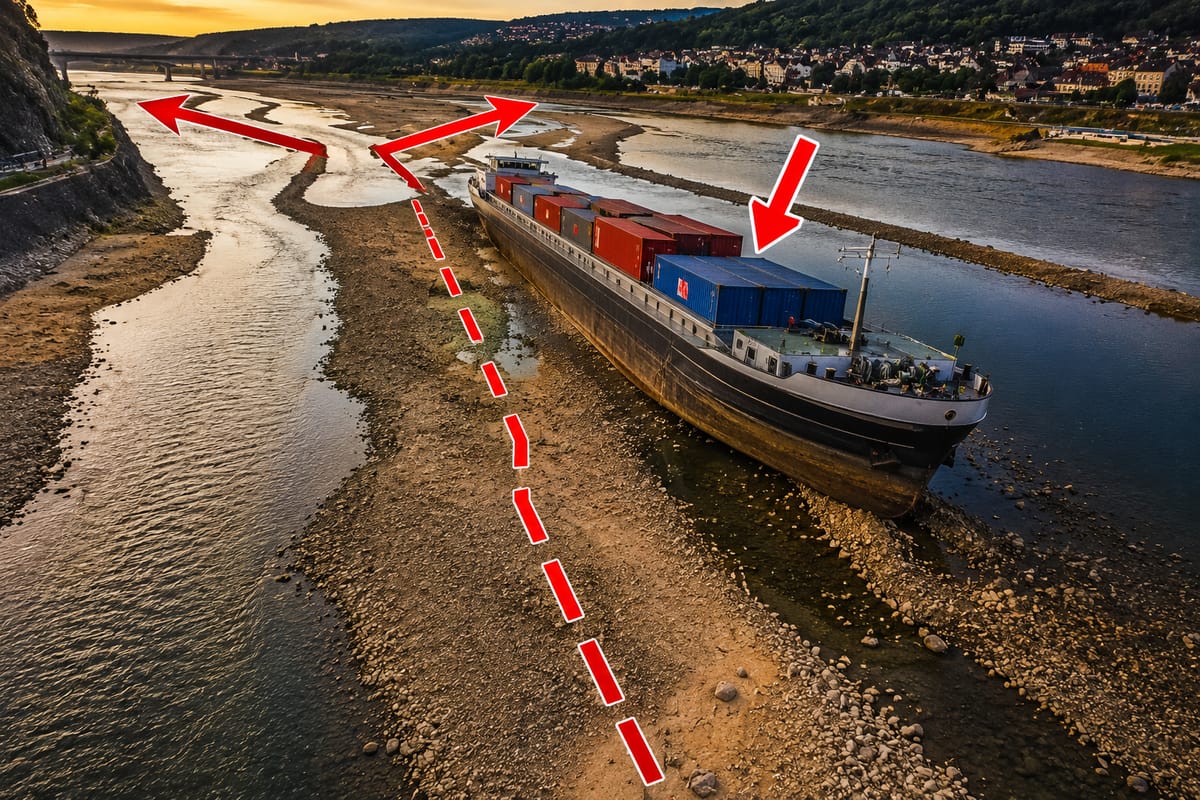
The Rhine River has served as a major transportation artery across Europe for centuries, but a dry summer and lack of rainfall have brought water levels to a point where shipping companies are no longer just discussing reduced cargo loads. They're warning of a scenario where parts of the river may become too shallow for vessels to pass through at all.
The area of greatest concern is near the town of Kaub, south of Koblenz in Germany. This section represents one of the Rhine's shallowest stretches and acts as a natural bottleneck, making every drop in water level particularly noticeable and consequential for navigation.
The Kaub bottleneck epitomizes Europe's new climate vulnerability.
Current water depths hover below 40 centimeters at critical passages, far below the 2-3 meters required for safe navigation, forcing barges to cut cargo loads to under 1,000 tons—multiplying trips and fuel costs by 40 to 50 percent. But this is no longer an anomaly.
The European energy crisis was greatly exacerbated by delays to coal shipments and interruptions to essential cooling processes at nuclear power plants in France, and major manufacturers including BASF and ThyssenKrupp were forced to cut production. 2025 droughts signal worsening trends, with forecasters noting no major water level revisions until 2027 but urging national adaptations. While the EU invests in dredging and climate-resilient infrastructure, the Rhine's strangled capacity increasingly threatens Germany's industrial output and Europe's energy security in ways that cannot be solved by logistics alone.
Without structural solutions to Alpine snowmelt and rainfall patterns, Europe's commercial artery may remain constricted indefinitely