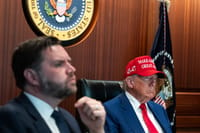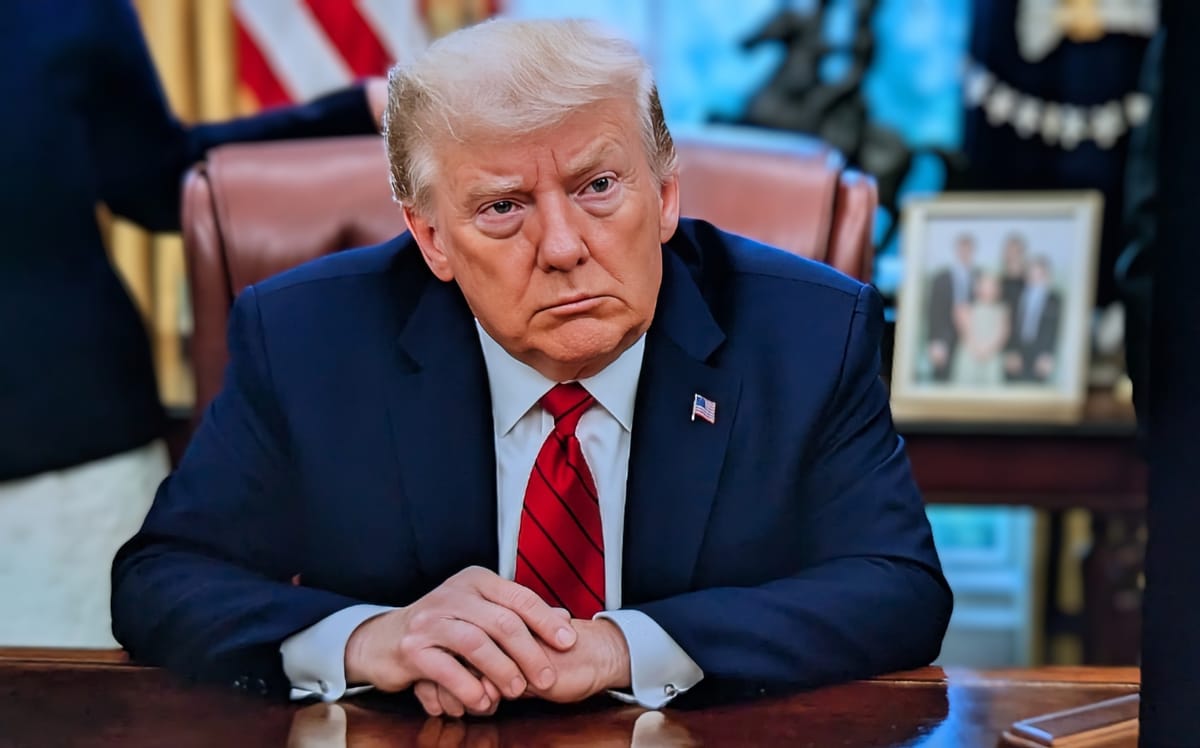
Months before the United States launched its bombing campaign against Iran, President Donald Trump sat in the Oval Office with Elon Musk and Tucker Carlson and gave them his word.
"They want you to go to war with Iran," Carlson told him.
"We're not doing that," Trump replied.
On February 28, the U.S. attacked Iran.
That exchange is among the most striking revelations in "Regime Change: Inside the Imperial Presidency of Donald Trump," a new book by New York Times reporters Maggie Haberman and Jonathan Swan, published this week and based on more than 1,000 interviews conducted over three years. The book paints a portrait of a president whose private statements and public actions diverged sharply — on Iran, on Netanyahu, and on the war that reshaped the Middle East.
'Con Man'
Trump's feelings about Prime Minister Benjamin Netanyahu, the book reveals, were considerably less warm in private than his public embrace suggested.
Trump called Netanyahu a "con man" — a term the authors note is considered one of the harshest insults in the president's personal lexicon. Trump initially said he wanted "no part of Netanyahu's war with Iran," but changed his position after a meeting in the Situation Room in which Netanyahu presented Israel's arguments.
The reversal, according to the book, did not come easily. It came after Netanyahu and his team made a hard pitch in the Situation Room, with Israeli military leaders appearing on screens and senior American officials, including chief of staff Susie Wiles, Secretary of State Marco Rubio, and Defense Secretary Pete Hegseth — seated in the room. The meeting, the authors write, was kept deliberately small to guard against leaks.
It apparently wasn't small enough.
The Oval Office Scene
The meeting with Musk and Carlson, described in rich detail in the book, captures the contradictions of Trump's pre-war posture.
Carlson had criticized Trump for refusing to take Netanyahu to task over Gaza and warned him that a broader war would be his ruin. "They want you to go to war with Iran," Carlson said. "We're not doing that," Trump answered.
Trump also told Carlson: "I don't think there's ever been an American president as powerful as I am." Struck by this, Carlson replied: "Certainly not since FDR. Really, the only thing that could wreck it is war with Iran."
Trump attacked Iran roughly a year later. Carlson has since said publicly he was "tormented" by the way he "misled" people to support Trump, who had vowed no new wars in the Middle East during the 2024 campaign.
Meanwhile, in that same Oval Office meeting, Musk was "transfixed" by a golden pager that Netanyahu had gifted Trump, an homage to Israel's September 2024 exploding pager operation against Hezbollah.
'It's Terrible, Terrible'
The pager attack itself, the book reveals, produced one of the more surreal scenes of Trump's early second term.
Trump described at length to Musk and Carlson severe injuries that included missing hands, and said one survivor "looked like a great white shark came and just took a chunk out of him." The authors wrote that Trump repeatedly said "It's terrible, terrible," and expressed astonishment at "the indiscriminate nature" and "recklessness" of the attack in a public space, while still being taken by the ingenuity of the operation.
The book describes Trump as both "fascinated and horrified" by the attack. That Netanyahu would later gift him a golden pager, which Trump displayed and praised, only adds to the peculiarity of the episode.
What the Book Means for the Netanyahu Relationship
The timing of the book's publication is itself significant. The excerpts emerged in the same week the U.S. and Iran signed a memorandum of understanding to end the war, a deal Israeli officials publicly opposed and which several senior Republican senators have called a strategic failure.
The portrait Haberman and Swan paint complicates the public narrative of a seamless Trump-Netanyahu alliance. Behind closed doors, according to the book, Trump saw Netanyahu as a manipulator who dragged the United States toward a war the president had explicitly said he didn't want — even as he ultimately went along with it, and even as Netanyahu gifted him gold-plated souvenirs from Israeli intelligence operations.
Trump thought that if the U.S. and Israel did attack, it would be a quick war. Senior officials including Vice President Vance warned in the Situation Room that a war against Iran could cause regional chaos and untold casualties, and could break apart Trump's coalition. The war lasted more than 100 days, cost over $100 billion, and claimed 13 American lives.
The White House has expressed concern about the extent of material Haberman and Swan obtained, including reported access to Situation Room recordings from classified meetings. The reporters say their account is drawn from direct quotes, contemporaneous notes, recordings, and transcripts.