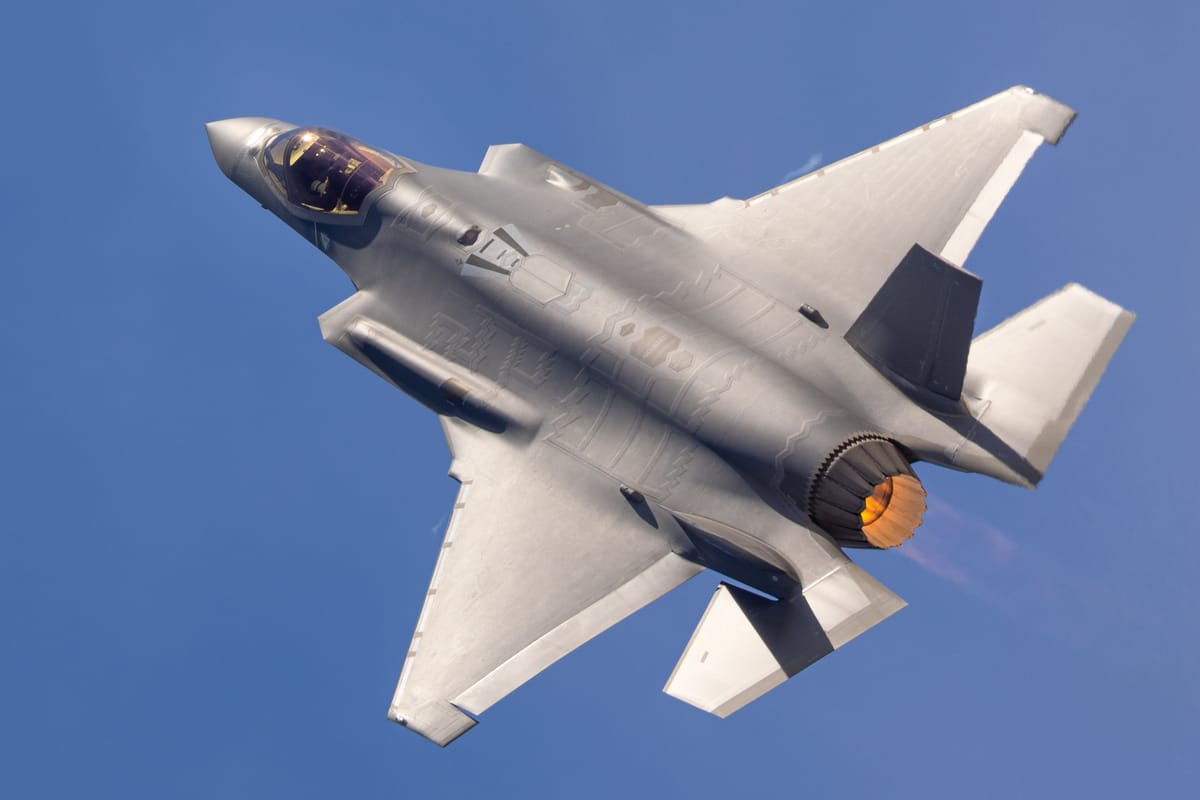
Israel is no longer alone in trying to prevent the United States from selling F-35 stealth fighter jets to Turkey.
Greece, Turkey’s historic regional rival and fellow NATO member, has reportedly conveyed a strong message of opposition to any move that would return Ankara to the F-35 program or authorize a new sale of the advanced aircraft to President Recep Tayyip Erdoğan’s government.
The Greek intervention adds another significant obstacle to Ankara’s effort to modernize its aging air force and comes as both Israel and Greece increasingly view Turkey’s expanding military power and regional ambitions with concern.
Turkey seeks sweeping air force modernization
Turkey has been working for years to overhaul its military aviation capabilities.
Its current combat fleet is built largely around approximately 240 F-16 fighter jets, alongside older F-4 Phantom aircraft. Ankara is now seeking a much broader modernization package that could be tied to enormous commercial aviation purchases from American manufacturers, including Boeing and Lockheed Martin, potentially worth more than $10 billion.
On the military side, Turkey is seeking dozens of advanced new F-16s while also pursuing modernization kits for roughly 150 older aircraft.
Ankara is additionally interested in acquiring fighter engines for use in its domestically developed KAAN combat aircraft, a flagship Turkish aerospace project intended to reduce the country’s dependence on foreign suppliers.
Although the KAAN has a modern stealth-inspired appearance, it remains far from matching the proven capabilities of the American F-35.
The centerpiece of Turkey’s ambitions, however, is far more dramatic: Ankara wants to acquire approximately 40 F-35 stealth fighters.
Israel and Greece push back
That prospect has triggered alarm in both Jerusalem and Athens.
Israel fears that Turkish access to the F-35 could partially erode the Israeli Air Force’s qualitative superiority in the region. Greece, meanwhile, has its own long history of military tension with Turkey over the Aegean Sea, territorial disputes and the broader balance of power in the Eastern Mediterranean.
The reported Greek opposition means the F-35 issue is no longer simply an Israeli concern.
Any potential agreement would face a complex American approval process. The Pentagon would have to support the deal, and Congress would also play a critical role.
At present, significant obstacles remain.
Turkey’s continued possession of the Russian-made S-400 air-defense system has long been one of Washington’s most serious concerns. Critics fear that operating the S-400 alongside the F-35 could expose sensitive information about the stealth aircraft’s capabilities and vulnerabilities.
Turkey was previously removed from the F-35 program after purchasing the Russian system.
The political character of Erdoğan’s government and Ankara’s increasingly independent foreign policy are also expected to fuel opposition.
Israeli military concerned
Israeli defense officials are reportedly troubled by the possibility that Turkey could field the same basic stealth platform used by Israel.
One Israeli security source stressed, however, that Israel’s F-35I “Adir” fleet is not identical to the standard aircraft operated by the United States and other allies. Israel has incorporated unique domestically developed systems and modifications into its version of the jet.
Even so, the strategic concern remains.
“Once the Turks have F-35s, Israeli Air Force pilots will no longer be the only ones flying stealth fighters in the Middle East,” one security source said.
That would represent a major change in the regional air-power equation.
A broader Turkish bloc?
The concern in Israel extends beyond fighter jets.
Israeli officials increasingly view Turkey as seeking to establish itself as the dominant regional power while developing new political and strategic partnerships across the Middle East and Eastern Mediterranean.
From Jerusalem’s perspective, an emerging Turkish-centered alignment may include countries such as Qatar, Egypt, Syria and Lebanon.
Israel is not part of that developing network.
The possibility of a powerful Sunni-oriented regional bloc under growing Turkish influence has attracted increasing attention inside Israel’s defense establishment, particularly as relations between Jerusalem and Ankara remain deeply strained.
For Israel, therefore, the debate over the F-35 is not simply about one weapons system. It is part of a broader question over whether Erdoğan’s Turkey is evolving into a strategic rival capable of challenging Israel’s military freedom of action.
And with Greece now reportedly joining the opposition, Ankara may find that its path back to the world’s most advanced fighter program is far more difficult than President Erdoğan had hoped.