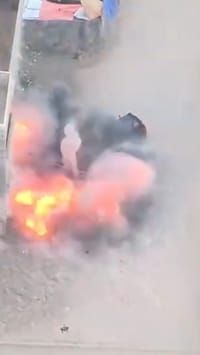

A powerful explosion was heard across northern Israel after the IDF destroyed a major underground Hezbollah tunnel complex in the village of Majdal Zoun in southern Lebanon, one of the terrorist organization’s key military strongholds in the western sector.
According to the IDF, the fortified underground route was more than 200 meters long and over 25 meters deep. It contained hundreds of weapons, including dismantled UAVs, aircraft components, warheads, explosives, and four launch shafts directed toward Israeli territory.
The tunnel was destroyed by forces from the 551st Brigade combat team and the elite Yahalom combat engineering unit, under the command of the 91st Division. The IDF said the compound had been built using technology and expertise supplied by the Iranian regime.
“This was an underground compound used by Hezbollah to store weapons and prepare attacks against the State of Israel,” the IDF Spokesperson said. “The IDF will continue operating in the security zone in southern Lebanon and removing every threat to our forces and to Israeli civilians.”
Prime Minister Benjamin Netanyahu and Defense Minister Israel Katz said the operation was carried out as part of Operation Sof Pasuk, in which the IDF destroyed Hezbollah’s underground terror infrastructure in the Majdal Zoun area.
“The route, which was more than 200 meters long and more than 25 meters deep, contained hundreds of weapons and several launch shafts intended to strike Israeli territory and Israeli civilians,” Netanyahu and Katz said in a joint statement.
Israel also notified the United States and the American representative in Lebanon ahead of the demolition, according to the statement.
Before the explosion, local councils in the Western Galilee and Upper Galilee warned residents that a large blast might be heard due to IDF activity against Hezbollah infrastructure in Lebanon. Some communities were told that the force of the explosion could even trigger independent earthquake alerts not connected to Home Front Command systems.
Officials stressed that there was no danger to residents in northern Israel.
Majdal Zoun, located roughly 10 kilometers from the Israeli border, has been described by the IDF as one of Hezbollah’s “deployment villages” in southern Lebanon — a civilian area used by the terrorist group as a military base. During the war, Hezbollah used the area for observation and attacks against communities in the Galilee.
Inside the underground compound, Israeli forces found blast doors, 12 rooms used for weapons storage and terrorist accommodation, and multiple launch positions. The IDF described the site as one of Hezbollah’s most significant assets in the sector, built over years with Iranian investment.
During IDF operations in the area, more than 20 Hezbollah terrorists were eliminated, including around 10 members of the Radwan Force, according to the military.
The demolition came shortly after the IDF announced the death of Captain David Hazut, 21, from Ashkelon, a platoon commander in Battalion 12 of the Golani Brigade, who fell in combat in southern Lebanon. One IDF soldier was lightly wounded in the same incident. The Hezbollah terrorist involved in the encounter was later eliminated.
The operation also followed Netanyahu’s announcement of a framework agreement with the Lebanese government. Under the arrangement, Israel is expected to withdraw from certain “pilot areas” in southern Lebanon and transfer them to the Lebanese army, while IDF forces will remain in most areas under Israeli control in the security zone until the Hezbollah threat is removed.
Netanyahu described the agreement as “a severe blow to Iran and Hezbollah,” and praised the Lebanese government for showing “courage.”