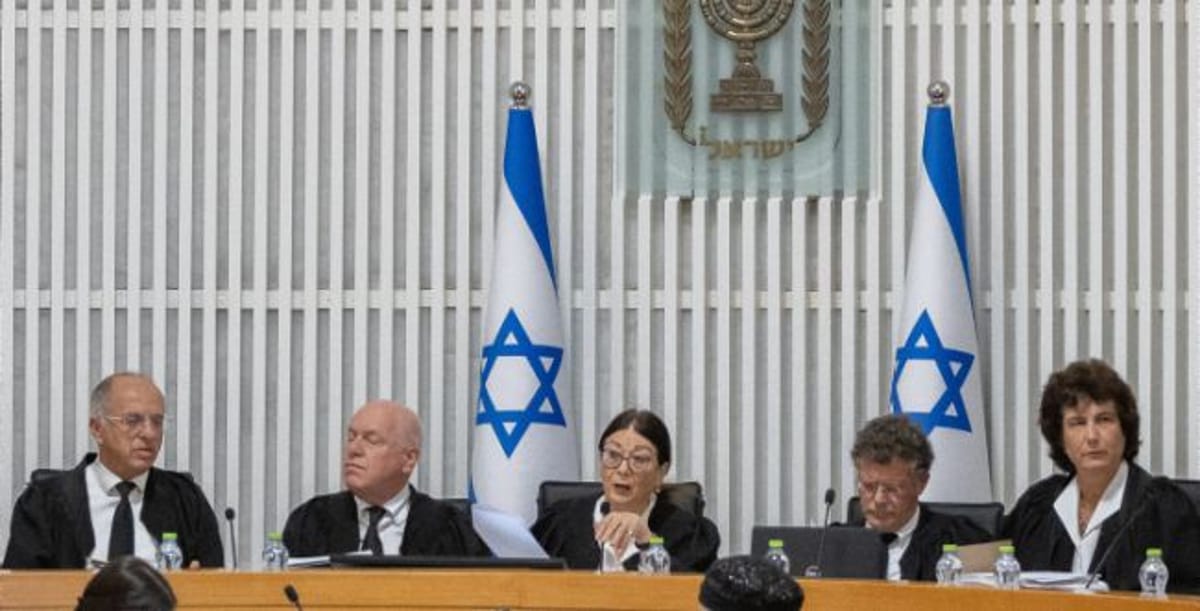
Supreme Court President Esther Hayut decided to join the debate, saying, "There are dozens of different scenarios" regarding the Clause of Reasonability. According to her, "Some might argue that since the establishment of the state, or at least for the past 40 years, you are blocking all the courts from granting relief to plaintiffs and are saying that a court cannot adjudicate." She continued, "There are thousands of individual decisions that ministers make and delegate authority that affect citizens in their daily lives, and they come and complain about decisions that are not reasonable. They have no evidence to prove that there are extraneous considerations or other reasons, and they say the outcome is not reasonable." She added, "In most cases, we do not intervene, but the law blocks this possibility from all the courts in the country."
Continuing with President Hayut's remarks, Justice Amit stated, "Blocking of the court," quite literally. Hayut added to his comments and noted that "you can restrict its boundaries (referring to the court - ed.), but not without boundaries." According to her, "You are preventing the courts from adjudicating thousands of decisions that concern citizens." She then referred to the speed of passing the law, saying, "These discussions about the Clause of Reasonability began in the Knesset on June 25th. You may count how many discussions there were." Finally, Vice President Fogelman intervened, adding, "We are not the Knesset, but you may examine the timelines of other basic laws."
In the continuation of the discussion, Justice Naam Solberg clarified that amending the Clause of Reasonability through the Knesset is not the correct way: "Anyone who wanted, wholeheartedly or not, to connect between the hearing and legislation now, then I conclude that I did not take any position. If they want to hold on to the unconstitutional constitutional amendment - the doctrine needs to take a broader look and not oversee every basic law in a separate constitution. We haven't reached a point where the use of this doctrine is impossible at the current stage."
President Hayut responded to the judge's comments and stated that "the Clause of Reasonability is one of the central tools that the court has, which has developed in case law. Even Justice Solberg's colleagues believe that narrowing it is not reasonable, and the platform to do so is not a basic law. The natural place to limit it is where the court has developed it."
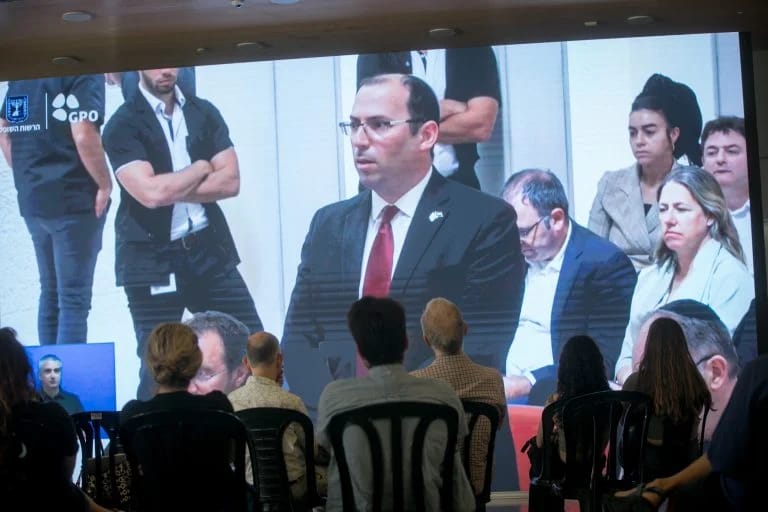
Attorney Helman, representing the Attorney General's office, commented on the resumption of the debate: "It would have been better if this basic law had not been legislated. To pass such a law, you need to define what a basic law includes, how it is legislated, and how it is changed. The Knesset was not authorized by the Constituent Assembly to create a Basic Law that does not conform to a Jewish and democratic state. The safeguards for our democratic regime are extremely weak."
He also said, "We always compare to the United States – in the past hundred years, they have enacted 8 amendments to their Constitution, and in the last 50 years, only one. The 25th Knesset managed to amend three basic laws in eight and a half months."
A representative of Gali Baharav-Miara mentioned, "This government can legislate and turn Israel into a non-democratic state. The court must prevent this."
In addition, Justice Solberg asked what could be done if the judges were wrong, whether the Declaration of Independence would allow the repeal of basic laws. Attorney Helman replied, "In our view, damage to the democratic core has already been caused." Justice Solberg asked, "So are we not living in a democracy? Today." President Hayut said, "It should be a fatal injury. We won't repeal every other basic law." Helman added, "The amendment creates a normative black hole in the system."