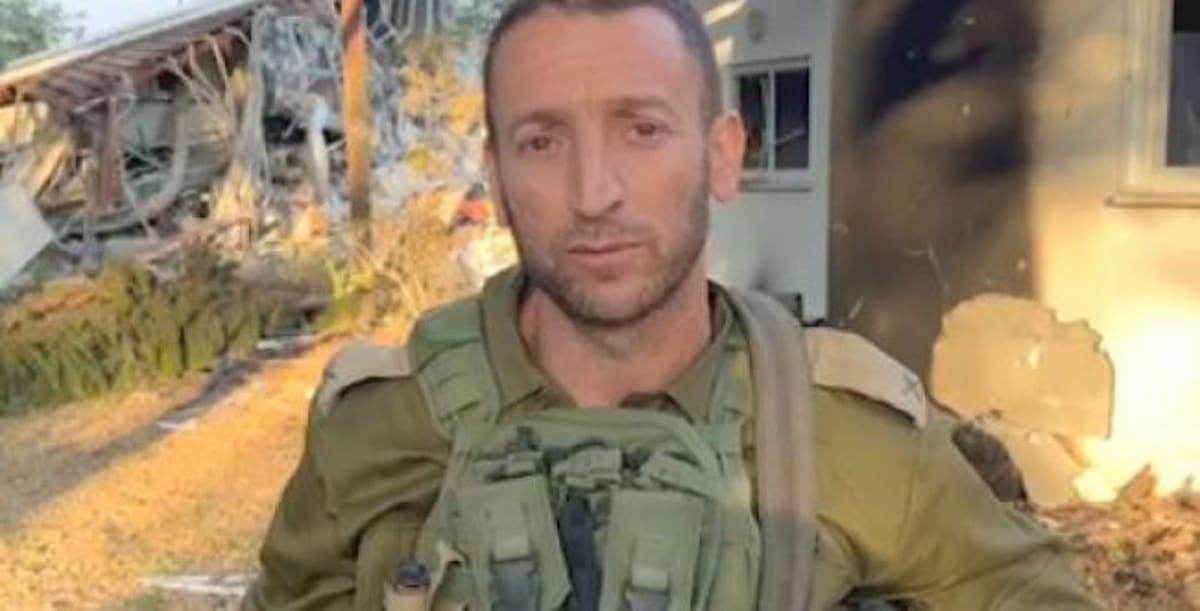
The war in the south. Colonel Barak Hiram, the commander of the IDF Bazak Division (Formation 99), led the battle for Kibbutz Be'eri. In a conversation with reporters, he describes the early morning summon, the intense battles fought against dozens of terrorists, and the horrors discovered after the community was cleared.
The Bazak Division includes the Kfir Brigade and reservist soldiers from the Commando Brigade. They fought against terrorists in Be'eri, where they encountered ambushes and terrorists dressed in IDF uniforms. In the end, tanks were forced to fire at the houses where the terrorists had barricaded themselves until they were cleared by Combat Infantry Corps.
"We failed in the mission of defending the Gaza envelope," says Hiram to the reporters, "but we have restored the situation to its previous state, eliminated the enemy, and secured the borders."
Hiram describes how he rushed out of his home upon hearing about the unusual events in the south. While on Highway 6, he received a phone call from Major General Shlomi Binder, the head of the Operations Directorate, who informed him that every division commander was being assigned to a region, directing him to the Netivot. On his way, Hiram collected two officers from Battalion 1, whom he referred to as "Kambatz," and a personal connection. In Netivot, he gathered soldiers from all security forces and organized the defense of the city.
From there, he went to Alumim, where he and his team neutralized three terrorists. When he saw that the settlement was under the control of the Local Combat Unit, he continued to Kibbutz Be'eri, where he gathered forces from Shayetet, Saldag, Matkal Reconnaissance Unit, Tzanhanim, Kfir Brigade, Unit 504, and even Prison Service teams.
"On Saturday night, an incident of hostages developed, not exactly hostages but more of an entrenchment, they did not negotiate with us. There was an entrenchment of 20 terrorists in a complex of railway buildings. Every call we made was answered with anti-tank fire, the group of murderers did not come in the direction of negotiations, and I had no choice but to give the order to capture the buildings. We rescued four hostages."
They encountered ambushes and dozens of terrorists scattered across many locations within the settlement. "We gained control of the kibbutz on Sunday at 22:00, but it was only on Monday afternoon that we finished eliminating all the terrorists."
"To send 108 terrorists to the kibbutz is not a mission of occupation; it's a mission of slaughter"
"After Monday, we began the effort to locate survivors. We searched from house to house. The terrorists, as part of their tactics to bring the residents outside, had a technique to remove spare tires from the jeeps, set them on fire, and rolled them into the buildings, which caused people to exit. We also found in several bomb shelters people who suffocated to death inside the bomb shelters, choosing not to leave.
"I had a very intense combat experience throughout an entire night with Shayetet 13 of the compound against 17 terrorists who were entrenched. There were numerous encounters with many terrorists, a lot of grenade throwing. We left our houses, fought with personal weapons against terrorists who came with a lot of explosives."