U.S. Fires 49 Tomahawks Into Iran as Regional Escalation Spreads Across the Middle East
American forces attacked Iranian air-defense, radar, command, surveillance and communications targets after a rapid escalation that also drew in Jordan, the Gulf, Lebanon and Israel’s northern front

A major regional escalation unfolded on Tuesday evening as the United States carried out a series of strikes against military targets inside Iran, while Tehran threatened American and regional assets and claimed attacks across the Gulf and Jordan.
According to early reports, a senior American official said all the targets struck were located in southern Iran and included air-defense systems, radars, and command-and-control units connected to Iran’s drone forces.
Shortly afterward, the Pentagon reportedly described the strikes as an act of “coercive diplomacy,” intended to force Iran to make concessions at the negotiating table.
The diplomatic track also appeared to be weakening. According to a New York Times report cited in the updates, hopes for a breakthrough in negotiations declined after a Qatari mediation delegation left Tehran without progress.
As the strikes continued, Iran announced that it was closing the Strait of Hormuz and warned that any vessel attempting to pass through would be attacked. U.S. Central Command later rejected the Iranian claim, saying the strait remained open to traffic.

At the same time, economic and political concerns were growing in Washington. The Wall Street Journal reported that Trump insisted the crisis with Iran was under control, but American officials said he had not expected the months-long ceasefire to collapse, nor had he expected Iran to launch missiles and drones so freely. The report also cited concerns over inflation reaching a three-year high and rising fuel prices wiping out recent wage gains.
In a separate development, Iranian hacker group “Handala” claimed that it had disrupted waves of American attacks using electronic capabilities.
The regional escalation also affected civilian aviation. Air Canada announced that it was extending its cancellation of flights to Israel until October 24.
By late Tuesday night, the picture was clear: what began as a military exchange had expanded into a broader regional crisis involving American strikes inside Iran, Iranian threats against shipping, reported attacks toward U.S. assets in Jordan and the Gulf, rocket fire from Lebanon, and growing concerns over the economic consequences of a widening confrontation.
The central question now is whether the American strikes will push Iran back toward negotiations — or whether Tehran will continue trying to expand the confrontation across the region.
Iranian state television also threatened both Israel and the United States, despite reports that Israel had declared it was not involved in the American strikes. President Donald Trump later said explicitly that Israel was not involved.
Trump then escalated the rhetoric further, saying that the Iranians had asked him to stop the strikes and that the attacks would end soon. He warned, however, that if Iran did not agree to a deal, the United States would strike again the next day. Iranian officials denied Trump’s claim and told Iranian media that Tehran had not appealed to him.
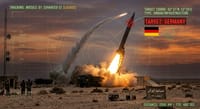
Trump also told Fox News that at least 49 Tomahawk missiles had been launched at Iran, with the closest target reportedly around 60 kilometers from Tehran. He described the situation as “the most broken ceasefire in history.”
U.S. Central Command later announced that American forces had completed additional strikes against Iranian military surveillance capabilities, communications systems and air-defense sites across Iran, using precision munitions.
The Iranian response then appeared to widen beyond Iran itself. According to claims by Iran’s Revolutionary Guards, Iranian forces attacked targets in Kuwait and Bahrain. Reports also indicated that Jordan had become a target, with Iranian missiles seen over Jordan reportedly aimed at an American base.
Later in the evening, Iranian sources claimed that 12 ballistic missiles had been fired at the Al-Azraq air base in Jordan. Reports also said Kuwait had closed its airspace.
The escalation was not limited to the Gulf and Jordan. Sirens sounded along Israel’s northern front following launches from Lebanon. The IDF later said that two launches had been identified and had fallen near an area where Israeli forces are operating in southern Lebanon.