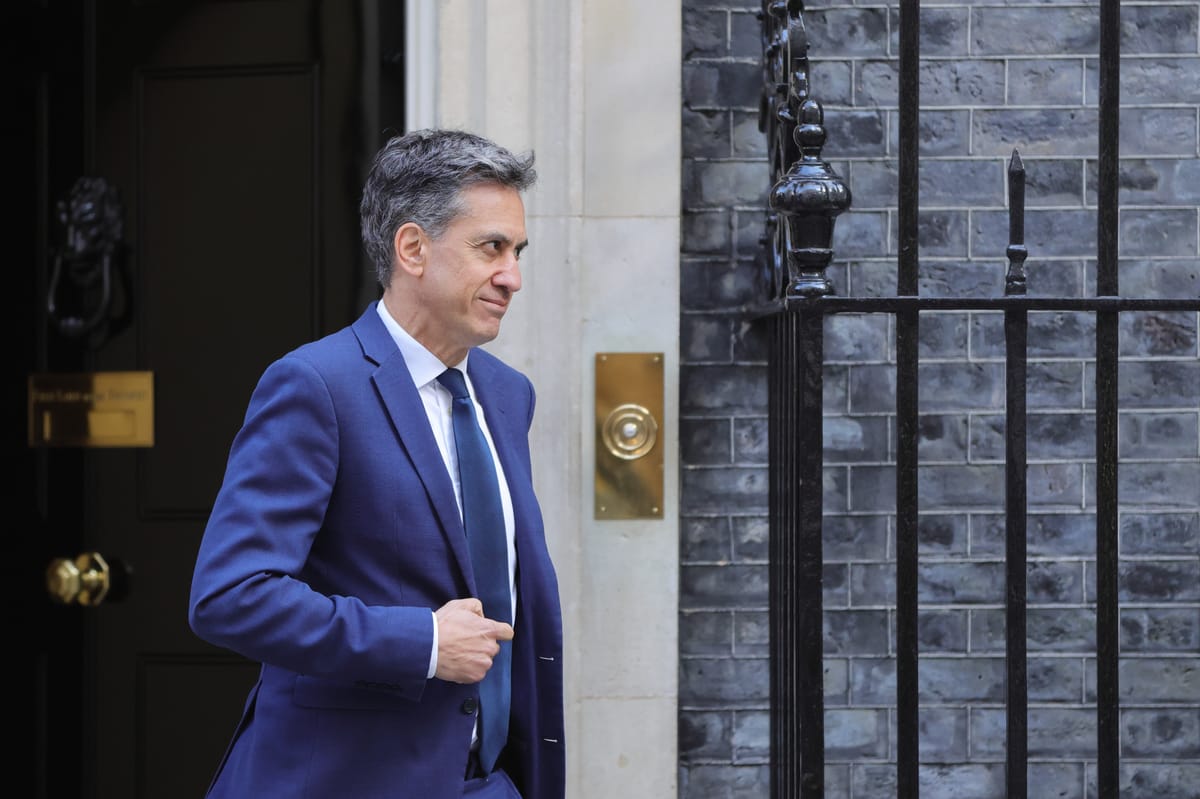
There is a particular move available to a politician who knows a decision will land badly, and Ed Miliband made it from the dispatch box on Tuesday before he announced a single measure.
He is proud of his Jewish heritage, he told the House, and unwavering in his support for the State of Israel, and there is no contradiction whatsoever between that and his support for a Palestinian state.
Set aside whether that is true. Ask instead why it was said. Miliband was not making an argument about settlement goods when he reached for his heritage. He was constructing a defense against a charge nobody in the chamber had yet made. If the policy is right, his grandparents are irrelevant to it. If it is wrong, they do not rescue it. Identity is not an argument, and a foreign secretary who reaches for it in the opening seconds of a statement is telling you what he expects the reaction to be.
He was right to expect it. Here is what he already knew when he stood up.
He knew that Chief Rabbi Ephraim Mirvis had objected. He knew the Board of Deputies had objected, and the Jewish Leadership Council. He knew because the Prime Minister had sat down with them last week specifically to hear it again, having already heard it. He knew that Jonathan Hall KC, his own government's independent adviser on terrorism legislation, had warned the night before that the announcement could affect the physical safety of British Jews. He knew that the independent reviewer of terror legislation had raised what it means to treat Israel as a pariah state a year on from Heaton Park. He knew that Peter Prinsley, a Jewish Labour MP sitting on his own benches, had gone on Radio 4 that morning to say the obvious thing: that the people who will act on this will not trouble to distinguish between the Israeli government, Zionism, and the Jews of Manchester and Golders Green.
Every institution that actually speaks for British Jewry told this government not to do it. The government did it anyway, and its foreign secretary opened by invoking the heritage of the community he had just overruled.
That is the objection. Not that he is the wrong sort of Jew, a charge that is beneath serious people and which his critics should stop making. The objection is that he used a personal claim to pre-empt a communal one, and the communal one had already been made, in writing, by the community's leadership, and rejected.
Now the timing, which is worse.
Israel votes on October 27. The E1 tender deadline falls on October 19. Britain has intervened in the internal politics of a democratic ally seven weeks before a general election, on a question that is squarely on the ballot. President Herzog called it gross interference, and it is difficult to see what else to call it. Reporting in the British Jewish press indicates the government believes the timing may act as an incentive to Israeli opposition parties. If that reporting is accurate, His Majesty's Government has a preference in a foreign election and has taken economic action to advance it.
And what set the calendar? Not the situation in the West Bank, which has been deteriorating for two years. Ministers were told there was a narrow window once Parliament returned, before the party conference recess. They were warned about the proximity to the Days of Awe. They proceeded. The scheduling of British Middle East policy was determined by the Labour Party's autumn diary.
Then there is the substance, which is not only lettuce.
Alongside the import ban, Britain announced sanctions on companies and individuals financing settlement construction, and a ban on arms export licences and other exports that materially contribute to the occupation. Read that again with a map open. Israel is at war with Iran. Iranian missiles and drones have struck American installations in four Gulf states in recent months. A British government has chosen this moment to tighten defense export licensing to Israel and to write into policy the formal position that the occupation is unlawful in its entirety, adopting the ICJ opinion wholesale.
Even Washington, which has spent a year pressing Israel hard over the West Bank, thinks this is wrong. Mike Huckabee, the American ambassador who has himself called violent settlers terrorists and stood in Turmus Ayya to say it, called the British measure discrimination against the Jewish people.
Let us concede what deserves conceding, because the case does not need overstatement. Settler violence in the West Bank is real, it is documented, it has been condemned by Israeli commanders and by Israel's closest friends, and it is a genuine moral problem for the Jewish state that will not be solved by pretending it is a fabrication. E1 is a serious decision with serious consequences and it was taken in the knowledge of them. Anyone who wants to defend Israeli policy in Judea and Samaria has to engage with that rather than around it.
But none of it is what Britain did on Tuesday. Britain did not sanction the men in Qusra. Britain adopted a blanket legal position on the occupation, restricted arms during a war, intervened in an election, and did so over the explicit objection of its own Jewish community and its own terrorism adviser. Those are different acts, and the first does not license the rest.
Miliband is entitled to his politics. He is entitled to conclude that the two-state solution requires this and that history will vindicate him. What he is not entitled to do is invoke a heritage as a certificate of good faith in the same speech in which he disregards every living institution that carries it, and then present the result as though the two were reconciled.
They are not reconciled. He simply spoke first, hoping nobody would notice which he had chosen.