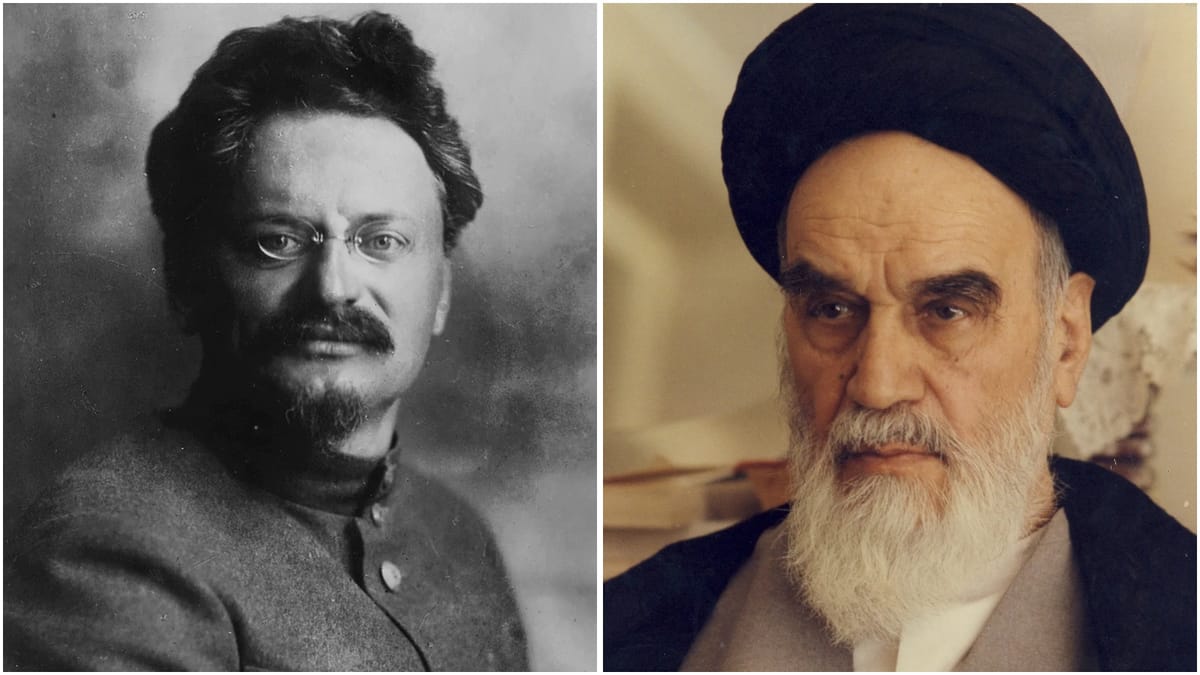
Nearly a century ago, Leon Trotsky faced a critical dilemma while building the Red Army. The former Tsarist military was filled with professionally trained officers who understood strategy, commanded large units, and possessed genuine combat experience. The Bolsheviks desperately needed this expertise to survive the civil war engulfing Russia.
The problem was ideological trust. These officers had served the Tsar for years under the very regime the revolution sought to overthrow. Now the Bolsheviks needed precisely these individuals to run their war effort, yet had no reliable way to ensure a given officer truly supported the revolution, or might instead sabotage it, defect to the opposing side, or simply fail to execute orders at a decisive moment.
Trotsky refused to abandon professional expertise. He continued employing the officers because without them there would be no functional army. But to address the loyalty problem, he constructed a dual command structure: alongside each professional military commander sat a "political commissar" of equal rank, whose role was to maintain discipline and ensure ideological compliance. In the early stages, no order could be executed without signatures from both the commander and the commissar. Trotsky himself described the concept in a phrase that became historical: "We took a military specialist and placed a commissar to his right and left."
Sixty-one years later, in 1979, Ayatollah Ruhollah Khomeini confronted a structurally similar dilemma. Iran's Islamic Revolution sought to combine republican institutions, an elected president, an elected parliament, to demonstrate that the regime represented the people's will, while simultaneously ensuring those elected officials wouldn't deviate from the revolution's core principle that the entire state must serve religious law. Khomeini explained the logic simply: since the people trust religious scholars and desire their guidance, it's appropriate for supreme religious authority to supervise the president's work to ensure he doesn't err or stray from the path.
The institutional solution was a network of "representatives of the Supreme Leader", clerics personally appointed by the leader and stationed in virtually every state institution and province. Western journalists called them "political commissars."
Bnei Brak 2026
Ostensibly, Degel HaTorah's leadership faced precisely the same dilemma (though of course without drawing any comparison between those historical figures and Torah sages). An editorial in the party's Yated Ne'eman newspaper stated: "We also need the accumulated experience in knowing the finest details of the parliamentary labyrinth", meaning it's impossible to manage the battle over military draft legislation without professionals who understand how committees function, how to draft legal clauses, and how to close deals with other parties.
On the other hand, there's concern (and it became clear) that among these professionals, some have loyalty to the religious leadership that isn't guaranteed: "When they learned about the review, they launched a media incitement campaign and PR staff work."
The solution: "Each of Degel HaTorah's public representatives will need to receive approval from the movement's rabbinic committee for the appointment of every single aide to his office." We took a parliamentary expert and placed a rabbinic committee to his right and left.
One could argue there's no innovation here. Degel HaTorah's banner has always been that its representatives are absolutely loyal to Torah sages. That's true, and precisely because of that we should emphasize that oversight has existed for forty years at the Knesset member level. What's been added now is a descent one floor down, to the person who manages the calendar, drafts responses, and speaks with journalists.
The Difference Between Bnei Brak and the Soviet Union and Tehran
With Trotsky and with Khomeini, the commissar was attached to the officer who held authority, and the commissar ensured he didn't deviate. In Degel HaTorah the arrangement is reversed: the veteran commanders Moshe Gafni and Uri Maklev (those whom the newspaper itself testifies have "absolute trust without reservation") were sent home "with nobility of spirit and complete obedience to Torah wisdom," and the new commissars were stationed alongside the successors.