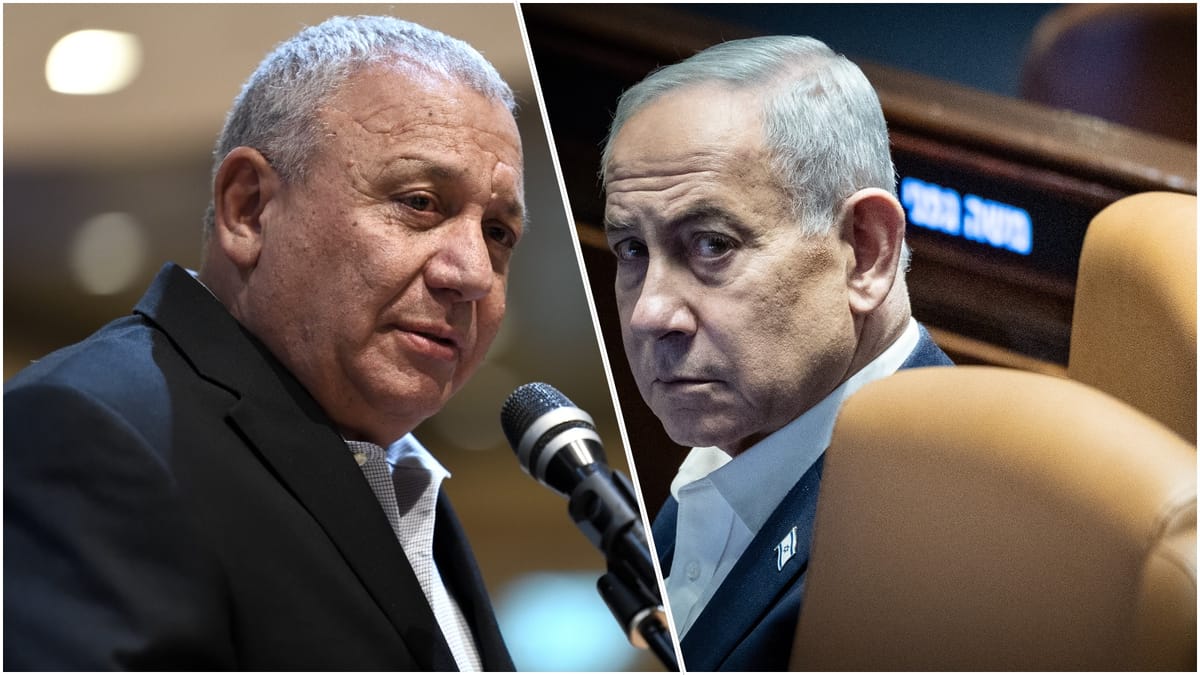
Does Eisenkot have an answer to this? Likud's smear videos argue: absolutely not. So who is Eisenkot? Eisenkot is an Israeli like us. True, he was IDF chief of staff, he "held a knife between his teeth," so he has power, but raw power alone isn't enough. A different kind of power is needed, a foreign and glamorous power identified with virtuoso command of English, and that's something Eisenkot can only dream about. What Eisenkot represents is "merely" average Israeli English, and that's obviously not enough.
The smear campaign tries to highlight this point especially. In a propaganda video Likud released, Netanyahu stands radiant in full glory before the standing ovation of House members, who respond enthusiastically to his polished English speech. Eisenkot, by contrast, is shown in the video speaking broken English and stammering something incoherent before Netanyahu's frozen gaze. Sealing this successful video is senior Trump judge, who rushes to respond to Eisenkot's failed rhetoric: "That's a very interesting and unique accent," he's heard saying, but adds: "The problem is I can't understand a single word the man is saying."
Eisenkot Needs to Change the Subject
What can poor Eisenkot do in the face of the supreme commissioner's ruling? Not much. What will he do, for example, if suddenly called to address the U.S. House of Representatives? What an embarrassment to choose him. Joining this demeaning description is a series of statements about Eisenkot's inferior intellectual level compared to Netanyahu.
This is how Knesset member Yaakov Bardugo explains it: "Eisenkot is not a man of books and thought like Netanyahu... Eisenkot doesn't read books, has no education... He doesn't understand anything about military literature. Maybe he read Harry Potter." Bardugo's words seek, of course, to add another stick to the bonfire of vanities and attack Eisenkot's modest intellectual abilities again.
What should the man do in the face of the "English panic" and intellectual assault that Likud's campaign broadcasts? First, one must admit there's a real problem here, since early polls Likud conducted showed the general public knows how to appreciate its leaders' rhetorical skills.
Given this, it seems the option before Eisenkot is to shift the discussion from questions of form and rhetoric to questions of substance and content, and argue that even the most polished English cannot cover Netanyahu's crimes, cannot whitewash the questionable moral character of a man who refuses to accept responsibility for the events of October 7 and opposes to this day, for personal reasons, the establishment of a state commission of inquiry.
Eisenkot can also highlight the fact that Netanyahu has stuck us for three years now in seven war fronts with no end in sight, with a cheerful forecast for escalation during the holidays and considerable chances for another round with Iran.
Another strategy is to emphasize the fact that the most wicked things in the world can be done in polished English, for example, inciting brother against brother, cultivating hatred toward half the nation ("the leftists"), encouraging conspiracy theories, and clinging to a false myth of invincible Israeli power that supposedly collapsed only because of the betrayal of despicable people (Noam Tibon? Yair Golan? Shikma Bressler?): these, according to Sara Netanyahu, were observed "dressed" and well-groomed, early on the morning of October 7, ready for battle, even before the prime minister was updated on the difficult situation.
In other words, English is important, but more important is the terrible policy that led to our colossal failure, turned Israel into an isolated country in the entire world, and all of us into lepers everywhere an Israeli foot dares to tread, and that includes the United States. That's what the debate should be about. It can and should be conducted in Hebrew.
Dr. David Gurevich's book "The Revolution Will Not Be Televised," on the cultural images of Trumpism, was recently published by Yetzira Ivrit (2026).