One of the most intriguing places in the solar system continues to surprise scientists. New research examining ice grains ejected from Enceladus, one of Saturn's moons, suggests the ice undergoes a complex process beneath the surface in which different materials from the subsurface ocean separate and even concentrate naturally.
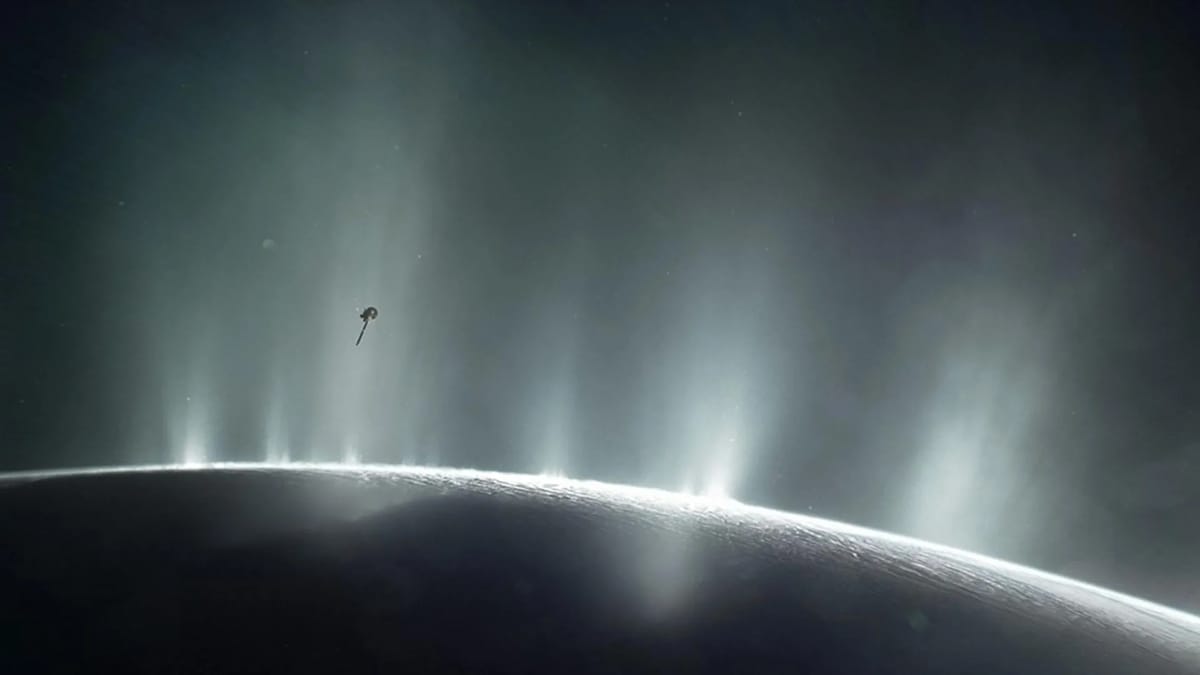
Enceladus is covered by a thick ice shell, but beneath it lies what appears to be a global ocean of liquid water. In its south polar region are large cracks called "tiger stripes" from which water vapor and ice grains burst into space. This means scientists can obtain indirect samples from the hidden ocean without drilling through kilometers of ice.
NASA's Cassini spacecraft, which operated in the Saturn system from 2004 to 2017, used a cosmic dust analyzer to examine the composition of ice grains ejected from Enceladus. But the data revealed something odd: if all the grains came from the same ocean, one would expect relatively similar composition, yet in practice, extremely significant differences were found.
Some grains contained unusually high concentrations of sodium chloride, or table salt, while others held more carbonates, phosphates, or potassium chloride. The researchers even noticed that chloride and carbonate rarely appeared together in the same sodium-rich grain.
To understand how these differences arise, researchers from the Institute of Science in Tokyo and other institutions created laboratory droplets simulating Enceladus's ocean water and froze them under various conditions.
They discovered that when relatively large droplets, about 200 micrometers in diameter, freeze slowly, the salts within them do not remain uniformly dispersed. Instead, different materials migrate and concentrate in separate zones within the ice. By contrast, when freezing is rapid, the droplet's composition remains more uniform.
The findings led the researchers to a new scenario for the journey water takes from the ocean to space. Rather than water droplets freezing immediately after leaving the ocean and rising quickly to the surface, they may move relatively slowly through a complex system of cracks and fissures in the ice.
During this slow journey they freeze gradually, and the salts within them have time to separate and concentrate in different zones. As the ice approaches the surface, the gas flow becomes faster, and the frozen ice particles collide with the crack walls and shatter into small grains.
Each fragment may come from a different part of the original droplet. This can explain how one grain is rich in one type of salt while another contains a high concentration of a different substance, even though both ultimately originated from the same ocean water.
But this explanation has implications far broader than decoding Cassini's data.
According to the researchers, when materials are separated during the freezing process, some may also become especially concentrated within certain ice grains. Previous studies have already indicated that organic compounds may undergo a similar process.
For future space missions, this represents a significant advantage. Molecules present in tiny concentrations throughout the ocean may appear in relatively high concentration in a particular ice particle. In a sense, Enceladus is performing two steps that scientists typically carry out in the laboratory: separating the materials and concentrating them before analysis.
The process may also have implications for the possibility of prebiotic chemistry on the moon. During ice crystal formation, tiny pockets of liquid brine solution can remain between them, where salts and organic compounds reach especially high concentrations.
Such concentration may allow molecules that are normally very dispersed in water to meet and react with each other at much higher frequency, a condition that may be important in chemical processes preceding the emergence of life. The researchers emphasize that the findings do not constitute proof of life on Enceladus, but they may help understand what conditions exist in its hidden ocean and how to search for signs of life there in the future.