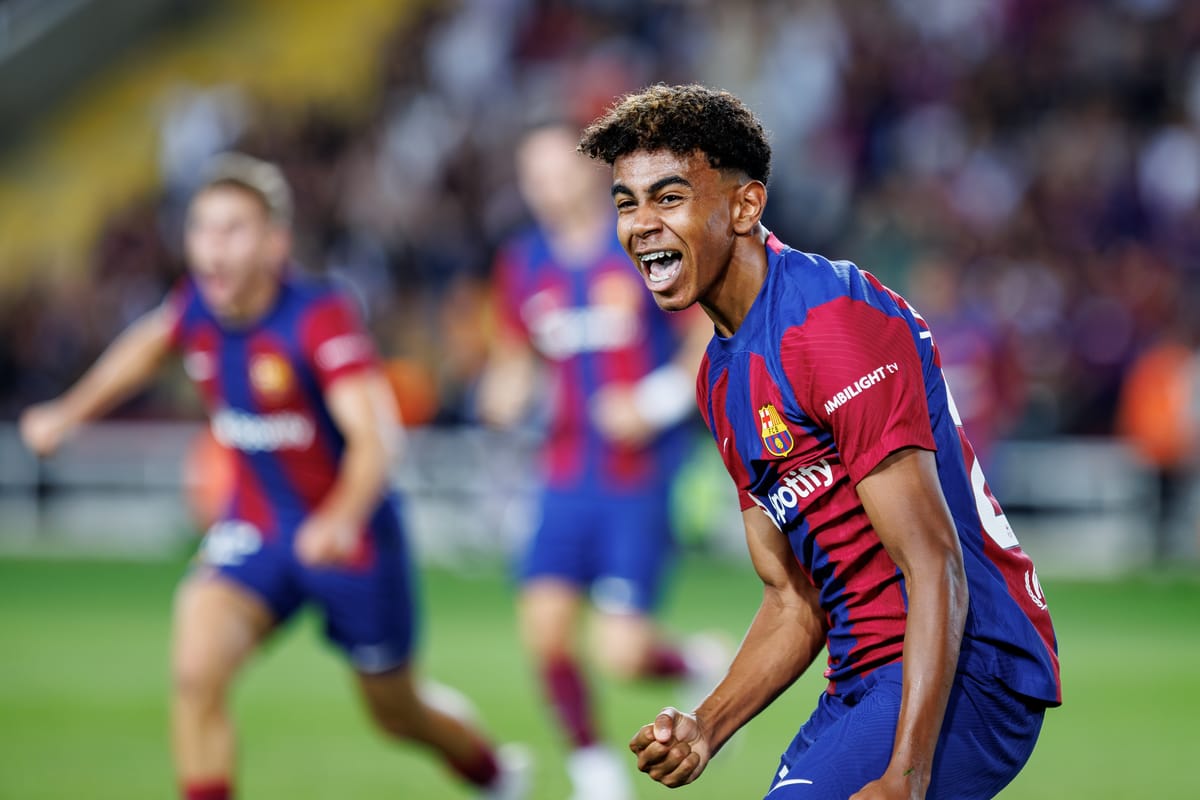
When 18-year-old Lamine Yamal stood on Barcelona's open-top championship bus last month and waved a Palestinian flag before 750,000 fans in the streets of Barcelona, the moment traveled far beyond Catalonia. In Gaza, people wept.
"Just 14 seconds," wrote Haitham el-Masri, a Palestinian student from Gaza, in a post that went viral. "Yet they were enough to make me burst into tears." Another Gaza resident, Muhammed Akram, wrote: "To some, it may look like a simple gesture, but here in Gaza, it reaches the heart in ways words cannot describe. Thank you, Lamine Yamal. From Gaza, you are loved more than you know."
A mural of Yamal was painted on war-damaged buildings in Gaza within days.
Now, with the World Cup underway in North America, those same Gazans are gathering around screens to cheer Spain, a team that has become, through one teenager's 14-second gesture, the adopted squad of the Palestinian cause. Prominent Palestinian writer Mosab Abu Toha commented directly on Yamal's Instagram post: "We love you, from Gaza."
The politics behind it are not incidental. Barcelona has emerged as one of Spain's most visible centers of pro-Palestine activism since the beginning of the war in Gaza, and Spain's government and a large part of its population have been highly critical of Israel's military operations in Gaza. Spanish Prime Minister Pedro Sánchez publicly backed Yamal's gesture, writing that the player had "merely expressed the solidarity with Palestine that millions of Spaniards feel."
Israel's then-Defense Minister Israel Katz did not take it quietly. "Lamine Yamal chose to incite hate against Israel while our soldiers combat the terrorist organization Hamas, an organization that massacred, raped and burned Jewish children, women and the elderly on October 7," Katz wrote on X.
Yamal, who is Muslim and whose father is Moroccan, responded on Instagram to anti-Muslim chants from sections of crowds at earlier matches, describing himself as a proud Muslim and calling the behavior disrespectful, ignorant, and racist. Barcelona coach Hansi Flick, asked about the flag incident, said Yamal was "old enough" to make his own decisions.
For Israeli and Jewish observers watching the World Cup, the phenomenon is uncomfortable but worth understanding clearly. Yamal is not a politician, and his flag gesture was not made on a football pitch, but the effect is entirely political: a generation of football fans in the Arab and Muslim world, and now in Gaza specifically, has found a superstar who signals solidarity, and they are routing their World Cup allegiance through him. Spain vs. Saudi Arabia on Sunday carried a charge it would not otherwise have had.
Yamal is widely regarded as one of the two or three best players on the planet at 18 years old, the likeliest heir to Messi and Ronaldo as football's global icon. That makes the politics attached to him durable, not a one-cycle story. If Spain goes deep into this World Cup, as many expect, Gaza will be watching every match.
That is the world the World Cup is now being played in.