
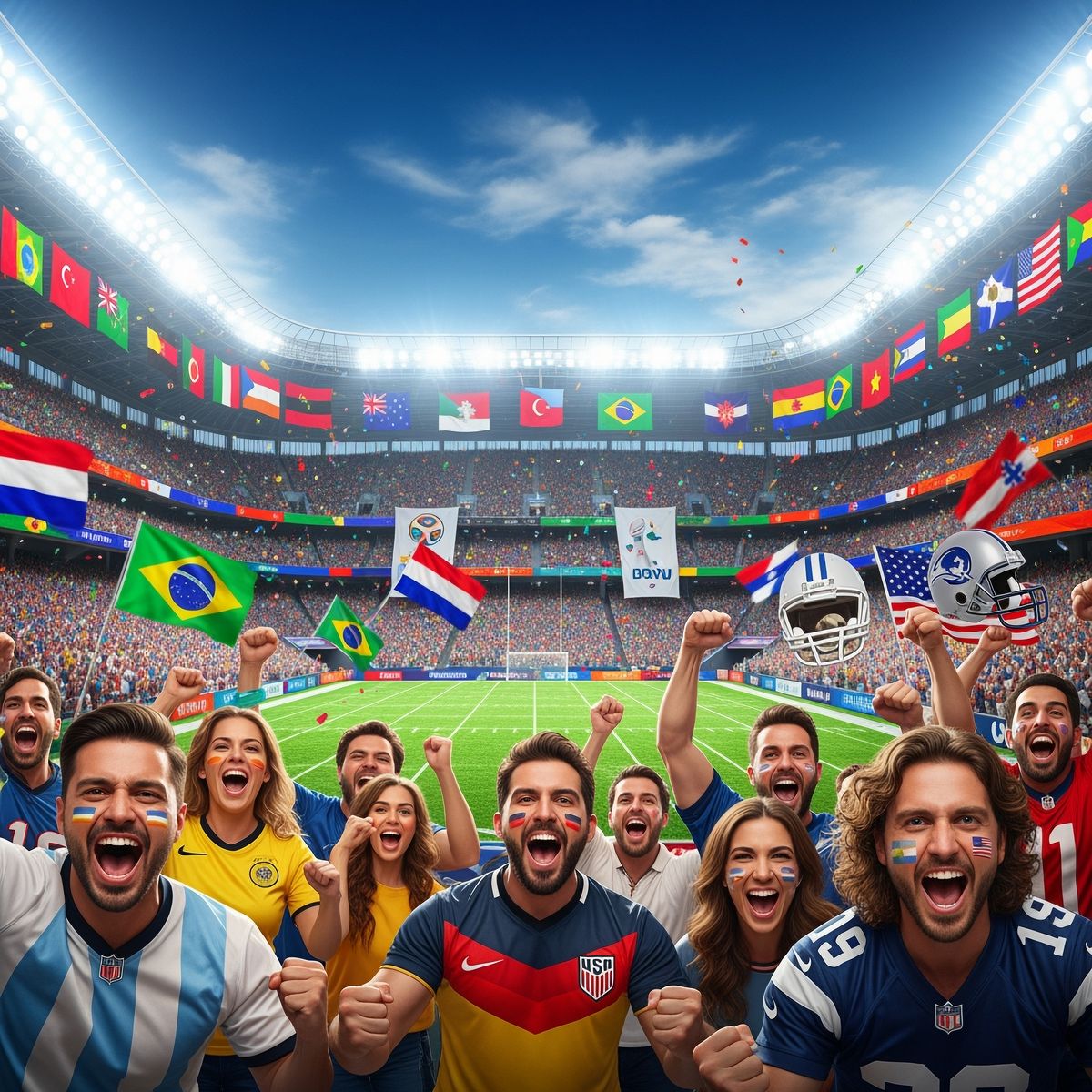
Beyond the astonishing surprises that have transformed the 48-team tournament from what many angry fans once saw as a terrible mistake into something that may very well be historically necessary, because football is becoming more global, more competitive, and higher in quality at an accelerating pace, what makes this tournament so great is the fact that most of it is taking place in America.
And this tournament is returning to America something it has lost in recent years, something that the masses of fans arriving from all over the world seem uniquely able to give it: color and freedom.
American diversity, very early on, became, except perhaps within the Jewish and Black communities, and more recently within the Spanish-speaking one, a demand to adapt oneself to a Protestant mode of conduct. And even that Protestant mode, being a far cry from the English original, was not especially successful. Before long, America’s colorfulness was either absorbed into the landscape or cut short by the call for conformity. Even the eruption of the 1960s could not save white America from its own pedantic nature, a nature so strangely un-American that, through its coercive focus on manners and restraint, the melting pot became almost Catholic in spirit.
But what America did preserve, to a large extent, was the yearning for liberty. And that yearning is produced through spectacle. There, and only there, can the underground currents that define the intersection between the untamed American and the foreign performer finally break free. In sports, music, and drama, America still knows how to allow others to liberate themselves.
Americans encounter football not simply with a demand for conformity, but as an escape from it. Yes, there is a deep suspicion toward the foreign invasion of “soccer.” But that suspicion, once contained within the limits of the carnival, turns into an infatuation with the other. It brings out the best of us as Americans. It reignites our genuine openness to real diversity, not the sterile diversity of feminist or post-colonial theory, but living diversity, carried by people, flags, songs, colors, accents, and gestures. And for once, we do not merely tolerate the culture-carrying fan. We invite him to create his own show and present it to us.
This is what turns the streets of America into a colorful carnival, where foreign fans can do almost whatever they please.
For their part, Americans experience this as a refreshing escape, as though someone still desires them despite the politically correct grayness America has wrapped around itself. It is an incredible trade-off. Americans receive color, passion, and an international atmosphere that pulls them out of their daily cultural numbness. Europeans, Africans, South Americans, and Asians receive a free space in which they can perform their own show before an eager audience, while the greatest entertainment industry in the world produces the content around them.
Add to this the fact that America is a nation of immigrants, many of whom are here to cheer for the countries from which they came, and the football stadiums become a nostalgic spectacle of ingathered, performative, free-range exiles. Within this sporting event, particular identity is not crushed under the Protestantism that created America, and certainly not under the political correctness that ruined it.
That is why this World Cup is so successful. That is why it photographs so well on social media. That is why it looks so excellent. It is almost as if the English game, adopted by the world, has finally found a place to reach catharsis in the land of baseball.
This also appears to be why the sharp-tongued Zlatan Ibrahimović and the precise Thierry Henry are so perfectly suited to the American audience. They are the bridge to this entire experience. Two footballing giants, among the greatest in history, who came and played in America, now bring European finesse deep into the American living room. They break the ice on screen in the same way we later see it broken in the streets by their own countrymen.
Thus, paradoxically, the most un-American sport may be bringing out the most American thing in a post-American social reality: untamed passion, celebratory manners, and the deep tradition of the travelling carnival, now distributed globally. America did not produce this culture. But it has enabled it to reach catharsis.
As for the fans drinking beer in the streets and getting drunk in the finest European and South American tradition, it seems American laws will have to start getting used to it.