In Israel, beyond the judicial and prison systems, there is no other environment where the state exerts such absolute authority over individuals as it does within the IDF (Israel Defense Forces).
Within the military system, a person essentially becomes a tool of the state; their freedom is restricted, their movement is limited, and their life is subject to the discretion of their commanders.
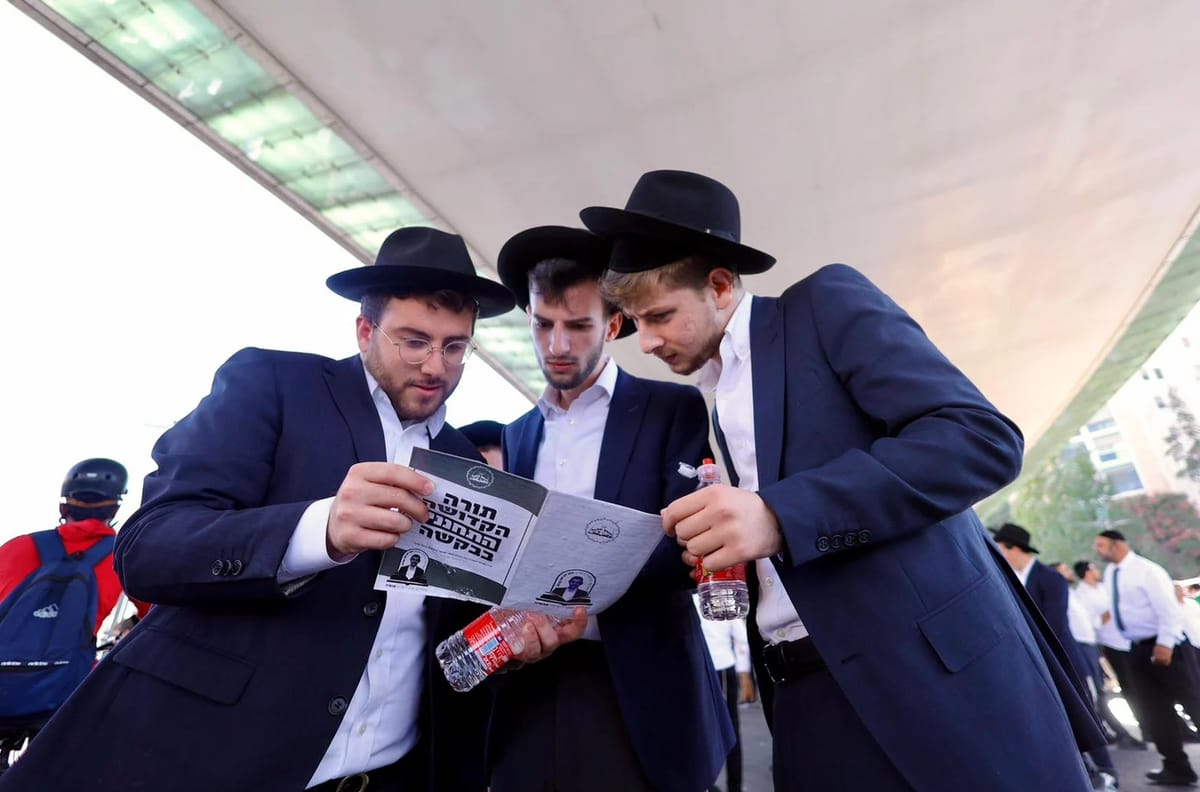
I do not believe that the ultra-Orthodox (Haredim) are any less brave than secular or religious Zionist individuals who enlist.
Many of the young protesters appear healthy and strong.
If so, why do the Haredim refuse to serve in the IDF?
Their refusal is, in fact, a rejection of total control by an institution where the status of Judaism is secondary to that of women and democracy.
In reality, it is likely that if the status of Judaism and tradition in the State of Israel were taken more seriously (which, for various reasons, it is not, partly due to the fragmented and diluted leadership of the Likud, which annually brings thousands of non-Jews into the country), the Haredi concerns would diminish.
Thus, the issue of military service is a derivative of another, deeper question: the question of the status of Torah Judaism in the Land of Israel and the State of Israel.
The position regarding enlistment in the state’s totalitarian systems is merely a consequence of this primary question.
Therefore, when we hear the Haredim speaking of the burden of Torah study in yeshivas, and others criticizing the perceived unfairness of avoidance, neither side is addressing the core issue, the possibility of genuine Jewish life within the frameworks of the state, including the IDF.
This is the uncomfortable question that non-Haredim avoid confronting, and prefer to stick to the legalistic functionality of the draft issue, while completely ignoring the context in which it has arisen.
During the War of Independence, and in fact until the Lebanon War, many Haredim contributed to the efforts of the settlement and the state.
The shift occurred when the status quo was completely disrupted, feminism and anti-traditional movements entered the educational, judicial, and security systems, making the integration of the Haredi community more challenging, especially during the 1980s, when it grew stronger both politically and demographically.
The real discussion that needs to take place is a Jewish one.
Clearly, the Likud party and its members lack the ideological depth and mental awareness to hold such a discussion, as they are a group of empty, hedonistic individuals. Similarly, many within the IDF are concerned about their status and sociological capital, making them hesitant to engage in such discussions. The same can be said of the judicial system, nothing more needs to be said.
If anyone truly wishes to resolve the issue of military service, they must begin with questions of education, law, and Israeli public life, all of which are derivative of the IDF.
If such a large segment of the population feels that the Zionist state and its institutions have waged war on Judaism, it is only natural that they will refuse to enlist in the IDF.
Until then, the claim of the Haredim, who were not raised on the principles of secular Zionism or religious Zionism, that none of those who come will return, holds some truth in their perspective, though not necessarily from the standpoint of the broader Jewish nation.
Haredi refusal should be seen as a national challenge to transform the state into a more authentically Jewish one.
Until that happens, there is little point in discussing greater security. And if it means that Israeli civil identity is valued more than Jewish identity, then yes, perhaps the Haredim will be expelled from here. But in doing so, we will lose many Jews, and Jews are the very reason this state exists. And there is no Jewishness without Judaism.
One potential solution could be separate units, but that is a topic for another article.