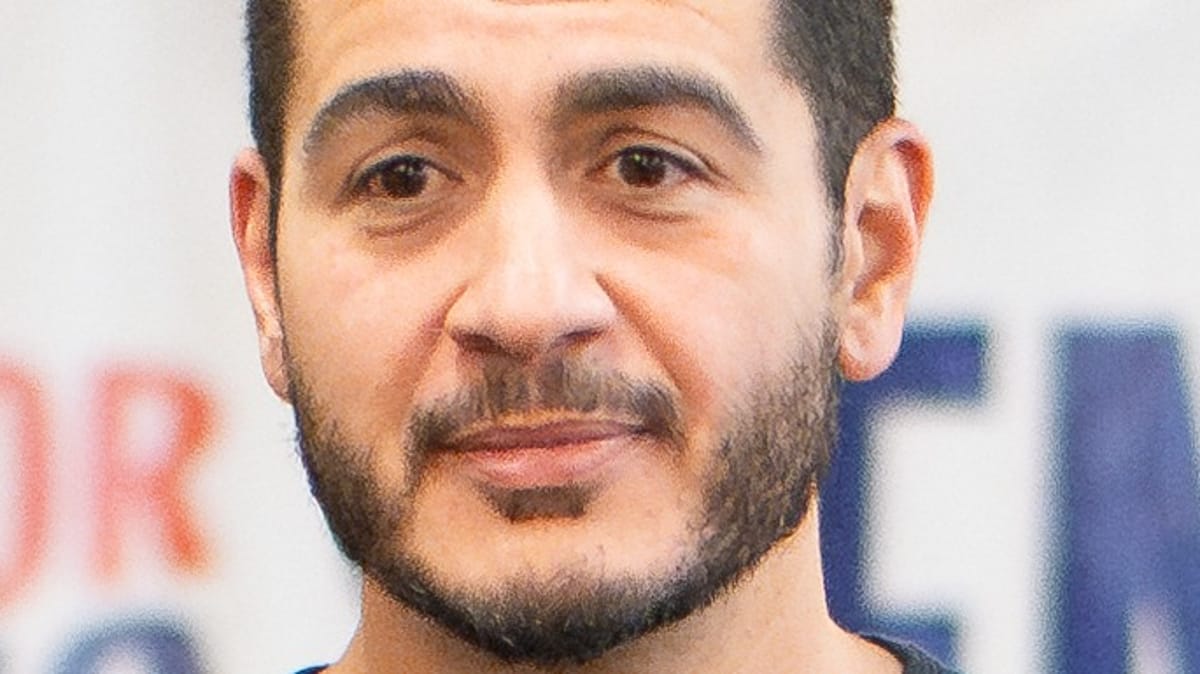
Abdul El-Sayed’s victory in Michigan’s Democratic Senate primary, and the real possibility that he may become the state’s next senator, marks the maturation of a long civilizational process.
El-Sayed’s father in law is one of the largest facilitators of donations to the Muslim brotherhood in the U.S. Thus, in a country like Jordan or the UAE he wouldn't be allowed to run for office due to terrorist ties.
El-Sayed entered the race through the language of class populism: against oligarchy (his official banner), corporate power, elites.-An advocate for “the people.”
Medicare for All, campaign-finance reform, opposition to corporate influence, Abolish-ICE, and ending U.S aid to Israel.
Marketing oneself as anti Corporate Money; Power; Privilege; Oligarchy; and calling for the restoration of government to “the people” is not uncommon in a post Bernie Sanders DNC.
The interesting place is when Bernie's Populism meets the Muslim brotherhood.
The young Islamic political class is successful in today's DNC for a few reasons. It's brown, educated, victimized, yet wise enough to form alliances and usher identity consciousness that are important for the post Obama democratic tent. From an organizational and symbolic perspective it inherited the old Jewish organizer vanguard, as the never ending march towards equality continues. Finally, it has deep pockets due to ties with gulf money.
A certain kind of white progressive embraces with hope the populist rhetoric and the exotic pronunciation of the new candidate's name, which proves all too well the generosity America extends to all its children. Especially Muslim ones, and especially after that dumb GW bush.
Meanwhile minority voters are attracted not by their objection to capitalist white elites as such, but to a society in which achievement, education, institutional power and cultural authority remain unevenly distributed.
Class/political and ethnic resentment than become difficult to separate, and their enemies - our great unifier.
But every synthesized vision or construct, be it social democratic, liberal, or conservative, needs a unifying other.
This unifying other may be a phenomena, condition, vision, even a historical period, sadly, seems to be that this unifying other, of "The People", is an actual people.
“The people” are gradually redefined to exclude those suspected of possessing too much money, influence, education or historical agency; conspicuously, these elements are not only the enemy of the new Rainbow-Social-Democratic wing that has overtaken the DNC, hurled by young and attractive Muslim Representatives like Omar and El-Sayed, but somehow their unifying other, is the same unifying other of the former philosophical cores of Marxism, Islam, National-Socialism, and post-colonialism.
Be it 19th century Marxism, 20th century national socialism and post colonialism, American 21st century populist leftism, or modern Islamic political theology as a whole - the dividing unifying other, the demiurge, is interestingly some premordial Hebrew father.
El-Sayed’s response to the attack on Temple Israel in West Bloomfield revealed the mystical core of his agenda. He condemned the attack and antisemitism. Yet invoked the maxim “hurt people hurt people,” discussed the assailant’s relatives (A clan of Hezbollah commanders) who had been killed in Lebanon and urged listeners to imagine a world without the airstrike that preceded the attack. He concluded that Americans must condemn both the synagogue attack and “the violence 6,000 miles away.”
El Sayed thinks the Jews are a mystical Force. He also thinks he can use words to play with the force, to hide what he truly thinks --- he insisted that Jews must be separated from Israel. And that criticism of Israel must not be treated as antisemitism.
He also reintroduced the connection to the Middle East precisely when Jewish people were attacked in the U.S. placing the attack within a causal cycle beginning in the Middle East; effectively turning Israel’s actions as a reasonable explanation for Muslims in America to hurt Jews thousands of miles away.
Thus, the connection between Jews and Israel is rejected when it supports recognizing the right for Jewish sovereignty or aid to Israel, but restored when it can be used to rationalize punishing Jews in Michigan.
Israel and the Jews are supposedly separate when the question is Jewish independence. They are connected when Jews are punished.
This is classical Hegelianism in that the unifying other which is contradicted in the act of defining my own boundaries, is being reimagined to suit the interests of a wider struggle. A more careful candidate wouldn't reveal the contradiction so easily.
The Master Jew may pray, write, remember, suffer and contribute. But once he is no Master, he will also lose the right to govern himself.
And this is why the world sees the Palestinians as the ultimate victims, despite their rejection of over a dozen statehood proposals within the last 90 years. Because the Palestinian leadership needs to be occupied and violent both at the same time. they will to be occupied but also to kill. for only under occupation, can the world face Jewish mastery, and only while they kill, can the world be exposed to Jewish Master cruelty. And only under these conditions can the there be provided a continuing image of the neo-platonic demiurge manipulator Master as the ultimate abuser. Only this ongoing crucifixion can create the vulnerability needed to not only turn the master into a slave, but to eventually strip him from self-sovereignty. The fact that the Jews are going along with it is actually what's amazing and interesting.
Thus, this exercise in anti Zionism (anti Judaism), is the mimicking of a future civilizational expectation to destroy the foundations of Roman/English monotheism.
White intellectuals may identify with this transformation of power fantasy without seeing that the Jews are a big deal in the process, because they imagine themselves enslaved by their own civilization, by reason, science, institutions, hierarchy and the guilt of historical power. Minority activists may adopt it as a rebellion against another form of white authority. The figure of the Muslim insurgent then becomes symbolically useful to both: outwardly marginalized, rhetorically anti-imperial and supposedly capable of outwitting the established order , and actually? The only one brave enough to single the original ever shapeshifting Marxian/Native/Catholic/Worker/Muslim demiurge.
In European radical thought, the fantasy was expressed through the language of masters and slaves, alienation, ressentiment and revolutionary inversion. In Islamist politics, it can acquire an additional religious dimension.
This neo-platonic (German - Arab) ideological convergence touches the Jew at the root of all negative construct, he has universal power, but is at its core the anti universal. The Germans and Arab did it in an intensity and determination that no British or even French enlightenment circle would dare to prior to the 2000s.
Behind it stands an older German-Arab ideological axis. A conviction of entire peoples and mainly their intellectuals, regarding Jewish morality, finance, theology, technology, science, and sovereignty as demiurgically intolerable,. corruptive, and demonic.
Israel will survive or fail principally through its own strength. It cannot organize American political life for Americans.
The ultimate problem is therefore not Israel’s.
It is America’s.
America must decide whether its language of equality means that sovereignty and tolerance should both be limited by neoplatonic fantasies, that in all forms, medieval-theological, modern-economic and post modern-colonial somehow wish Jews to be treated differently.
It must decide whether antisemitism ceases to be antisemitism when translated into the vocabulary of class struggle, anti-elitism and human rights.
And it must decide whether a politics that recognizes the bond between Jews and Israel only when Jews are to be blamed, but denies it when Jews claim independence, belongs in the United States Senate.
For Hitler, Judaism was the greatest enemy of the world, for its morality.
For Mohammad it was the greatest enemy of the Muslim Nation for its corrupting of the scriptures and betrayal of the prophet.
For Marx it was the greatest enemy of the workers due to its class exploitation and what his mentor Bauer called it's "bourgeois essence".
Carl Jung defined Hitler as having a "Mohammadian Personality".
Arab socialism, like German socialism, are both neoplatonic constructs that have been killing Jews for over 100 years now.
America, will have to ask itself whether its going out on a war against the Jews in the name of this, or returning to its Aristotelian-English roots. Michigan decides first.