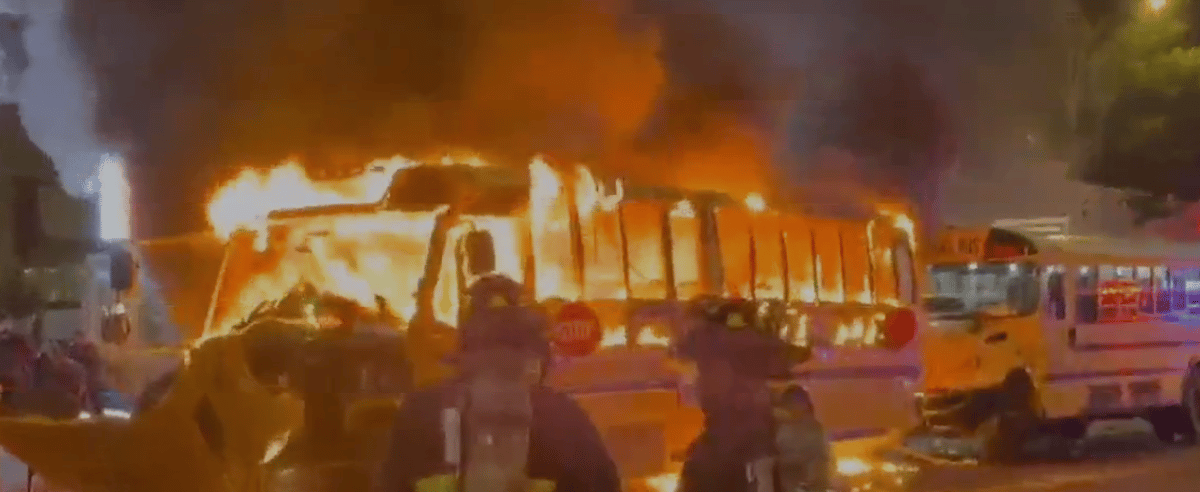
When the New York Knicks won their first NBA championship in 53 years on Saturday night, the city erupted. Fans scaled scaffolding, climbed school buses in Times Square, smashed taxi windshields, assaulted police officers, and set at least one bus on fire. Gunshots rang out in Times Square. A crowd watching on a big screen outside Madison Square Garden roared as the final buzzer sounded, and then the mayhem began. 56 people were arrested after Game 4 alone, before the Knicks had even clinched, with ten police officers injured.
The reaction online was predictable: shock, outrage, the inevitable question. Why would people destroy their own city to celebrate something they love?
The answer, it turns out, is ancient. And it has almost nothing to do with sport.
The First Sports Riot: Constantinople, 532 A.D.
To understand where this comes from, you have to go back not to the 1990s Chicago Bulls or even the English football hooligans of the 1970s, but to the chariot races of the Byzantine Empire.
The Hippodrome in Constantinople was the sporting and social center of the ancient world, seating 100,000 spectators divided into fanatical factions, the Blues and the Greens, named for the colors worn by competing chariot teams. These weren't merely fan clubs. They were quasi-political organizations with deep class and theological dimensions, the Blues broadly aligned with the aristocracy, the Greens with the lower classes. Rivalries were existential.
In January 532 A.D., something unprecedented happened: the Blues and Greens, usually bitter enemies, united. In a moment of collective grievance against Emperor Justinian, the two factions turned their violence not on each other but on the state. What began as a sports riot became a full-scale insurrection. The Blues and Greens joined forces and attempted to supplant the Emperor himself. The riot was brutally quashed by Justinian's general Belisarius, with the loss of approximately 30,000 lives. The Nika Riots, named for the Greek word for "victory" that the crowd chanted, burned half of Constantinople to the ground.
Sports historian Allen Guttmann, tracing spectator violence from antiquity to the present, concluded that "in comparison with this bloodbath, the worst modern outbreaks of British and Latin American soccer fans seem relatively innocuous."
The lesson of Constantinople is the first and most important one: sporting events have always been proxies for something larger. Tribal identity, class conflict, political grievance. The sport is the occasion. The crowd is the thing.
The Psychology: Why Victory Triggers Violence
Modern research has established a surprisingly consistent picture of why celebratory riots happen. The mechanism is counterintuitive: winning, not losing, is often the more dangerous trigger.
When a crowd is seized by euphoria, it undergoes what psychologists call "deindividuation," a process in which personal identity dissolves into the collective. Inhibitions fall away. Normal social constraints, the ones that keep you from smashing a taxi window on any ordinary Tuesday, loosen dramatically. The crowd becomes an organism with its own logic, and that logic is not rational.
Alcohol is almost always a factor, compressing the timeline and amplifying emotional extremes. But it is not the cause. Studies of championship riots have found that violence tends to radiate outward from the city center, moving from festive areas to residential neighborhoods, and that the perpetrators are overwhelmingly young men, the demographic most susceptible to deindividuation and most hungry for status display.
Soccer fandom in particular creates what researchers describe as a "warrior psychology," making threats to the group feel personal and driving fans to defend their identity aggressively. High-stakes rivalry games cause violence to surge by up to 70%.
There is also, crucially, an element that has nothing to do with sport at all. The most destructive celebratory riots in history have tended to occur in cities with underlying social fractures: economic inequality, racial tension, political grievance, and an alienated young male population with few legitimate outlets for the energy that mass euphoria releases. The championship win is a permission structure. It gives people license to enter the street, to belong to something enormous, and for a portion of those people, to act out something that was already there.
The American Timeline: Detroit to Chicago to New York
The modern American pattern of championship riots crystallized in the late 1980s and early 1990s, a period of acute urban stress in many U.S. cities.
In June 1990, seven people died in Detroit after the Pistons won their second consecutive NBA title. Hundreds were hurt by gunfire, stabbings and fighting as widespread looting broke out. The geography of the violence was telling: it concentrated in Detroit's most economically devastated neighborhoods, where the championship provided cover for settling grievances that predated the final buzzer by years.
Then came Chicago, repeatedly. The Chicago Bulls won six NBA championships in the 1990s, and each one produced riots. The most severe came in June 1992, after the Bulls defeated the Portland Trail Blazers, with rioting beginning among people pouring out of bars on Division Street and then spreading to the impoverished South and West Sides. Over 200 civilians and 95 police officers were injured, 61 police vehicles were damaged, and 347 stores were looted. The same city. The same team. Six times.
The 1994 Vancouver Stanley Cup riot offered a different variation: after the Rangers defeated the Canucks, a destructive riot broke out in the streets of Vancouver, 2,400 miles from where the game was played. The home team had lost. It didn't matter. The Nika Riots principle held: the sport was the occasion, not the cause.
Football and the European Catastrophe
In Europe, the intersection of sport and violence took a different and more lethal form, reaching its nadir in the English football hooligan culture of the 1970s and 1980s.
English clubs of that era had developed organized "firms," essentially fighting gangs that attended matches specifically to engage in territorial combat with opposing supporters. The phenomenon had class roots, working-class communities finding in football violence a form of masculine status assertion unavailable elsewhere in Thatcher's Britain. It was ritualized, anticipated, and in a perverse sense, organized.
The consequences at Heysel Stadium in Brussels in May 1985 were catastrophic. Right before the European Cup final between Juventus and Liverpool, a group of Liverpool fans, drunk from a day spent at bars in Brussels, charged after a group of Juventus fans. A stadium wall collapsed, crushing spectators, and others were trampled in the rush to flee. Thirty-nine people were killed. English clubs were banned from European competition entirely, and were only readmitted after the 1990 World Cup.
Heysel was not a celebratory riot. It was a pre-match territorial assault. But it illustrated the same dynamic: football had become a theater for enacting conflicts that existed independently of anything happening on the pitch.
The Modern Form: PSG and the Banlieues
The most instructive recent parallel to the Knicks riots happened in Paris just last year. PSG defeated Inter Milan 5-0, becoming the first French club to win the Champions League in 30 years. Celebrations began immediately after the match and, as night fell, spiraled into riots. Chaos erupted across the city as thousands took to the streets. Multiple videos showed young men clashing with police, destroying vehicles, climbing monuments, and causing mayhem. 264 cars were burned.
The geography was again the tell. The worst violence came from the banlieues, the peripheral housing estates around Paris that have chronic unemployment, racial segregation, and deep resentment of the state. PSG's triumph was their triumph too, for one night, until it wasn't. The burning cars were not about football.
Back to Manhattan, 2026
The Knicks won their third championship in 80 years on Saturday, their first since 1973, ending a 53-year drought that had come to define New York sports suffering. That duration matters enormously. The longer the wait, the more psychic weight fans have invested in the outcome, and the more explosive the release when it finally comes.
Rowdy fans clashed with police, smashed windshields, scaled scaffolding, climbed school buses in Times Square, and tried to hitch rides on moving fire trucks. Later, one of the buses was set on fire. The Knicks owner James Dolan interrupted his own players' press conference to plead for calm. It made no difference.