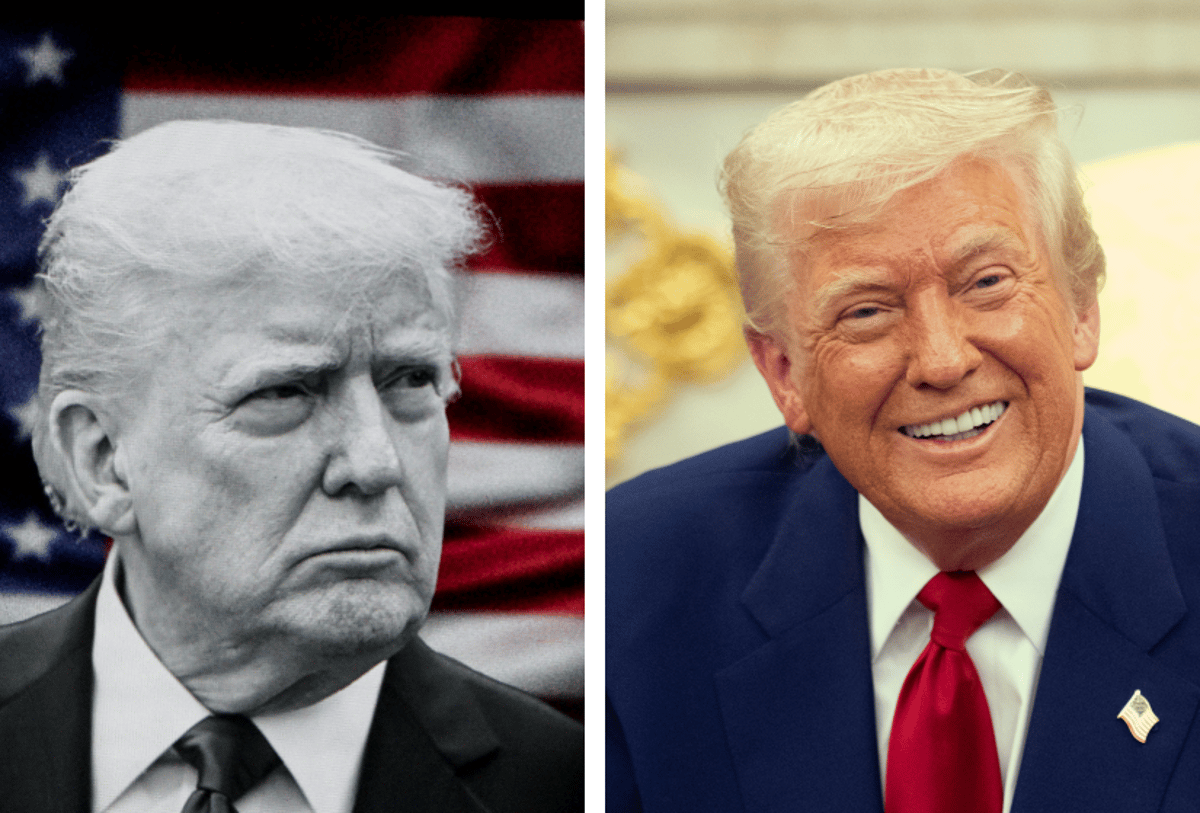
Since President Donald Trump ordered Operation Epic Fury on February 28, 2026, his public statements on the war with Iran have swung so often between total victory and total collapse that even his own allies have struggled to describe a consistent through line. What follows is a chronological look at the record, and an attempt to make sense of a pattern that has left European leaders, Gulf mediators, and Israeli officials alike trying to read a strategy into what may simply be improvisation.
The war opened with absolute certainty. In his statement announcing the strikes, Trump declared that Iran can never have a nuclear weapon, framed the strikes as a continuation of the previous year's Operation Midnight Hammer, and told Iranian security forces to lay down their weapons or face certain death, language that strongly implied regime change was the goal. Within days, that certainty dissolved into contradiction.
Asked how long the operation would last, Trump told Axios he could go long and take over the whole country, or end it in two or three days. A day later he told the Daily Mail it would be about four weeks. By Monday, speaking to CNN's Jake Tapper, he said only that he did not want to see it go on too long.
Meanwhile his own cabinet could not agree on why the war was being fought at all. Vice President JD Vance said regime change was incidental to stopping a nuclear weapon. Secretary of State Marco Rubio said the operation was about eliminating missile and naval threats. War Secretary Pete Hegseth framed it around missiles, drones, and Iran's navy. CNN's reporting at the time noted that Trump and his officials had also overstated Iran's missile capabilities relative to what US intelligence actually assessed, repeating a claim that Iran was building missiles capable of reaching America even though an unclassified Defense Intelligence Agency assessment said such a capability was roughly a decade away.
By March, the war settled into a rhythm of ultimatums followed by extensions. On March 21, Trump gave Iran forty eight hours to reopen the Strait of Hormuz, then extended the deadline by more than a week. He alternated between saying Iran did not need to make a deal to reopen the strait and saying the opposite. Analysts at the time counted more than a dozen instances since the war began in which Trump promised a decision "in two weeks," a phrase reporters noted he has used constantly since his first term, on Iran, on tariffs, and even on healthcare, often without the promised decision ever materializing.
The pattern reached its most theatrical point on April 6 and 7. Trump posted on Truth Social that "a whole civilization will die tonight, never to be brought back again," threatening to destroy Iran's power plants and bridges if Tehran did not reopen the strait by 8pm Eastern. Hours later that same evening, he announced Iran had agreed to reopen the strait and declared a two week ceasefire, calling it a "total and complete victory" and posting that it was "a big day for World Peace." Legal experts had already noted that the infrastructure targets Trump threatened, civilian power and water systems, would likely constitute war crimes under international law had the strikes gone forward.
Over the following weeks, the same sequence repeated itself at least eight separate times by one Associated Press count: a threatened deadline, a threat to escalate, and then a walk back, often attributed to requests from Gulf mediators. On May 18, Trump said he had personally called off a planned strike at the request of Saudi Arabia, Qatar, and the United Arab Emirates because serious negotiations were underway.
By mid June, those negotiations produced the Islamabad memorandum of understanding, signed by Trump at Versailles and by Iranian President Masoud Pezeshkian in Tehran. It was there that the reversal became most explicit. Trump insisted at the signing that he had "never cared about regime change," a claim that sat uneasily beside his own February video urging Iranians to overthrow their government. He went further, describing Iran's surviving leadership as very rational, smart people who were nice to deal with and not radicalized, a striking turnaround from a leadership that had spent the war executing its own citizens and that analysts generally consider more hardline than the government that preceded it.
That warmth lasted barely three weeks. After Iranian forces struck three commercial tankers in the Strait of Hormuz on July 7, Trump reversed course again, this time at a NATO summit in Ankara, calling Iran's leaders cuckoo, scum, and sick people, and declaring the ceasefire over. The US resumed strikes for two consecutive nights, hitting close to 170 targets in total, and Iran retaliated against American bases in Bahrain, Kuwait, and Qatar. By Thursday, barely a day later, Trump had softened again, telling reporters he did not think the war would restart in full and that any renewed fighting would end very quickly, since the US was not seeking a long war.
Laid end to end, the record shows a consistent shape rather than a series of unrelated missteps. Trump escalates rhetoric to its most extreme possible register, civilizational destruction, certain death, total victory, only to retreat within days or hours once the practical costs of following through become apparent, whether that cost is a Gulf ally's objection, an oil price spike, or the reality of what destroying civilian infrastructure would actually require.
His own administration has at times described this as intentional unpredictability, a version of the old "madman theory" of deterrence in which an adversary who cannot predict what a leader will do next is more likely to make concessions rather than call the bluff. There is a case for that reading. Iran did, after all, come to the table more than once immediately after Trump's most extreme threats.
But the same record supports a less flattering interpretation, one voiced increasingly by foreign policy analysts across the political spectrum: that the flip-flopping reflects a decision making process oriented around how each moment plays rather than around a fixed strategic objective, a pattern in which declaring victory matters more than defining what victory means, and in which the audience being managed, whether it's Gulf allies, NATO partners, or the American public, changes minute to minute. Whether that amounts to shrewd improvisation or something closer to a preoccupation with appearing dominant in the moment is, ultimately, a matter of interpretation rather than fact, and reasonable people watching the same eighteen weeks of statements have reached very different conclusions about which it is.
What is not in dispute is the practical cost of the inconsistency. Oil markets have lurched with nearly every reversal. Gulf states hosting American forces have absorbed real retaliatory strikes tied to a ceasefire whose status changes by the week. And Israel, which fought alongside the US at the war's outset, has been left to calibrate its own operations in Lebanon against a partner whose position on regime change, negotiations, and the war's very continuation has moved this dramatically at least half a dozen times since February.