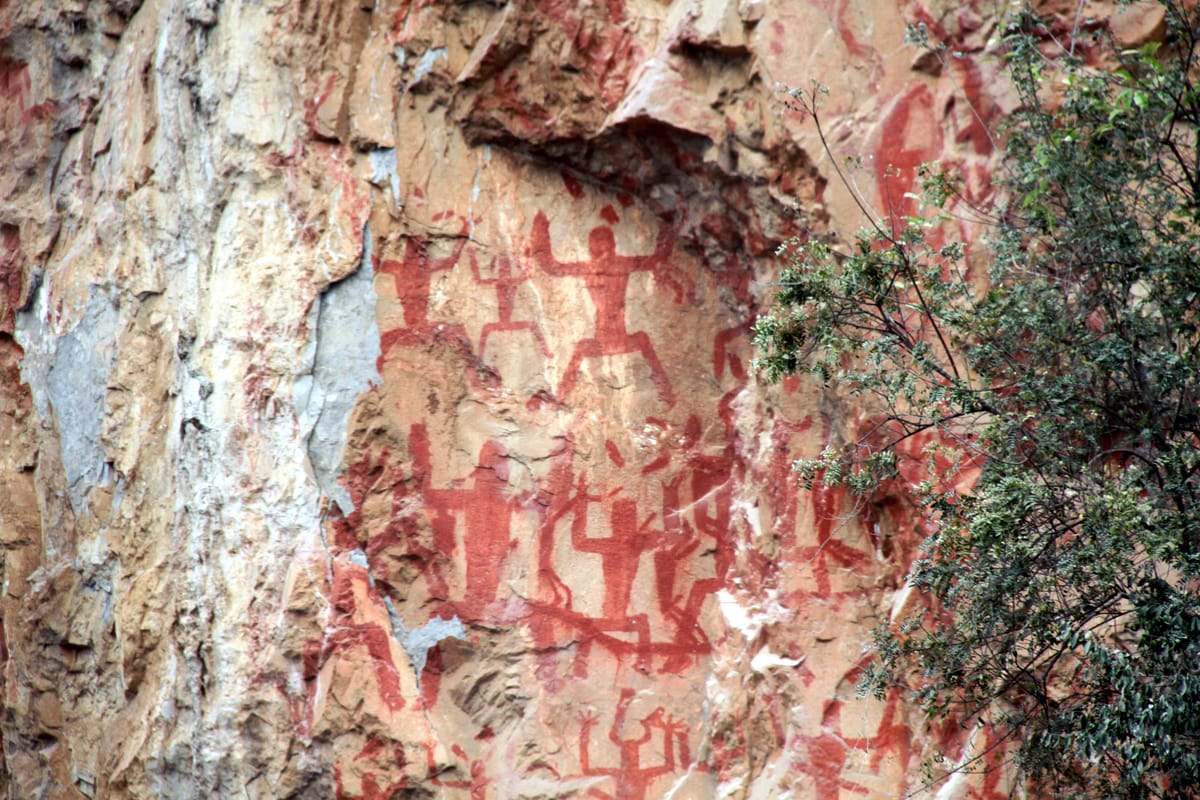
For over two millennia, thousands of red figures depicting humans, animals, boats, weapons and musical instruments have adorned limestone cliffs in Guangxi province in southern China. Now researchers believe they have solved one of the great mysteries surrounding the Huashan rock paintings: how these ancient artworks retained their vivid color for more than 2,000 years despite the region's punishing climate.
A new study has found that the paint used by ancient artists was a sophisticated mixture of red clay rich in hematite, lime, and blood. According to the researchers, proteins in the blood contributed to a chemical process that formed calcium carbonate around the pigment particles, creating a natural binding agent that firmly attached the paint to the limestone rock.
The research was led by Meng Wu of Shandong University. To avoid damaging the paintings themselves, the team examined rock fragments that had fallen from three sites in the region. Using microscopy, spectroscopic testing, and protein analysis, they studied the paint layers and analyzed the organic and mineral materials within them.
The findings revealed that tiny hematite particles, responsible for the red color, were encased within an artificial layer of material based on lime and blood. The researchers concluded that the reaction between proteins and lime helped create an exceptionally stable organic-mineral binding system. This mechanism may explain how the paintings survived thousands of years in an area subject to intense heat, humidity, monsoon rains, and even typhoons.
The Huashan rock paintings are part of the UNESCO World Heritage site "Rock Art Cultural Landscape of Zuojiang Huashan." According to UNESCO, 38 major sites in the region were created roughly between the fifth century BCE and the second century CE, and are attributed to the Luoyue people. The paintings depict rituals, human figures, and bronze drums, among other subjects, providing unique testimony to the ancient culture that flourished in the area.
But the most intriguing aspect of the research concerns the source of the blood. The researchers identified human serum proteins alongside evidence of animal blood. They suggest the possibility that some of the human blood used was related to childbirth and fertility, and may have been chosen for its ritual significance to the ancient society that created the paintings.
Archaeologist José-Miguel Pérez Gómez, who was not part of the research team, told The Art Newspaper that the hypothesis about using blood specifically from childbirth is the weaker part of the study. According to him, the proteins found are not unique to childbirth, no ancient DNA was extracted from the samples, and the tests were conducted at only three sites out of more than 80 rock art sites in the region.
Despite these reservations, identifying blood as part of the paint's binding system could change our understanding of the technology used by ancient rock art creators.