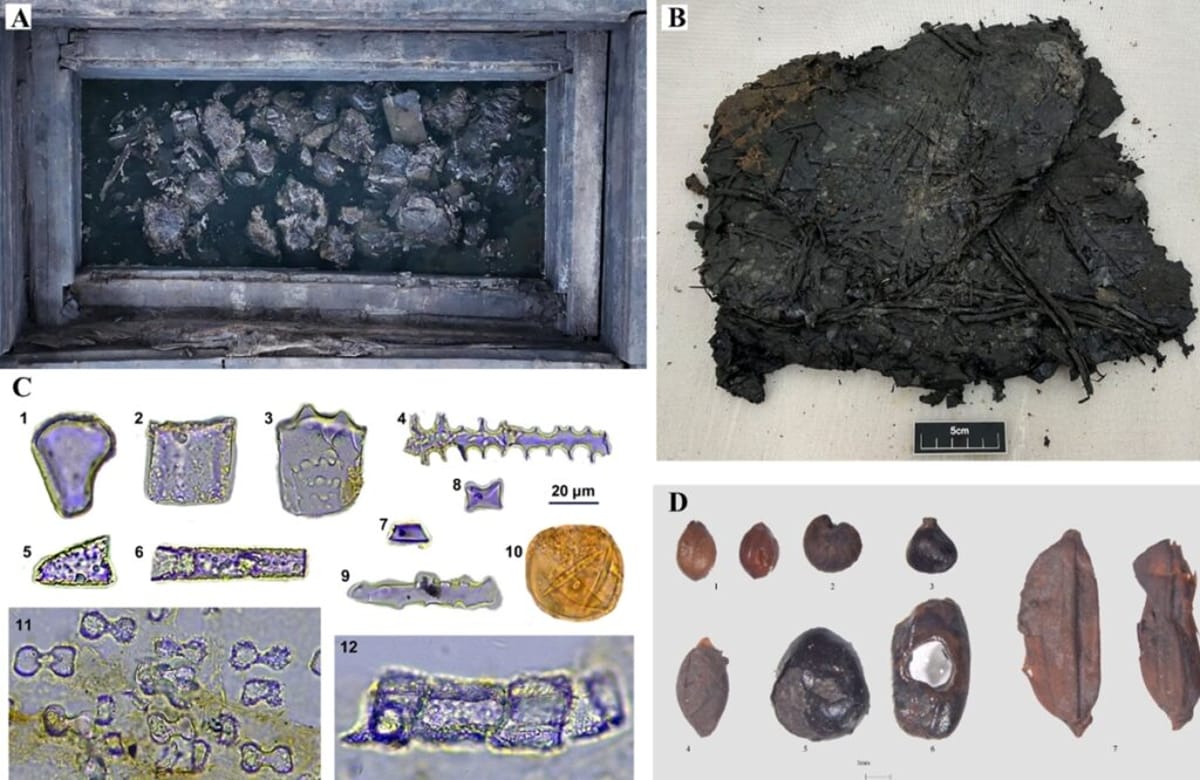
An archaeological discovery in eastern China may offer rare evidence for the origins of a custom preserved in Chinese culture for thousands of years. Inside the Wangdong tomb, identified with King Kaoli of the Chu kingdom who died in 238 BCE, researchers found bundles of plant material wrapped in leaves and tied with rope. Waterlogged conditions inside the burial chamber allowed the delicate parcels to survive more than two millennia intact.
Laboratory analysis revealed that the wrapping leaves belonged to the oak species Quercus dentata, while the ropes were made from grasses rather than hemp. Inside the bundles, researchers found extensive remains of rice, common millet, and foxtail millet. The team analysed 456 seeds from ten bundles and determined that approximately 43.6% were rice, 26.1% common millet, and 28.5% foxtail millet.
Initially, researchers considered the possibility that these were simply food rations placed beside the deceased. But microscopic examination pointed to a different explanation. The team found no starch granules that would be expected in flour or dough, and instead discovered large quantities of pollen and phytoliths originating from plant parts not typically intended for consumption. Among other things, traces of wheat and barley were identified. These findings led the research team to conclude that the bundles likely served as ritual offerings rather than ordinary food.
Here the story takes an intriguing turn. The bundles bear a strong resemblance to zongzi, a traditional Chinese food typically made from sticky rice or millet wrapped in leaves and tied with string. The dish is particularly associated with the Dragon Boat Festival and with the legend of the poet and statesman Qu Yuan, who lived in the Chu kingdom in the third century BCE.
According to Chinese tradition, Qu Yuan drowned in the Miluo River, and after his death locals threw rice bundles wrapped in leaves into the river, partly so that fish would eat them instead of disturbing his body. For centuries it remained unclear to what extent the story reflected a custom that actually existed in his time.
The bundles discovered in the tomb do not prove that the legend occurred as it was told in later generations. However, they demonstrate that in that region and roughly that period, a real custom already existed of wrapping grains in leaves, tying them with plant rope, and using them in burial rituals.
Findings from another site, Chengjiangjing, also included similar bundles containing rice and millet wrapped in leaves of the same oak species. This strengthens the possibility that this was not a one-time occurrence, but rather a ritual custom widespread in the Chu kingdom during the Warring States period.
The researchers emphasise that the findings should not be defined as zongzi in the modern sense. According to them, it is more accurate to view them as a possible ancestor of the custom. The study, published in the scientific journal National Science Review, indicates that a tradition of wrapping grains in leaves for ritual purposes existed in the Chu kingdom at least 2,200 years ago.