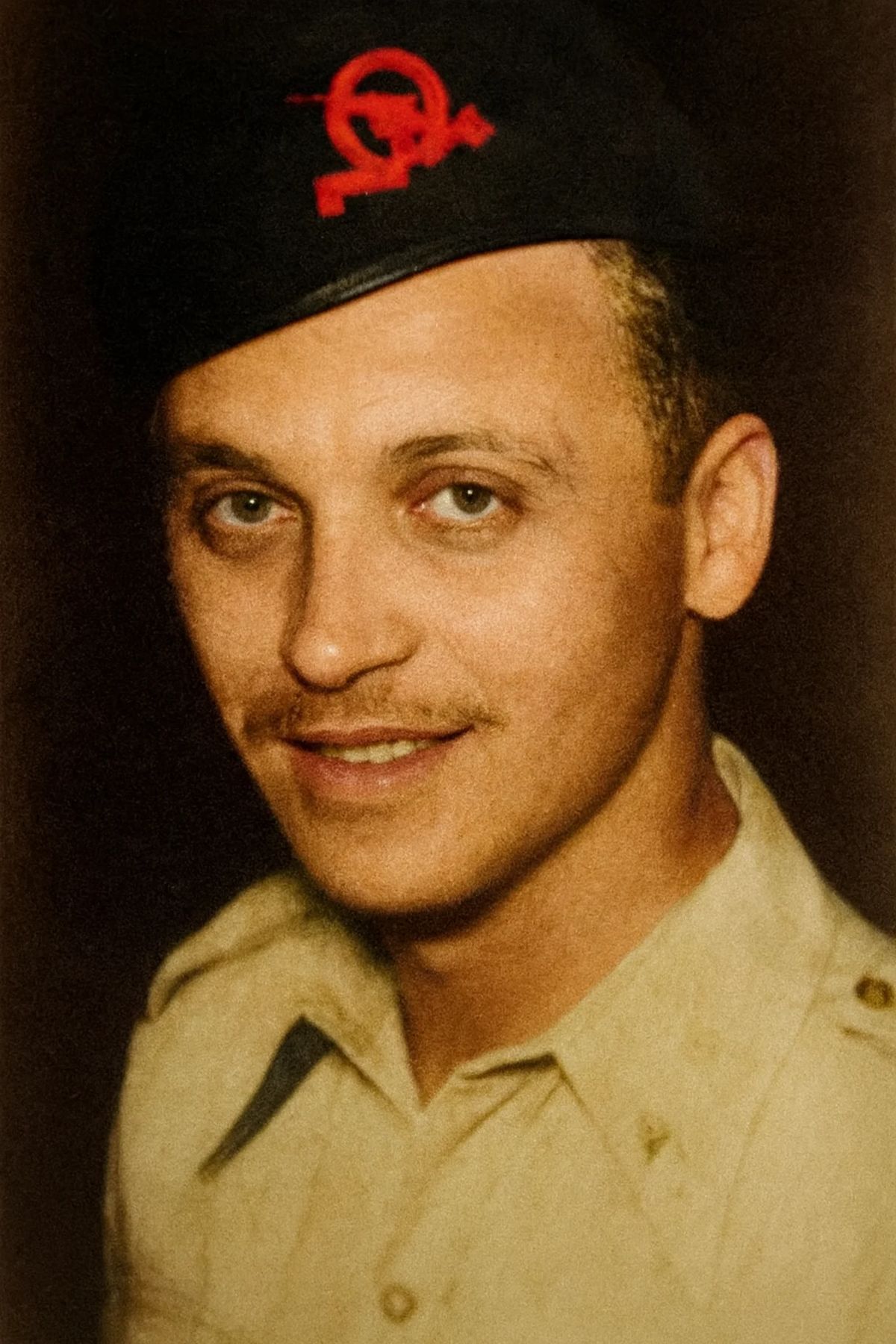
The Unbelievable Story of Gabriel Zisman, an IDF Officer Who was Really a Nazi
At the end of World War II, Nazis in uniform faced an existential dilemma: fight to the last bullet or join the enemy | One SS soldier did the unimaginable, choosing to connect with the Jews fighting for their homeland, under a false identity and an exciting cover story he infiltrated the IDF only to betray it again and again

With the end of World War II, the Nazi leadership came to the clear understanding that they were about to lose everything. While parts of the army fought to the last bullet, many others began planning escape and infiltration routes.This might interest you
The operating principle was: If you can't fight it, join it. And so, many Nazis, for example, switched to the US Army, helped in atomic development, infiltrated and received purification for their bloody past. But did you know that one SS man infiltrated Israel and even reached the rank of officer in the IDF?
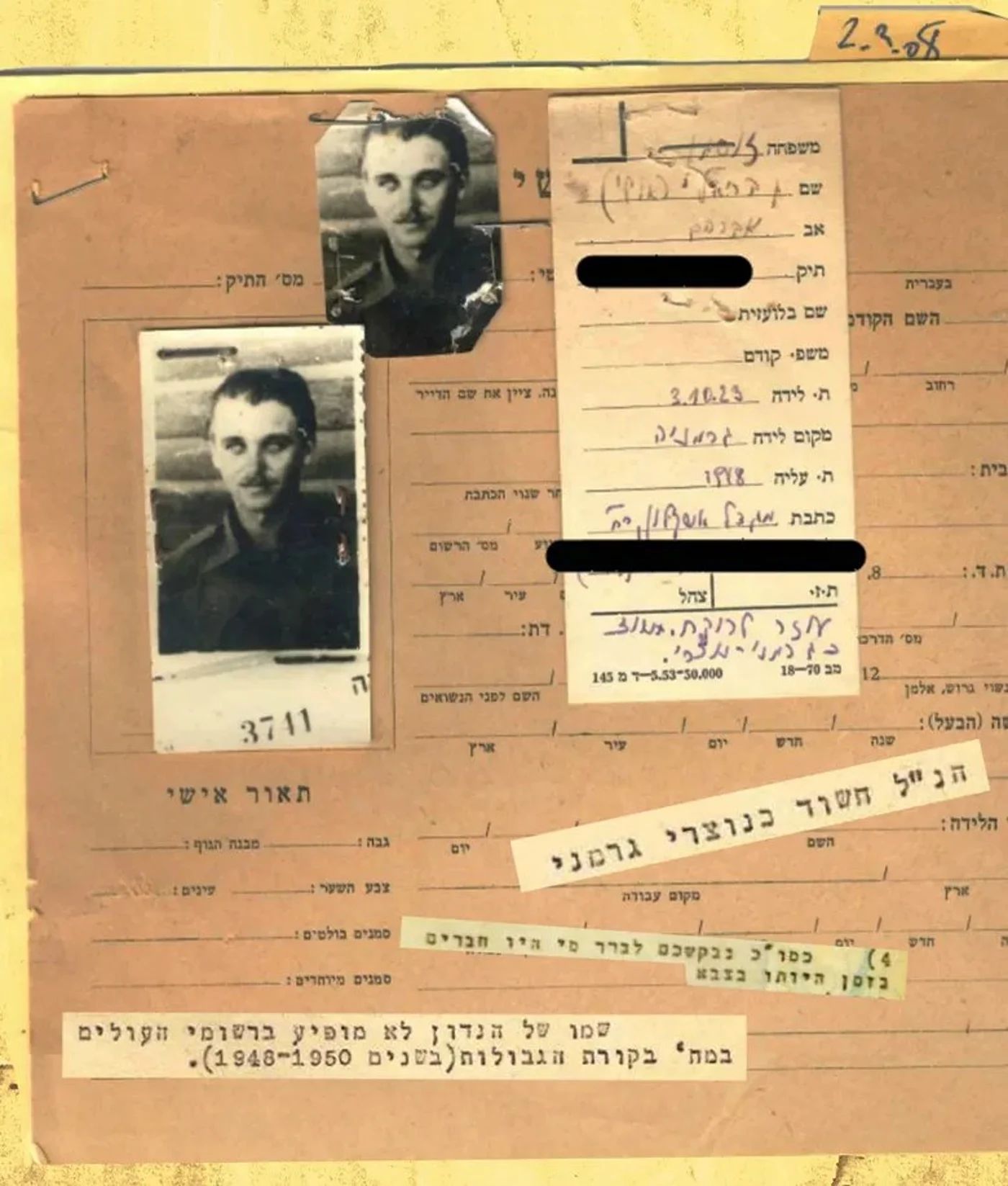
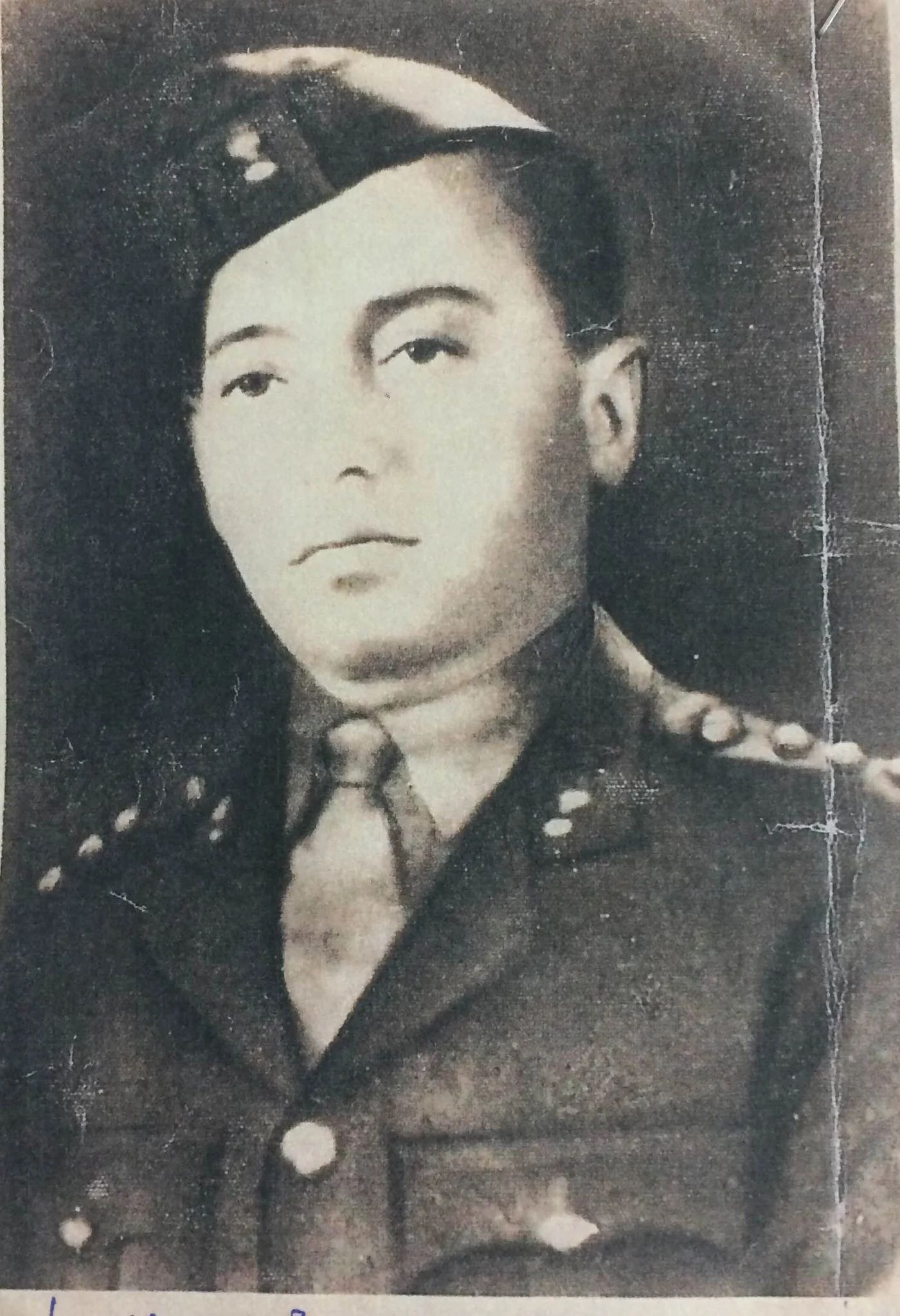
This is the unbelievable story of Ulrich Schnaft, also known by the alias "Gabriel Zisman".
The Double Identity
The drama of the end of World War II left Germany torn. Its cities were ruined following heavy bombings, the country was divided into four occupation zones, food was rationed, and finding work was a difficult challenge.In this chaos, Ulrich Schnaft, a former SS soldier born in Königsberg, was released from captivity and arrived in Munich. There, in a survival game where he demonstrated high skill, Schnaft discovered a creative way to live: he shared a room with a Jewish roommate, who revealed to him that the Joint organization distributes aid and food packages to displaced Holocaust survivors.
Without hesitation, Schnaft decided to shed his Aryan identity and assume a new one as a Jewish refugee, with the irony of the matter, that an SS man joins the ranks of the victims, not bothering him at all. He declared that he was the son of a German mother and a Jewish father, and thus set out with a group of immigrants from Marseille in France, adopting the name Gabriel Zisman.
Immigrant, Explosives Instructor, and IDF Officer
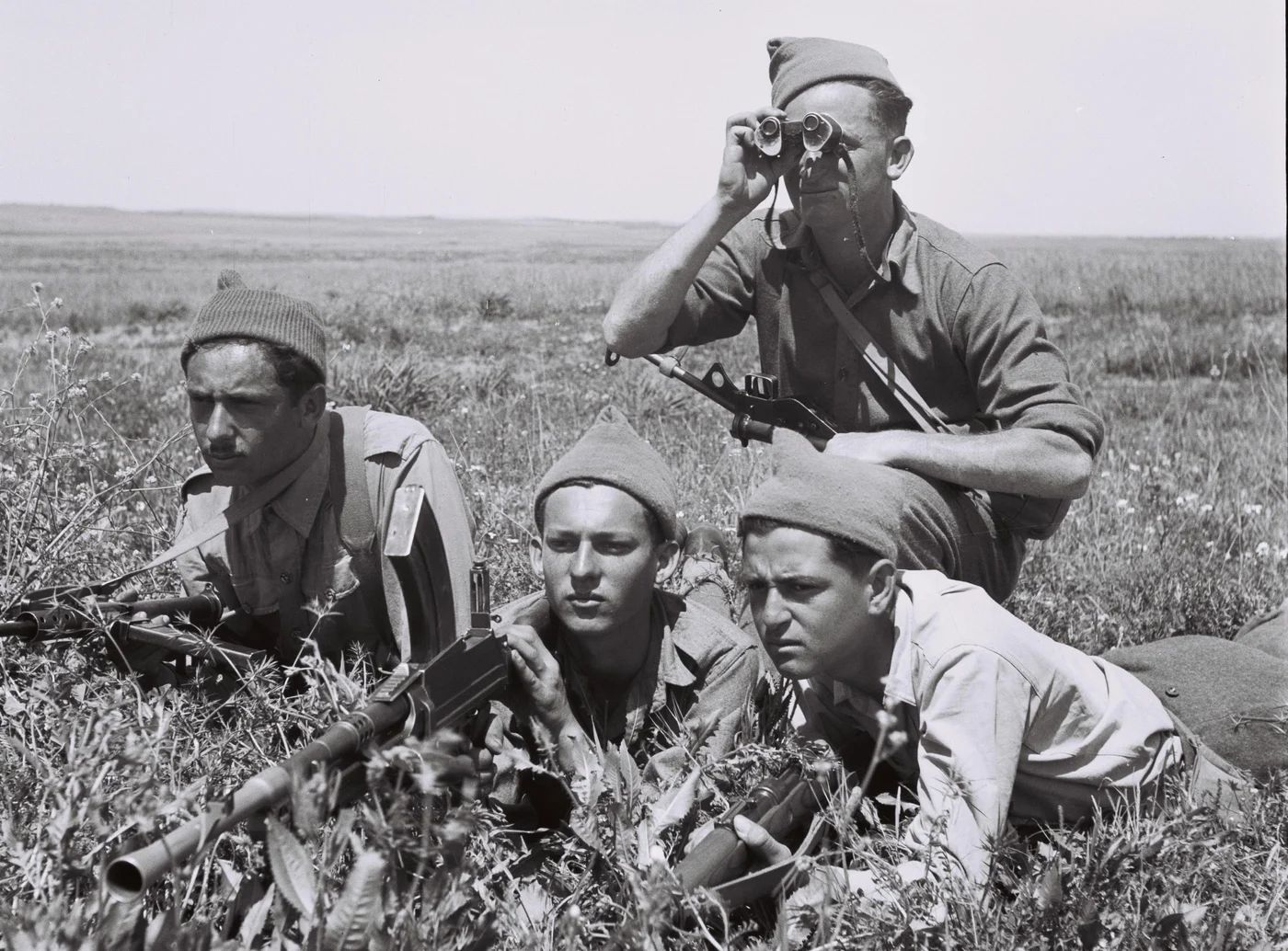
Upon his arrival in the country, Gabriel Zisman joined the Haganah. Schnaft, who was a young, sturdy, and well-built man, made a strong impression on his recruiters, who knew nothing about his military past in the SS. He was recruited to the Haganah's training team, where he trained other young people in weapon handling, and demonstrated ability in handling explosives in a camp in Cyprus.
His unbelievable military skills came to sharp expression during his service in the IDF after the establishment of the state: he served as an artillery officer. According to later claims, Schnaft managed to eliminate six infiltrators from Egypt alone during a patrol near Ashkelon.
The former SS man became, within a few years, a respected officer fighting for the Jewish state.

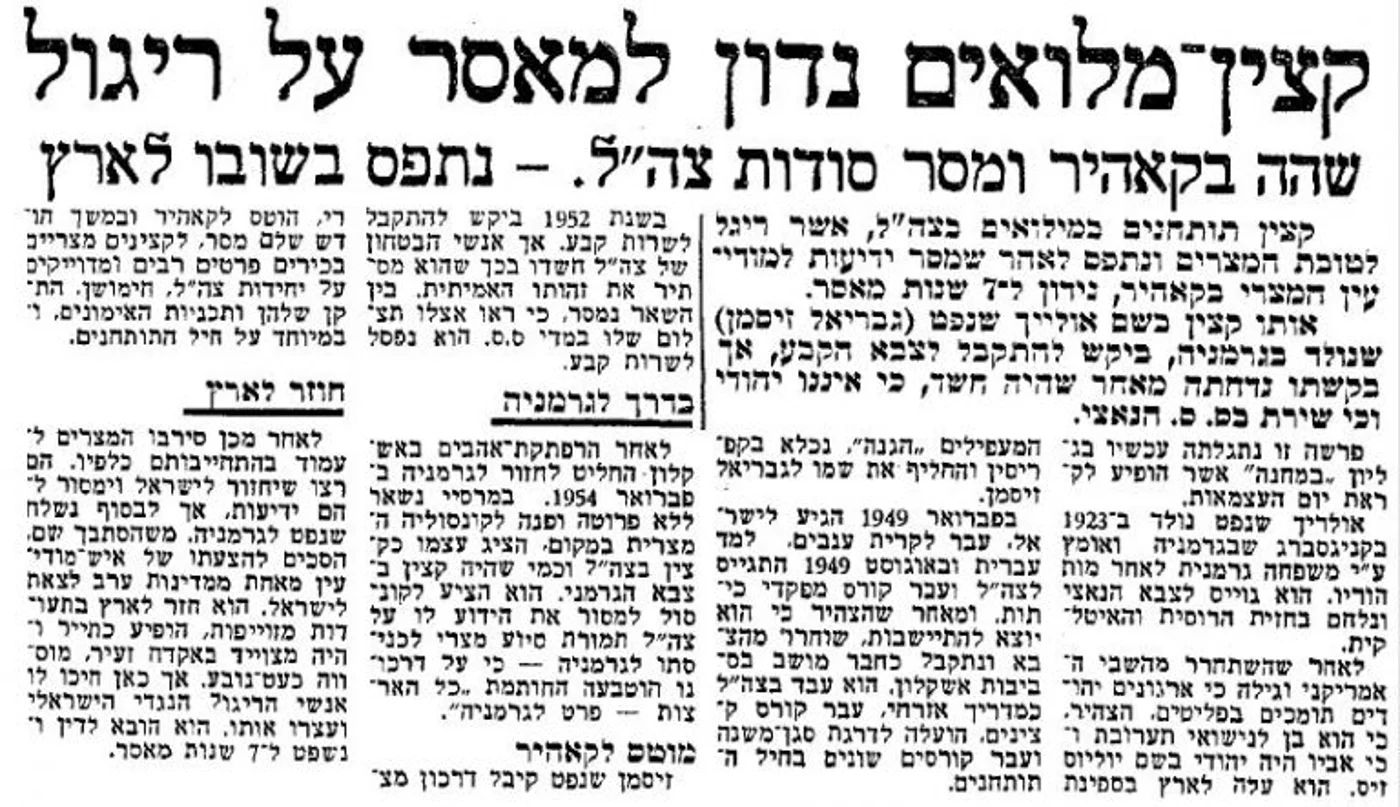
Ulrich Schnaft was born in 1923 in Königsberg, the cradle of Prussian-German culture. His mother, who never married, gave him to an orphanage, and little Ulrich was adopted by a typical German family. In the vocational school where he studied, he acquired education as a technician, and when he turned 18, in 1941, he was drafted into the SS and sent to the Eastern Front as part of Operation Barbarossa to conquer the Soviet Union.
At the beginning of the battles, he was lightly wounded, luck that saved him from a maneuver that left a quarter million German dead, and after recovering, he was sent to the Yugoslav front. Toward the end of 1944, he fell into American captivity in northern Italy, and was released only in 1947, because as a regular soldier he was not involved in murdering civilians or crimes against humanity.Over time, anonymous information revealed that while drunk, he showed his friends a photo in which he was wearing SS uniform and confessed that he was living under a false identity. This important information passed to the high ranks who immediately ordered his release from the IDF.
The Desire to Return Home
Disappointed by his dismissal from the IDF, Schnaft remained in Israel and worked occasionally in odd jobs while renting a room in the home of a couple of Jewish immigrants from Germany. During his stay, he convinced his landlady, and the two considered leaving the betrayed husband behind and returning together as a married couple to Germany.
While news of West Germany's rapid recovery also reached the Holy Land. Gabriel Zisman convinced the landlady to board a ship to Genoa in Italy, and from there continue to Germany and build a new life alongside his successful family, who left behind many assets.In Genoa, Zisman submitted a visa application at the local West German consulate, but was refused; Israel still prohibited entry to Germany at that time. The landlady continued to Germany with her German passport, while Zisman encountered repeated refusals, even when he revealed his true identity to the consulate representatives.

Betrayal - The Egyptian Temptation
Despite his achievements, Schnaft developed homesickness, Schnaft's hope to return to Germany was disappointed, and he was left with a meager sum of money. Out of financial distress and searching for an escape route, he turned to the Egyptian consul in Genoa and offered his services in exchange for money and help to return to West Germany. The consul transferred him to the Egyptian military attaché in Rome, and from there Schnaft flew to Cairo on an Egyptian passport under the name "Robert Hayt", after depositing his Israeli passport with the attaché.
In Cairo, senior intelligence officers interrogated him extensively in English and German, initially suspecting that he was an Israeli agent sent to spread disinformation. Schnaft was interrogated again and again on the same questions, which touched on his military past, IDF units, their locations, armaments, training plans, and names of officers. His answers were detailed and satisfied the interrogators.
During his month-long stay in the Egyptian capital, he was also taken on relaxed tours of the city and famous tourist sites like the pyramids and a night cruise on the Nile. But at the end of the interrogation, came the tempting and disturbing offer: to return to Israel, try to reenlist in the permanent army, and act as a covert agent for pay for the Egyptians.The Egyptian idea was to turn the Israeli officer into a "dormant agent", who would provide information only after establishing his position in higher ranks.
Schnaft received detailed briefing, and was even equipped with an amazing item: a fountain pen "that shoots gas and can eliminate people".
Although Schnaft wanted only a "one-time deal", the Egyptians did not insist particularly, because they believed there was a good chance that in the end he would agree to work for them as a long-term agent, and arranged ways of contact with him.
The Confession and the Trap: "Captain Adnan"
Schnaft returned to Germany under his Egyptian identity. He managed to locate his landlady, Margo, in Berlin, Schnaft confessed to her all his experiences: his service in the SS, his impersonation as a Jew, and his new secret service for Egyptian intelligence.
His revelations deeply shocked her. When the meeting did not go well and Margo refused to leave her husband, the husband, encouraged by his wife, decided to report him to the authorities in Israel. The information reached the hands of the head of the Shin Bet, Amos Manor, and the head of the Mossad, Isser Harel. The two decided that action must be taken to bring Schnaft back to Israel to stand trial for contact with a foreign agent.

Since the operation was supposed to be carried out outside the country's borders, the task was assigned to the Mossad. To capture him, Shmuel Moriah was chosen, who posed as "Captain Adnan ibn Adnan".The Mossad created a sophisticated cover story: they would offer Schnaft an economic espionage mission. The goal was not to scare him with a military mission, but to penetrate his doubts and gain his trust. The story revolved around the latest oil discovery in the Halutz area near Ashkelon, a topic that aroused international interest.Shmuel Moriah, 1955. Presented himself as Adnan in the role of the Iraqi military attaché at the Iraqi embassy in Paris and Germany.
Contact was made in a nightclub in Frankfurt, where Schnaft met Moriah who identified himself as an Iraqi citizen. Schnaft, who had returned to a life of poverty and degeneration in Germany, was convinced and decided in his heart to accept the offer, on the condition that he receive a new passport and decent pay. He believed that the Iraqi captain was a military attaché at the Iraqi embassy in Paris.
In Paris, Moriah applied good babysitting on Schnaft. He did not let him be alone for three days, took him to restaurants and entertainment. Moriah was careful and took him only to side streets and unfamiliar restaurants, those suitable for Arabs, so that he wouldn't encounter acquaintances. And indeed, in one of the Persian restaurants near the Arc de Triomphe, a near-disaster occurred: Moriah ran into an Israeli couple, where the husband was a "Mossad" employee who had met him a few days earlier. Moriah had to "lower his head and sour his face" to prevent identification and conversation in Hebrew. After that, a few days later, they were already back in Israel.

Arrest, Trial, and Disappearance
After being convinced that the Iraqis would provide him with a false identity and a safe envelope, he agreed to accept a new role in his life – another identity under the name David Wizberg.When he arrived at Lod Airport, he got into a waiting taxi, settled comfortably in the back seat, and ordered the driver to start driving. In a moment he did not expect, two Shin Bet men entered the taxi and asked him directly: "How should we address you, Gabriel Zisman or Ulrich Schnaft?" He didn't have time to decide and the taxi sped off and led him directly to the Shin Bet basements.
He was arrested. He was put on trial in the Tel Aviv District Court on charges of contacts with Egyptian agents and passing information to the enemy. His willingness to spy for the "Iraqi intelligence" (the Mossad trap) was not included in the indictment, for fear that the court would reject these clauses on the grounds that Schnaft was induced to commit the offenses by an inducing agent (Shmuel Moriah).The trial was conducted behind closed doors, and Schnaft was found guilty and sentenced to seven years in prison. Toward the release of a French security prisoner in Ramle Prison, Schnaft begged him to pass a message to Captain Adnan at the Iraqi embassy in Paris. The prisoner, who feared his release would be delayed, betrayed him.
After serving his sentence, Ulrich Schnaft was deported from the country. And since his return to Germany, his traces have disappeared. Schnaft's story, an SS soldier who became an artillery officer in the IDF and spied for Egypt, faded into the mists of history, and today it serves only as a chapter in the heritage and history lessons of the General Security Service.