Get our mobile app
Download on the App StoreGet it on Google Play

The Personal and Political Journey

Moshe Feiglin: Disobedience to Tragedy

In a candid podcast interview, the Israeli political figure discusses his childhood inventions, the founding of the Zo Artzeinu movement, his ideological battles with Netanyahu, and the profound guilt he carries over his grandson's death in Gaza

Moshe Feiglin Opens Up: From Civil Disobedience to Personal Tragedy
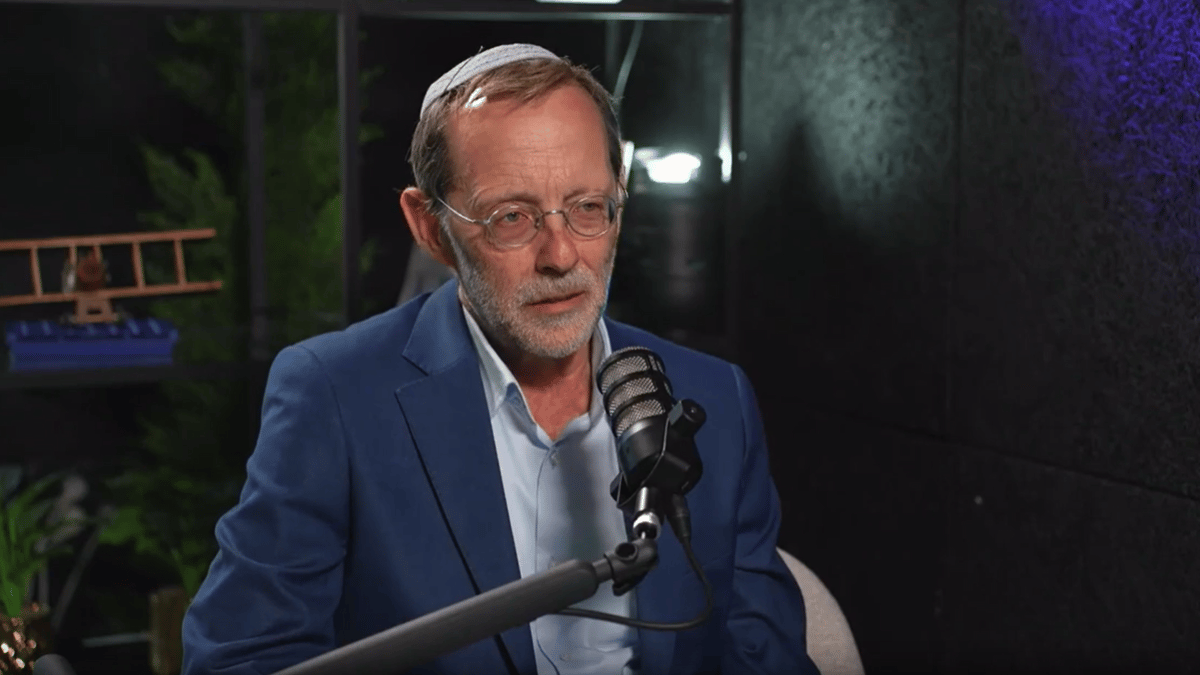
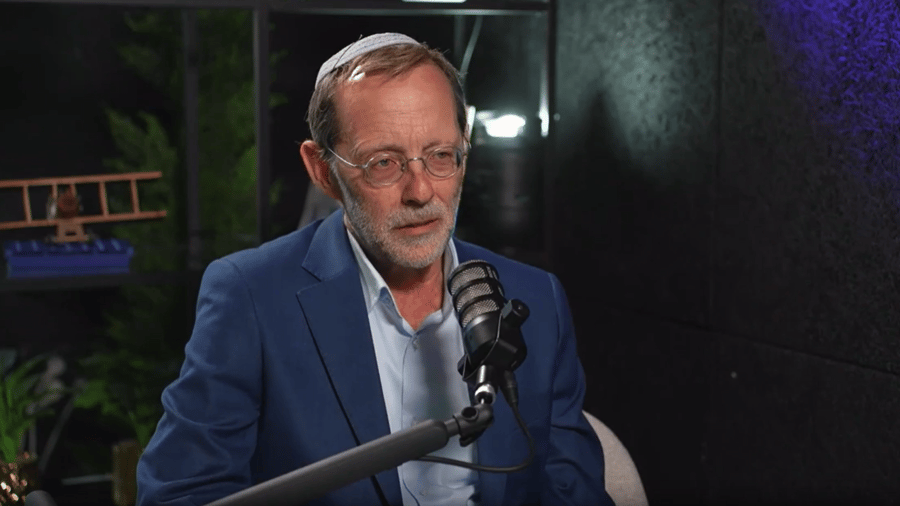
משה פייגלין בריאיון לאלי גוטהלף

In a revealing interview on the Kikar FM podcast with host Eli Gotthelff, Moshe Feiglin, a prominent figure in Israeli right-wing politics, began with an unexpected detail: his ban from entering the United Kingdom. Feiglin confirmed he has been barred from Britain for approximately two decades, describing the country as having transformed into "the Islamic Kingdom."

The ban arrived in an official brown envelope from Her Majesty's government, informing him in formal English that he was prohibited from entering England. The reason cited was a statement he had written claiming that "the Arab is not the son of the desert but the father of the desert."

Feiglin revealed that the quote originally belonged to Lord Jarvis, the first British High Commissioner to Sinai in the 1930s. "For quoting an official British figure, they ban entry to England," he remarked. When asked if he was pleased by the decision, Feiglin said it mostly surprised him—he initially thought it was a prank.

Gotthelff steered the conversation back to Feiglin's childhood in Rehovot, where he emerged as an unusual child. In first grade, young Moishe took his water bottle and set out on foot for Ashdod, a journey that lasted six to seven hours as he navigated by reading road signs.

Eventually, a stranger noticed him and called the police, forcing his mother to retrieve him by bus. The young boy was constantly occupied with improving the world through technology. He invented a refrigerator storage system featuring a retractable arm that allowed shelves to rotate and return to a different dimension.

Another childhood patent involved a device for rapid water heating in showers. A further invention addressed armor, proposing bullets that would function as batteries and detonate ammunition inside enemy tanks. He sent his hand-drawn tank shell design directly to the Israel Defense Forces.

To his surprise, he received a response from an IDF major general who took his proposal seriously. Feiglin describes himself as having read every book in the Rehovot municipal library, already sensing that he could read the map better than others. This attraction to books, he says, shaped the language and rhetorical skills that accompany him to this day.


The Divorce That Tore the Home and the Formative Encounter with the Western Wall

Gotthelff identified a sensitive moment and chose to address the complex subject of his parents' divorce. Feiglin admitted he had hoped the topic wouldn't arise, but shared that the divorce occurred when he was seven, during the shadow of the Six-Day War. His father came from a secular pioneering family that helped establish Mishmar HaYarden, while his mother came from a very religious Hasidic background in Australia.

The ideological gaps between his parents were significant, and attempts to bridge them ultimately failed. Feiglin describes the breakup as an event that dismantles a child's world. "I suggest to every couple today, understand that there is nothing harder to do to a child than to break up his family," he warns.

The divorce created in young Feiglin a longing for both worlds—the religious and the secular. He sees this as a process through which the Almighty passed him, a system of struggles designed to lead him to his mission. "This internal need within me to connect the worlds led me, among other things, to this ideology eventually," he explains to Gotthelff.

As a child, his father's secular world fascinated him, and he wanted to walk without a kippah (skullcap). However, visitation arrangements were stable and his father maintained close contact, visiting the family at home. Despite the difficulty, Feiglin describes his parents' separation as a consensual divorce, without the fights and court battles that characterize similar processes today.

A significant spiritual moment occurred immediately after the Six-Day War, when the family traveled to Jerusalem. Feiglin saw the Western Wall emerging from the ruins of the Mughrabi Quarter, a sight that left a powerful impression on him. He quickly pulled a kippah from his pocket to place on his head.

The sight of the Wall created deep excitement and an internal call to holiness. Today, however, he admits to Gotthelff that he tries not to pray at the Wall. "The Wall has become a barrier to the real thing, the Temple Mount," he argues, referring to current reality.

Minefields, Fallen Comrades, and Israeli Flags on Cars

From there, Eli Gotthelff led the conversation to Feiglin's military service period, following his studies at a military boarding school. Feiglin recounts that he refused the hesder yeshiva track (combining religious study with military service) and requested full service out of a desire to connect with the people of Israel. He served as an officer in combat engineering, dealing daily with mines and explosives.

One of the difficult moments he remembers occurred during navigation that went wrong, when the unit mistakenly returned to the heart of a minefield they themselves had laid. Feiglin maintained composure and ordered his soldiers to take deep cover in the sand and place hands on their heads. He lay there and counted precisely all ten explosions to ensure everyone could rise safely.

During the First Lebanon War, Feiglin experienced personal tragedy when the armored personnel carrier of the unit he had trained was hit by a Syrian helicopter missile. He shares with sorrow that half the soldiers who were under his command, along with the officer who replaced him, were killed in that incident. This memory returned during the First Intifada, when another officer who replaced him burned to death in a jeep set on fire in Nablus (Shechem).

Gotthelff asks what goes through one's mind seeing such events, and Feiglin answers simply that it's a feeling that the Almighty is protecting him. Rather than fear, these experiences planted in him a deep sense of mission and commitment to the life he was spared. "As long as I'm here, it's a sign I haven't finished my task," he says in the studio.

While describing reserve duty, a story emerges about how he dealt with stone-throwing in the Judea and Samaria area. While everyone protected themselves with nets and helmets, he decided to hang a large Israeli flag on his car and drive that way on the roads. His wife Tzippy turned the flag into her identifying mark when she would arrive through Shechem to bring cookies to the soldiers.

This private initiative later became a national project that Feiglin himself initiated. He found an importer who brought the patent for car flags and began distributing them to encourage driving with heads held high. Thus, he claims, the familiar trend of hanging flags on car windows on Independence Day was born.

From Window Cleaning by Rappelling to Civil Disobedience That Stopped the State

Gotthelff seeks to understand what happens after discharge from the army, when a person with technical abilities and vision enters the world. Feiglin recounts that immediately after his discharge, he flew to the United States and returned with rappelling equipment and a business idea. He established Israel's first rappelling window-cleaning company, which employed a dozen workers and cleaned the buildings of the Diamond Exchange and Elbit.

Business activity didn't stop there, and he partnered to establish a high-tech company. The idea was to create a computerized system that would shorten the inspection processes of rappelling workers at the exchange by sixty percent. His aspiration in those days was to make enough money, retire early, and live comfortably.

The economic plans changed abruptly with the signing of the Oslo Accords, an event that altered his life's trajectory. He saw the traditional demonstrations and understood they wouldn't change reality, so he conceived the idea of civil disobedience. Within the framework of the Zo Artzeinu ("This Is Our Land") movement, he called for establishing outposts in Judea and Samaria and blocking roads throughout the country at the same hour.

Gotthelff raises the question of leadership, and Feiglin describes how he rushed from settlement to settlement to convince people, despite not knowing his neighbors. "I brought the concept of non-violent civil disobedience. We went down to the roads with handcuffs on our hands, we said take us to jail," he describes. These actions indeed succeeded in stopping traffic throughout the state and put the government under pressure.

When he stood in the middle of a blocked intersection, his wife Tzippy called to report that the plan was working throughout the country. That moment, he shares, was one of the happiest moments of his life, because he understood his vision was becoming reality. The abandonment of the high-tech and rappelling businesses became absolute, and he chose to dedicate his life to public activity.

The state responded by filing a serious indictment against Feiglin on charges of sedition and illegal assembly. In court, he refused to request leniency and declared he was proud of his actions and ready to bear the consequences. He hung a copy of that indictment in his living room as a symbol of standing by his principles.

The Ideological Confrontation with Netanyahu and the Price of Lacking National Vision

As the conversation in the Kikar FM studio turned to politics, Eli Gotthelff asked about the gap between Feiglin's rhetoric and the absence of governmental achievements. Feiglin defended himself and rolled the ball back to Benjamin Netanyahu, asking what Netanyahu had accomplished before becoming prime minister beyond being an ambassador to the UN. According to Feiglin's approach, execution without clear vision and purpose doesn't lead the state anywhere.

He analyzes Netanyahu's character and argues that despite his crisis management abilities, he lacks vision. "Netanyahu is the last Mohican of survival Zionism. There is no goal to which he is leading the state beyond survival," Feiglin diagnoses. According to him, the goal of Zionism today must be a Zionism of purpose that leans on Jewish identity.

Gotthelff raises Feiglin's past attempt to capture the Likud party from within through the Jewish Leadership movement. Feiglin recounts that he recruited 22,000 people to Likud and built a force comprising a quarter of the central committee members. The plan failed because the recruits refused to vote as a unified ideological bloc, choosing instead to give their vote to politicians in exchange for tactical promises.

Gotthelff doesn't hesitate and also raises accusations of megalomania sometimes directed at Feiglin by critics. Feiglin firmly rejects these accusations, explaining he has no personal interest in sitting in the Knesset (Israel's parliament). "If there were another Feiglin, I would donate to him and go back to riding my bicycle. My problem is I don't have enough ego," he says.

He admits that the lack of political ego makes it difficult for him to generate the drive required to survive the system. Nevertheless, he manages to rise again and again after every fall, because the force driving him is mission, not interest. His vision isn't focused on a seat, but on presenting a deep alternative that doesn't currently exist in the traditional Israeli right.

Feiglin believes that today a stable and genuine electoral base is being built behind him thanks to podcasts. According to him, this is a loyal public that understands the ideas deeply and won't crack from attacks by other politicians. This base is composed of ultra-Orthodox and secular Jews who find in his message a renewed connection to their Israeli-Jewish identity.

The Family Tragedies That Shaped Faith and Coping with Bereavement

In the final and painful part of the interview, Gotthelff directed the conversation toward the family events that befell Feiglin. Feiglin tells of his son David, who was severely injured in a traffic accident while riding his bicycle. Feiglin received the news while riding a tandem bicycle in Yarkon Park together with his wife Tzippy.

Tzippy sat for an entire year beside David's bed at Beilinson Hospital and refused to leave the place. During those difficult days, Feiglin wrote the article "The Doors Open for Me," in which he explored the meaning of Israeliness from within the hospital. The broad support he received from all strata of the people demonstrated to him the connection that exists in Israeli society.

The second and fresher blow that struck the family was the fall of grandson Yair in battles in Rafah in the Gaza Strip. Feiglin recounted how he received the phone call from his daughter Nechama, just before he was about to begin a lecture. He immediately folded up the lecture equipment and announced to those present that his grandson had been killed and he had to leave.

Gotthelff asks when the breaking point came, and Feiglin reveals that the moment he was alone on the morning of the funeral, he burst into bitter tears. He discloses that a feeling of guilt accompanies him constantly, as he sees a connection between the failure to stop Oslo and the war. In his view, the people continue to be led by the same ideas that led to the massacre.

The close relationship with Yair became clear in full force during the shiva (seven-day mourning period), when they heard from his friends in the reconnaissance unit how much the conversations with his grandfather had shaped him. For Feiglin, the political mission and public struggle are tools designed to prevent the next disaster. "October seventh was just a prelude. Our state continues to be led by the same people, the same ideas," he warns.

Toward the end of the conversation in the Kikar Shabbat studio, Feiglin asks to convey a message of appreciation to his family. He requests that listeners pray for the recovery of his wife, Tzipora Penina bat Rachel Chaya, and defines her as the greatest gift he has received. Gotthelff concludes the interview and thanks him for the exposed and honest conversation.

Ready for more?

Join our newsletter to receive updates on new articles and exclusive content.

We respect your privacy and will never share your information.

Enjoyed this article?

Yes (32)
No (1)
Follow Us:

Unmissable content


Loading comments...

Also of Interest