
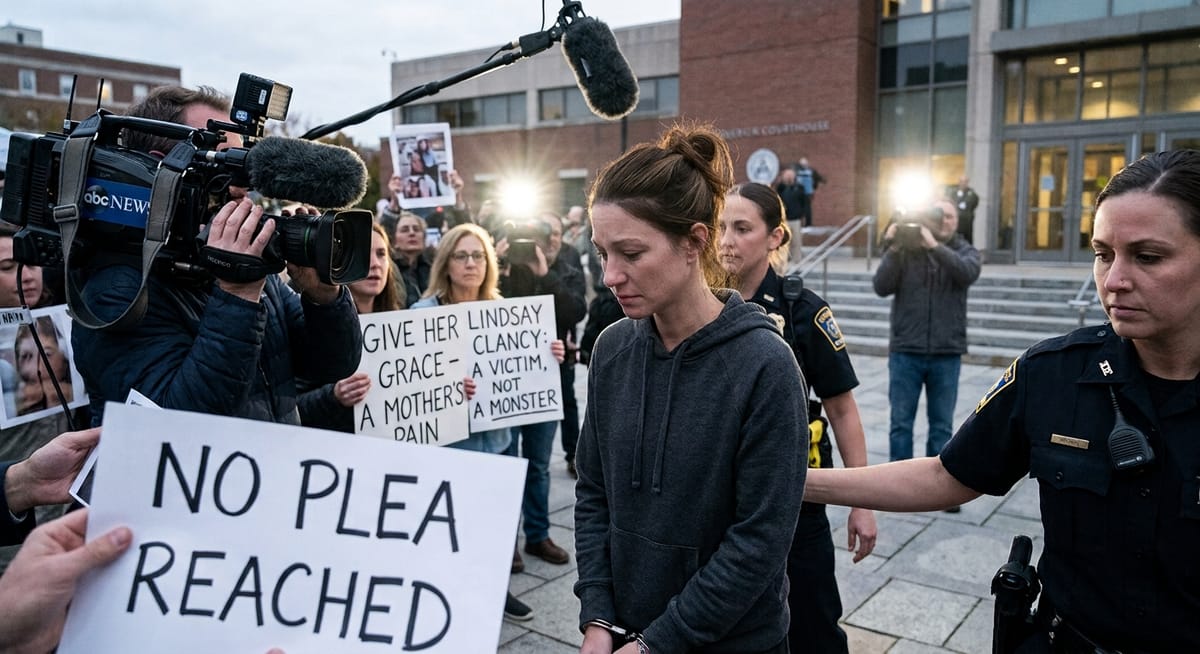
Twelve jurors in Plymouth, Massachusetts, went out this afternoon to answer a question so narrow it can be stated in a single line: on the evening of January 24, 2023, did Lindsay Clancy lack the substantial capacity to appreciate that what she was doing was wrong, or to conform her conduct to the law? That is the whole of it. Not whether she is a monster. Not what she owes. Not what the years since have made of her. One night, one mind, one legal threshold — and everything else the case contains falls outside the jury's mandate by design.
It is worth saying plainly that this narrowness is a feature of a decent legal system, not a defect in it. A society that punishes people for what they could not have prevented is not a just society, and the insanity defense exists because that principle is worth protecting even in the cases that make us sick. Postpartum psychosis is a real clinical entity, rare and severe. The prescription record in this case is real: Reddington has argued for three years that his client was handed Valium, Prozac, Klonopin and Zoloft in overlapping succession by a system that mistook masking her symptoms for treating them. Even the psychologist the Commonwealth hired, Kirk Heilbrun, told the jury that Clancy had bipolar disorder and depression, worsened by insomnia and by adverse reactions to what she was prescribed. Nobody in that courtroom argued she was well. The dispute was only ever about whether being ill was the same as not being responsible.
But a legal question that narrow, asked for twenty-two days by seventy-odd witnesses, has a gravitational effect on everything around it. It pulls the entire account of that night inside one woman's head and leaves it there. Watch how it worked. Heilbrun, testifying for the prosecution, did not accept the command hallucinations and did conclude that Clancy was criminally responsible — and still explained the killings by saying she planned to end her life and did not want to leave her children behind, convinced they would suffer without her. He called it killing out of love. That is a prosecution witness describing a triple homicide in the vocabulary of maternal devotion. It is not that he was wrong to say it; it may well be accurate. It is that the framework leaves no other way to speak. The defense's version and the prosecution's version are narrated from the same vantage point, differing only on what she could see from there. Kevin Reddington opened his closing by naming Cora, Dawson, and Callan and telling the jury they were the victims in this case — and then, because the law gave him nothing else to argue, spent the remainder of it on their mother. He was doing his job. That is precisely the problem.
Cora was five. Dawson was three. Callan was eight months old and lived several days in a children's hospital before he died. In a trial about a state of mind, they function as circumstances. They are what the mind acted upon. Almost nothing said across twenty-two days was about who they were, because nothing about who they were bore on the question the jury was empaneled to answer.
Jennifer Sprague came closest to naming what the framework cannot hold. It was a choice, she told the jurors: Clancy could have killed herself and left the children alive. As a legal argument that is a claim about deliberation and capacity, and the jury will weigh it as such. As a moral proposition it is something much larger, and it does not go away no matter which box the foreperson checks. Somewhere in that house, in clarity or in fog, in three minutes or over three months, a judgment was reached that three lives would not continue without one. Illness may fully explain how such a judgment was reached. It cannot make the judgment not have been reached.
And here is the gap the verdict will not close. Criminal responsibility is measured at the instant of the act; competence is measured at the instant of the proceeding. By construction, every defendant who raises insanity is lucid at trial — that is what makes a trial possible at all. So the law renders a finding about one evening in 2023 and then falls silent, permanently, on everything that has happened in the mind that survived it. Whatever the jury decides, it will not have addressed what is owed afterward, or what an accounting would even look like, or why the public conversation about this case has arranged itself so completely around the suffering of the person who did the killing. Those are not questions a jury is allowed to reach. They are also not questions that stop existing because no institution is assigned to them.
If Clancy is convicted, she faces life without parole. If she is found not criminally responsible, she goes to a state psychiatric hospital. Both outcomes are defensible readings of a hard record, and I would not want to be one of those twelve people this evening. But either way, the machinery will close the file on the only question it was built to ask, and the other one — the one about three children who are not the subject of their own story — will be left exactly where it has been since January 2023, which is nowhere at all.
If you or someone you know is struggling, call or text 988, or chat at 988lifeline.org. Free, confidential support is available 24 hours a day.