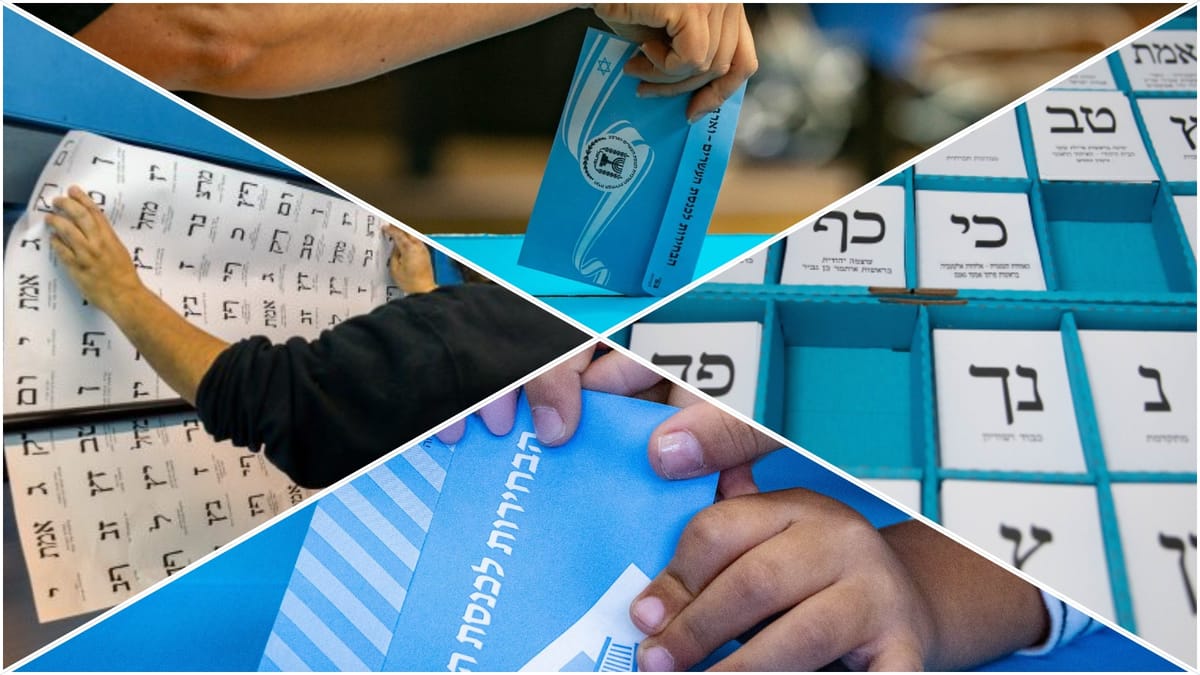
Polls opened across Israel at 7 a.m. Tuesday for the election of the 26th Knesset, Israel's parliament. Some 7.3 million Israelis are eligible to vote, and 36 party lists are competing for 120 seats. The contest pits Prime Minister Benjamin Netanyahu's right-wing bloc against an ideologically diverse opposition bloc led by former army chief Gadi Eisenkot. This is the first parliamentary election since Hamas's October 7, 2023, massacre and the first since November 2022.
A total of 7,331,981 people are eligible to cast ballots. Most polling stations stay open until 10 p.m., while stations in small communities of up to 350 voters, and special stations in hospitals, nursing homes and prisons, are open from 8 a.m. to 8 p.m. Israel's Central Elections Committee, which staffs the polling stations and printed the ballots, has set up 12,018 regular polling stations, plus about 300 special stations in hospitals, prisons and army bases. Ynet reported that 12,335 polling stations had been prepared nationwide.
Israelis abroad face strict rules. Voting takes place in person only, generally at the polling station assigned to the voter's registered address. About 810,000 eligible voters, roughly 11% of the total, live abroad, according to the Central Bureau of Statistics, and an estimated 67,000 of them are flying in to vote, according to the Fly&Vote initiative.
Election Day is a national holiday. Most workplaces and schools are closed, while shops and entertainment venues remain open. Free travel runs on about 660 intercity bus routes and on all Israel Railways lines, and The Jerusalem Post noted that the service is available to every passenger, not only to voters.
The operation is massive. Acting committee director-general Dean Livne told Ynet that nearly 100,000 committee workers are staffing polling stations and regional committees, and that the parties employ another 200,000 people. The committee has printed about 450 million ballot slips using roughly 250 tons of paper, and some 18,000 ballot boxes are in use. The election budget stands at NIS 690 million.
"This is a celebration of Israeli democracy, and approximately 330,000 young men and women will be taking part in it today for the first time," the acting director-general stated as voting began. About 333,000 more people are eligible to vote than in 2022. Among eligible voters living in Israel, just over 5 million (77%) are Jews and about 1,159,000 (18%) are Arabs.
Designated polling stations have been set up for displaced residents of communities including Be'eri, Kfar Aza, Nir Oz and Holit. Around 20,000 police officers are deployed nationwide, and police cyber units are working to curb disinformation online. Election-integrity inspectors are using some 15,000 cameras to detect irregularities at polling stations.
The committee rejected a claim circulating online that Likud representatives were tracking voters at polling stations through an app. "As of now, the Committee has received no reports of any such activity," it said, adding that party representatives are barred from passing information about individual voters to their parties.
Shas Party Chairman Rabbi Aryeh Deri cast his ballot in Jerusalem's Har Nof neighborhood, while Joint List chairman Jabarin voted in Umm el-Fahm.
Weather is also a factor. Forecasters warned of thunderstorms, hail and rain intensifying toward noon, with significant flooding expected in the southern Negev, the Arava, the Judean Desert and the Dead Sea area. The public has been urged to stay away from streambeds.
Where the race stands
In the final polls, published Friday, neither bloc reached the 61 seats needed for a majority, JTA reported. Most surveys put Netanyahu's bloc at around 50 seats, with Eisenkot's Yashar party and its potential partners better placed but still short. The Arab-majority Joint List and Ra'am were projected to win a combined 14 or 15 seats, and neither is expected to join a Netanyahu-led government. Two parties are hovering near the 3.25% electoral threshold: Ofer Winter's Amcha Yisrael and the Reservists list led by Yoaz Hendel and Yaron Zelekha.
"It's a referendum about Israeli democracy," said Udi Sommer, who heads the Barak Leadership Center at Tel Aviv University. "It's also about Netanyahu's performance and accountability for the people who were in charge on Oct. 7." Tani Frank of the Shalom Hartman Institute said the most likely outcome was that neither bloc would win a clear majority. "A key question, then, is who remains in power if Israel heads to another election," he said.
The first results are expected overnight, after most polling stations close at 10 p.m.