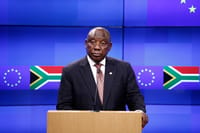
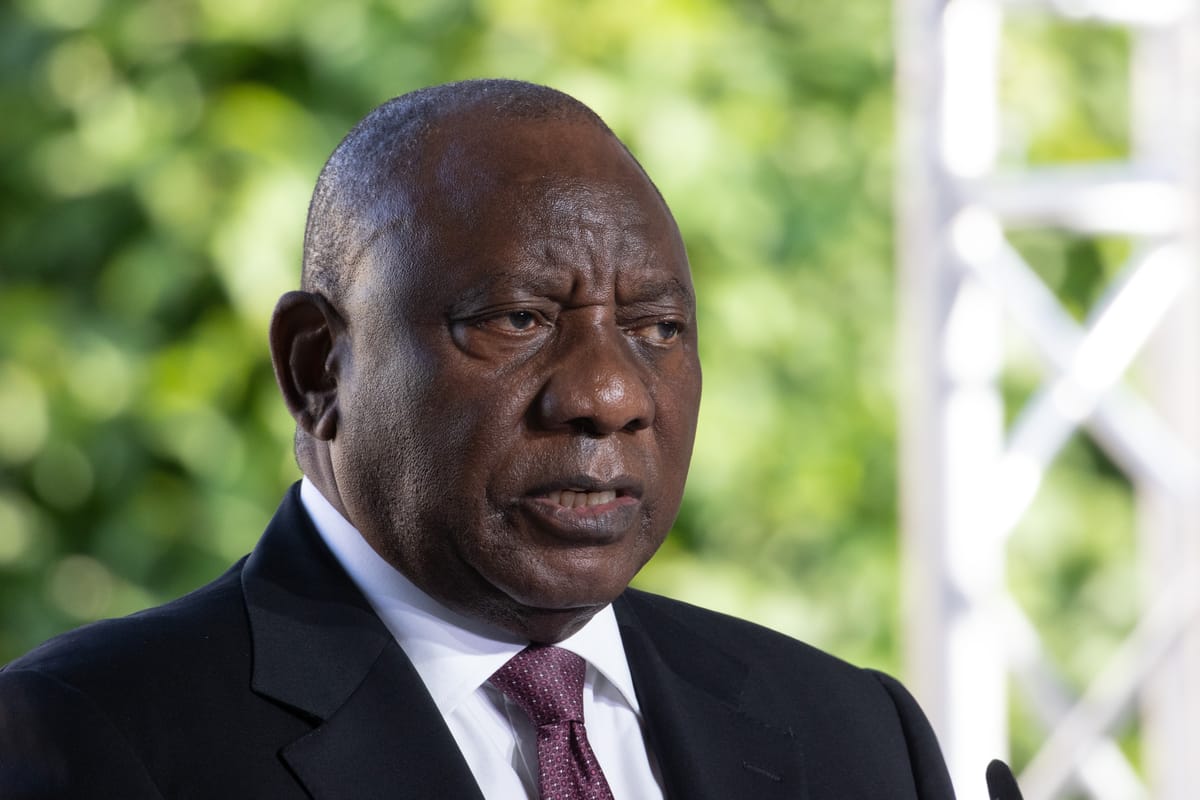
South African President Cyril Ramaphosa met with the family of Daniel Perez on August 10 after the South African government helped facilitate the return of Perez's remains from Gaza. The presidency said Ramaphosa expressed condolences and reaffirmed Pretoria's support for an inclusive peace process for Israelis and Palestinians.
It was meant to be a quiet humanitarian gesture. Instead, it triggered a political firestorm that has exposed fundamental contradictions in South Africa's approach to Israel.
Perez was born and raised in Johannesburg before moving to Israel with his family in 2014. He served as a captain and tank commander in the Israeli Defense Force and was killed by Hamas while he was defending Israel against the Hamas massacre on October 7, 2023.
But here's where it gets complicated:
South Africa's constitution explicitly prohibits citizens from participating in foreign armed conflicts without authorization from the National Conventional Arms Control Committee. According to reports, no such authorization existed for Perez. If this is accurate, his military service violated South African law. And if the South African government helped return his remains without addressing this legal breach, Pretoria may have violated its own constitutional commitments.
The Economic Freedom Fighters, the militant left-wing opposition party, saw the opening immediately. EFF MP Carl Njhouse submitted 12 parliamentary questions to International Relations Minister Ronald Lamola asking for details about the meeting, the circumstances of Perez's remains being returned, and whether his military service was authorized under South African law. In a statement, Njhouse framed the presidential meeting as a betrayal.
"It is a betrayal of the law, a betrayal of South Africa's stated solidarity with the Palestinian people, and a betrayal of the very principles the government claims to uphold when it speaks of justice and opposition to genocide," he said.
The stakes are higher than one family meeting because South Africa's entire identity on the global stage rests on its commitment to international law and Palestinian rights. For three years, Pretoria has built a legal case against Israel at the International Court of Justice, filing a genocide case in December 2023 that positions South Africa as Palestine's champion in the world's highest court. That position has been backed by South African political leaders and activists who have repeatedly marched in solidarity with Palestinians, linking the two struggles against what they describe as 'oppression'.
Many South Africans sadly confuse their own anti-colonial fight with the 'Palestinian cause'. Indeed, that 'moral clarity' South Africa as the nation that knows what oppression looks like, has become central to Pretoria's diplomatic strategy.
Yet the Ramaphosa-Perez meeting suggests something more complicated: a government that wants to pursue Israel at the ICJ while also managing humanitarian obligations to its own citizens, even when those citizens served in the Israeli military. The presidency has said the intervention reflected the state's responsibility to assist South Africans caught in conflict zones. That is a legitimate argument. But it allegedly collides with the constitutional prohibition Perez apparently violated and with Pretoria's sweeping legal position against Israel.
For Ramaphosa, the political challenge is now clear. He must balance the humanitarian responsibility of the state with South Africa's legal framework and its high-profile foreign policy commitments. Parliament is demanding answers. And the question is no longer abstract: it is whether South Africa's solidarity with Palestine can coexist with helping return the remains of an Israeli soldier, even when doing so may have required skirting the nation's own laws.
The presidency has not directly addressed the constitutional question. In the coming weeks, that silence may become harder to maintain.
Editor's note: Of course, anyone who knows anything about the current South African government knows that they are in no position to preach about moral clarity after the corruption within. They also know that South Africa has no particular love for Israel or for its own Jewish citizens, both of which make Ramaphosa's actions all the more boggling.