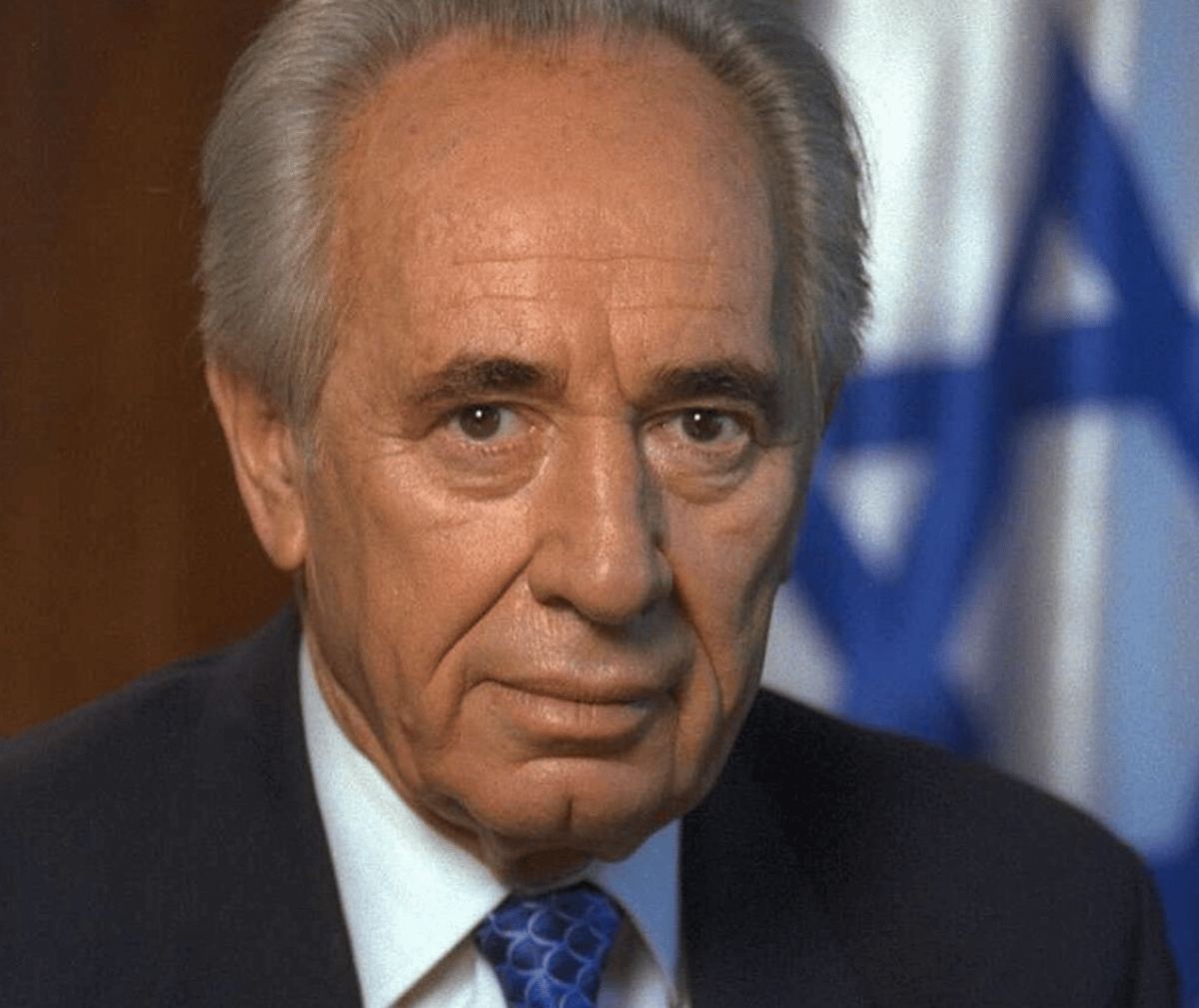
A man in his sixties with a thick mustache and a full head of hair walked into King Hussein's palace in Amman in the autumn of 1993. The mustache was false, the hair was a hat, and the name he was travelling under was not his own. He was Shimon Peres, then 70 and Israel's foreign minister, in a country still formally at war with his own.
The Peres Center for Peace and Innovation released excerpts from the minutes of that meeting on Tuesday, ten years after Peres's death, on the day of the state memorial ceremony and the naming of the Jerusalem International Convention Center in his honor.
The approach had come a week earlier. On October 26, 1993, a message reached Israel from the Jordanian royal court: Hussein wanted to meet Peres, a man he regarded as a creative thinker, and Jordan would take the measures needed to keep the foreign minister from being identified. The date agreed was November 2.
That morning Peres crossed the Allenby Bridge on foot with his bureau chief and the deputy head of the Mossad. Two cars waited on the far side. The one that took Peres to the palace was driven by the head of the king's private office.
Hussein spoke about time. He told Peres he might have a year or two left, and that he intended to put everything on the line, invoking the killing of his grandfather Abdullah I in 1951 and his wish to leave the best possible legacy for his brother Hassan and for the government. Peres told him there was now enormous public appetite for an agreement, and that the young were tired of war, poverty and the absence of freedom.
Peres then laid out the vision he had been carrying for a decade: shared infrastructure, ports, aviation, roads, regional projects, economics as the scaffolding for politics. He proposed writing up an informal summary of what they had agreed so he could take it to Yitzhak Rabin.
The meeting did not come from nowhere. It followed years of covert contact with Hussein, including Peres's attempt to reach a deal through the London Agreement of 1987, which Israel's government declined to pursue.
That night the two men initialed a memorandum of understanding. Eleven months later, in October 1994, Israel and Jordan signed their peace treaty in the Arava.
Neither man had as long as he wanted. Hussein, who told Peres he might have a year or two, got five, and died in 1999. Rabin, who sent Peres to Amman and signed the treaty, was murdered thirteen months after the Arava ceremony. Peres outlived them both by decades and spent those decades arguing for a region that never arrived.
The treaty held anyway. It has survived two intifadas, the collapse of Oslo, a war in Gaza that brought Jordanian crowds into the streets against it, and an ambassador recalled from Tel Aviv. It is colder now than at any point since it was signed, and it is still standing.
That is what the documents released today are actually a record of: not a vision that came true, but the last time two men in a room could commit their countries to something and make it stick. Peres wanted the ports and the shared roads and the regional projects. What he got was a border that has not gone to war in thirty-two years.
On the evidence of the last three years, that was worth the fake mustache.