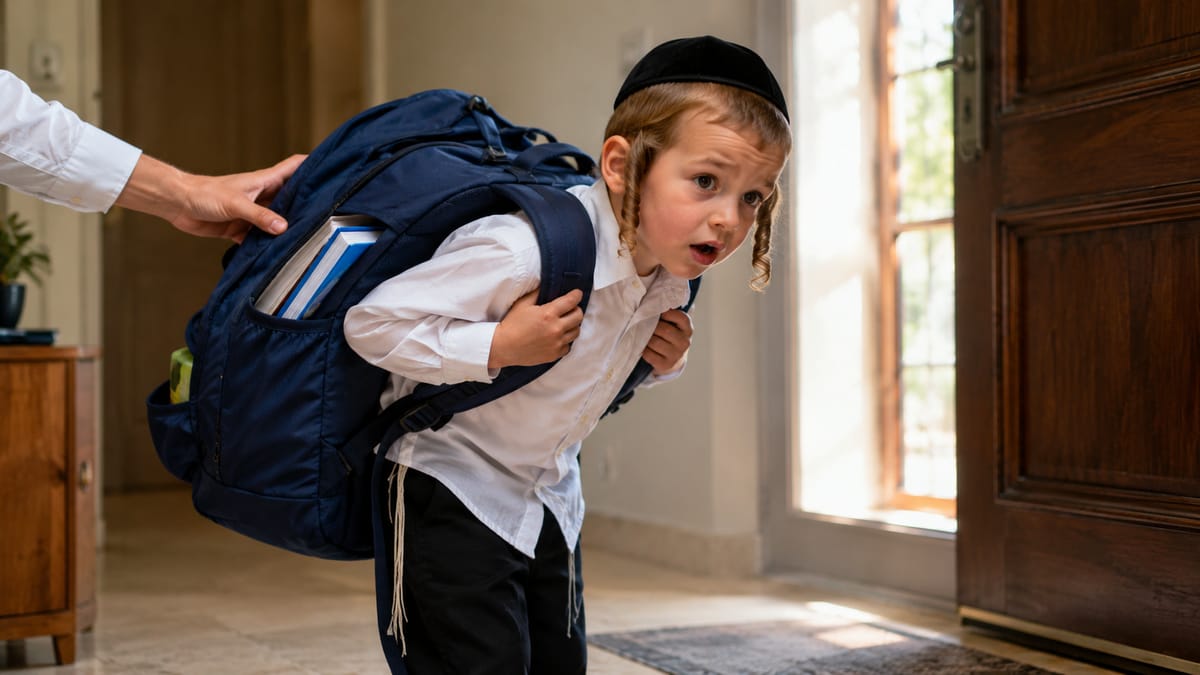
There's something almost comical about watching a small child head off to school in the morning carrying a backpack that looks like they're embarking on a three-week trek through the Alps.
Pencil case, notebooks, textbooks, prayer book, water bottle, lunch box, an extra notebook "just in case," tissues, colored pencils — and somewhere at the bottom, probably a small rock that no one knows how it got there.
Parents invest hours selecting the right backpack, covering books, labeling supplies, and organizing pencil cases until every item is perfectly arranged. But just before the child hoists this entire operation onto their back and heads out the door, there's one simple check worth doing.
Take the backpack — and weigh it.
Yes, literally on a scale.
How much does your child's backpack actually weigh?
According to the American Academy of Pediatrics (AAP), an overly heavy backpack can cause pain in the back, neck, and shoulders. On its dedicated safety page, the organization recommends that backpack weight should not exceed approximately 15% of the child's body weight. In its back-to-school guidelines, it cites a general range of 10%-20%.
In simple terms: a child weighing 20 kilograms (44 pounds) — a backpack of about 3 kilograms (6.6 pounds) already reaches 15% of their weight.
A child weighing 25 kilograms (55 pounds) — about 3.75 kilograms (8.25 pounds).
A child weighing 30 kilograms (66 pounds) — about 4.5 kilograms (10 pounds).
Suddenly, when you place on the scale a backpack that seemed "not so bad" and discover it weighs four or five kilos — things look a bit different.
Want an even simpler check? Look at your child.
You don't always need a calculator.
Load the child with the backpack exactly as they would carry it in the morning and observe them from the side. If they immediately lean forward to balance the weight, the AAP notes this is a sign the backpack is too heavy.
And if they set it on the floor and say "Dad, lift it for me" — maybe it's not laziness. Maybe we've actually sent them to first grade with equipment suitable for a college freshman.
Before buying a new backpack — empty the old one.
The good news is that you don't always need to replace the backpack. Sometimes you just need to empty it.
AAP experts recommend regularly reviewing the bag's contents and removing items that don't really need to be carried around. Heavier items should be positioned close to the back, the various compartments should be used to distribute the load, and parents should ensure the child uses both shoulder straps rather than carrying the bag over one shoulder.
This is a good moment for a small experiment that may surprise you.
Remove everything from the backpack.
Now put back only what's actually needed for tomorrow.
Not the notebook they might need on Thursday, not three pencil cases, not all the markers received as a gift, and not a textbook they finished studying from two weeks ago.
Then — weigh it again.
Pay attention to the backpack itself as well.
A larger backpack isn't necessarily better. According to the AAP, when there's plenty of empty space, there's a natural tendency to fill it with more and more items. It's recommended to choose a bag that fits the child's height and measurements, with two wide, adjustable shoulder straps, a padded back, and compartments that allow weight distribution.
When the backpack is on the back, it should sit close to the body and centered on the back — not dangling low like a sack of potatoes. A chest or waist strap, if available, can also help distribute the load.
So before the first day — do a two-minute test.
Weigh the child.
Weigh the backpack when it's packed exactly as they'll carry it to school.
Check what percentage of body weight the child is about to carry on their back — and also observe how they stand when wearing the backpack.
Because yes, children carry many important things to school with them: books, notebooks, food, excitement, and perhaps some worries too.
What they don't really need — at least that can be removed from their backs.