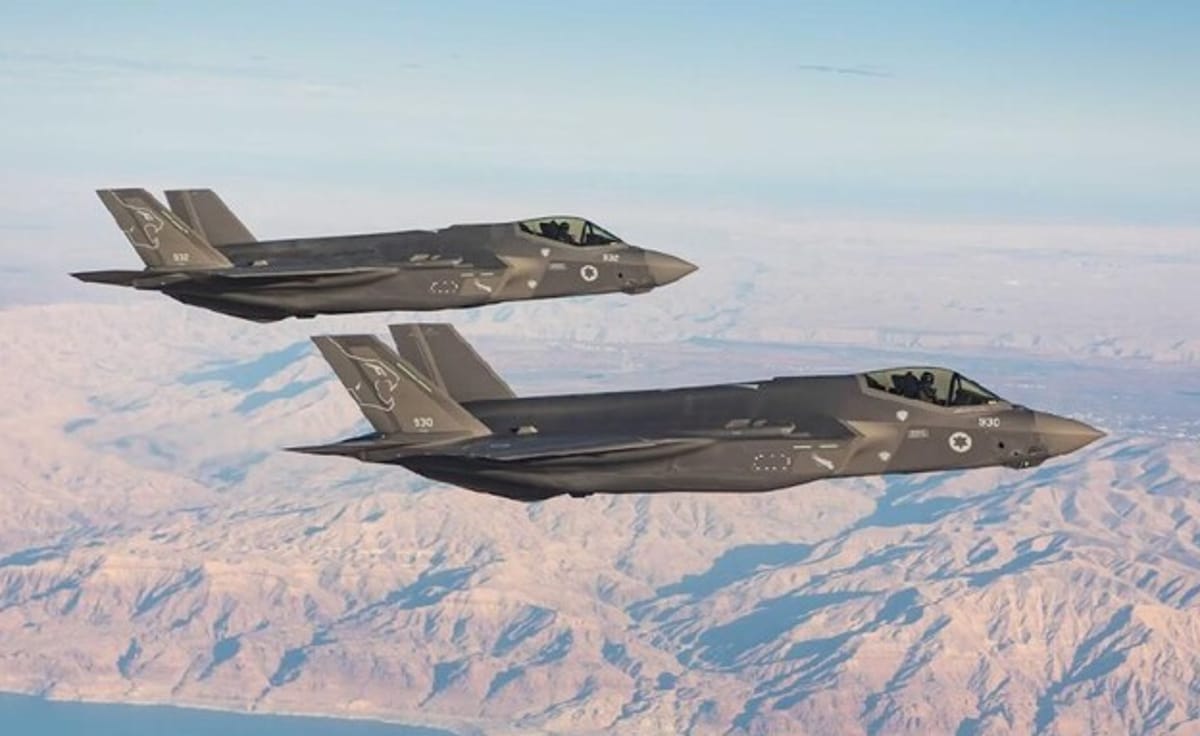
As reports circulate regarding potential US sales of F-35 stealth fighters to Saudi Arabia and Turkey, generating significant concern within the Israeli Air Force (IAF), Israel’s defense establishment is already setting its sights on the next generation of military technology to maintain its qualitative edge.
Senior IDF sources stress that Israel must vehemently oppose any F-35 sales that could undermine its air superiority over regional armies. The security establishment is planning to demand significant compensation from the US in upcoming discussions between Prime Minister Benjamin Netanyahu, Defense Minister Israel Katz, and American officials.
The Next Generation: F-47 and Deep Penetration
Israel is particularly interested in acquiring the next-generation F-47 fighter jet, an American Boeing-manufactured aircraft currently in development. This future aircraft is slated to feature Artificial Intelligence, advanced networking capabilities with drones and unmanned aerial vehicles (UAVs), and satellites. Designed primarily for air superiority, it will also handle ground attacks, espionage, and electronic warfare, boasting a maximum speed exceeding Mach 2 and even greater stealth capabilities than the F-35. It is expected to begin flying by 2030.
In the near term, Israel is focusing on crucial technological and acquisition demands:
- Expedited F-35 Delivery: Israel is currently purchasing a fourth squadron of F-35 stealth fighters (known as the "Adir"). Shortening the delivery schedule and receiving clearance for previously denied upgrades and authorizations would significantly bolster the IAF's strength.
- Advanced Munitions: The security establishment is pressing for the sale of classified American weapon systems and advanced munitions that the US has historically refused to sell to Israel. This includes technologies for cracking underground systems, armaments immune to electronic warfare, and highly advanced maritime warfare capabilities, both above and below the water, a domain of serious concern for the IDF.
- Advanced F-15EX: Israel also seeks an acquisition program for two squadrons of the F-15EX with favorable terms. This highly advanced fighter jet, equipped with a powerful radar, currently offers superpower-level air superiority and has only been sold to the U.S. military.
Nuclear Concerns Tied to F-35 Sales
The potential sale of F-35s to Saudi Arabia is compounded by significant concerns over Riyadh’s nuclear ambitions. Recent U.S. tests, conducted by the U.S. Air Force and Lockheed Martin in the Nevada desert, successfully integrated a tactical nuclear bomb drop capability into the advanced stealth fighter.
The implication: Any country possessing the F-35 will soon be able to carry non-conventional weapons. This presents a massive advantage, particularly for states lacking ballistic missile capability, and fuels Israeli fears of a regional arms race.
Israeli security officials are deeply concerned that under the guise of the agreements, the F-35 sale could pave the way for Saudi Arabia to obtain nuclear capabilities and, in a hypothetical "reversal of aims," pose an existential threat to Israel.
Another concern is the issue of civilian nuclear technology. Before the war, Saudi Arabia's desire for civilian nuclear technology was vetoed by Israel, leading the U.S. to block the move. Israel is now closely monitoring this, fearing the transfer of civilian nuclear knowledge from the U.S. to Saudi Arabia.
As a reminder, U.S. foreign policy is legally bound to ensure Israel's Qualitative Military Edge (QME) over its neighbors, a position achieved through the superior technology provided by the U.S. However, the future sale of advanced aircraft like the F-35 or a similar model (like the F-15QA sold to Qatar) to regional powers creates a complex challenge to maintaining that edge.
The U.S. government has reportedly been cautious, with officials telling AP today that an F-35 deal with Saudi Arabia is not expected during the visit this week, due to fears of undermining Israel's QME and the possibility of sensitive defense technology leaking to China.