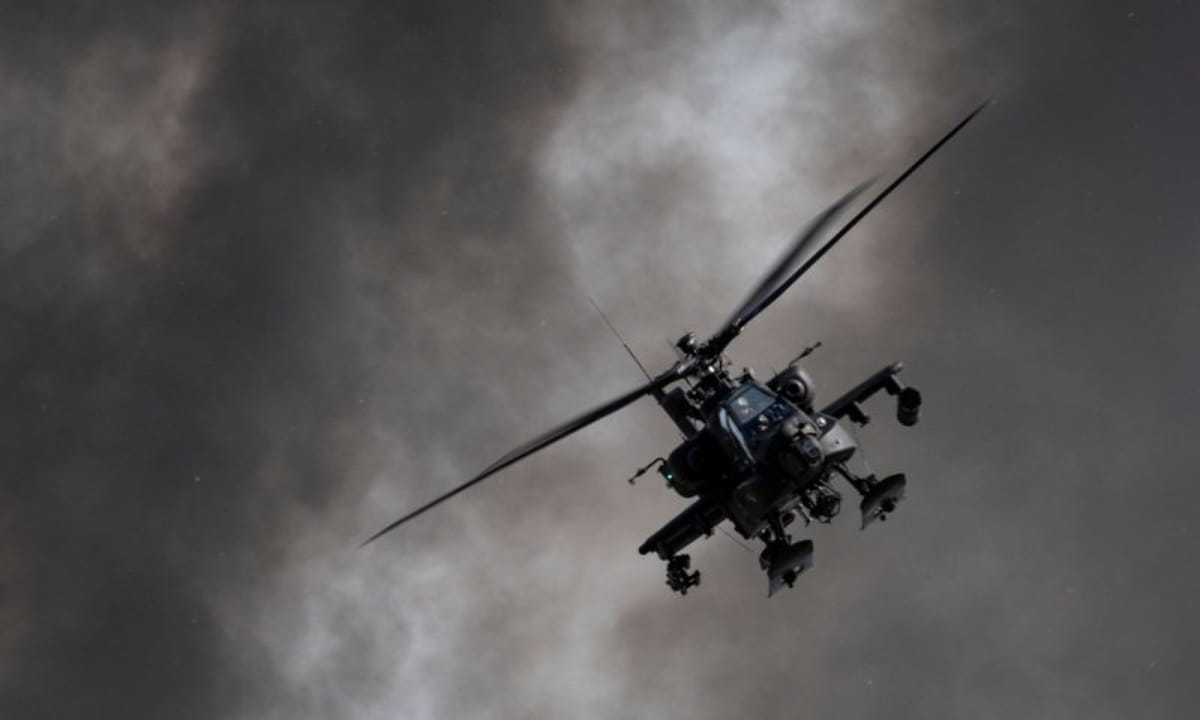
A tense international standoff has deepened following a series of defensive statements from the political leadership in Tehran regarding the recent destruction of an American military asset. Iranian Foreign Minister Abbas Araqchi spoke out to downplay the severity of the incident, which involved the downing of an advanced United States Apache combat helicopter over the critical transit routes of the Strait of Hormuz. The remarks come as intelligence sources monitor emergency movements on the ground, including reports that Iran has initiated a rapid evacuation of civilian aircraft from the main airport tarmacs in Tehran due to fears of imminent Western bombardment.
Araqchi attempted to deflect direct state responsibility for the military strike, framing the presence of Western naval and aerial forces as an inherent hazard that naturally leads to operational accidents. The foreign minister stated that foreign forces operating in close proximity to Iranian territory remain at constant risk due to their own human errors, simple accidents, or the potential to be caught in a crossfire. He asserted that to mitigate these operational risks, the optimal solution is for those forces to completely depart the region, while reiterating that the Strait of Hormuz consists of territorial waters divided between Iran and Oman rather than international transit space.
The defensive rhetoric from Tehran stands in sharp contrast to the explicit red lines established by United States President Donald Trump, who used his platform to confirm that American investigators had verified the source of the attack. Trump detailed that a sophisticated Iranian drone had targeted the helicopter, forcing both pilots to abandon the airframe over open water. The American commander in chief warned that Washington is now compelled by the gravity of the circumstances to execute a direct military response, a sentiment echoed by media correspondents who report that the executive branch is actively organizing a large scale retaliatory campaign.
The initial moments following the mid air explosion were marked by extreme operational uncertainty, as military command centers in Washington spent two hours executing an emergency search mission to determine the fate of the missing flight crew. The two American pilots were eventually located and extracted from the maritime zone with the assistance of an advanced naval sea drone, which guided rescue teams to their position. Both personnel are currently receiving medical evaluation at a regional facility for minor injuries, and while some intelligence analysts question whether the drone strike was an authorized state action, Trump has made it clear that the regime will face full accountability.
As the rhetoric intensifies, political figures in Tehran have unified behind an aggressive stance, mirroring earlier warnings from Parliamentary Speaker Mohammad Baqer Qalibaf. Araqchi concluded his remarks by noting that while his government theoretically prefers the language of traditional diplomacy, its forces are highly proficient in communicating through far more destructive methods. With civilian aircraft fleeing the capital and Western refueling wings mobilizing across the perimeter, the window for a diplomatic resolution appears to be closing rapidly.