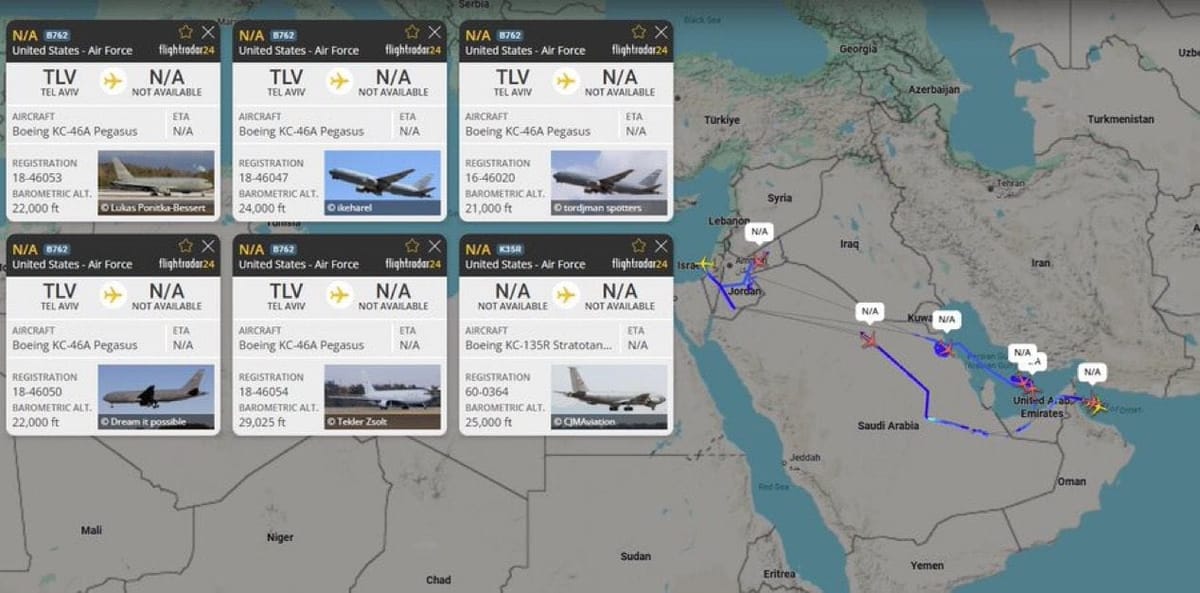
The skies across the entire theater of operations have transformed into a massive logistical staging ground as the United States Air Force deploys an exceptional number of strategic refueling assets. Real time tracking logs sourced from public flight monitoring networks like Flightradar24 show a dense network of heavy tankers maintaining active orbits over critical sectors. The sudden, coordinated appearance of these long range support aircraft indicates that Western air commands are preparing for or actively executing extended long range strike missions.
A detailed analysis of the active flight data confirms that at least eight heavy refueling platforms, including specialized Boeing KC-135R Stratotankers and state of the art KC-46A Pegasus aircraft, are simultaneously maintaining positions in regional air corridors. These specific hulls, bearing registration codes such as 18-46053, 18-46047, 18-46020, 18-46050, and 18-46054, departed from secure logistics hubs and established multi aircraft refueling tracks. The vast geographic footprint of the operation spans directly over Israel, Jordan, Saudi Arabia, the Persian Gulf, and the outer approaches of the Gulf of Oman.
The specific deployment of aerial refueling assets is a definitive indicator of high intensity military activity, as these large aircraft do not operate independently or carry offensive weaponry. Instead, their sole operational purpose is to transfer fuel mid air to short range fighter jets, stealth bombers, and tactical reconnaissance platforms, allowing combat squadrons to remain airborne for extended hours without returning to base. The presence of multiple tankers over distinct sovereign nations suggests that a massive, multi pronged air operation involving dozens of strike fighters is being supported simultaneously.
Military analysts note that the current geographic distribution of the tanker fleet allows American and allied strike aircraft to strike targets deep inside foreign territory from multiple vectors. By maintaining constant refueling orbits over both Jordan and the Persian Gulf, the United States Air Force can sustain continuous combat air patrols and ensure that strike packages targeting hostile infrastructure have sufficient range to return safely. This massive demonstration of airborne logistical power comes at a moment of extreme regional volatility, effectively signaling to hostile state actors that the alliance possesses the immediate capacity to launch overwhelming air campaigns at a moment's notice.