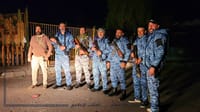
Iran's parliament speaker, Mohammad Bagher Ghalibaf, has warned the United States of a new war while unveiling what he called a new "missile city," which he claimed was built during the war and "under enemy fire."
Ghalibaf paired a conditional offer of a deal with a direct military threat. "If the Americans accept our logical conditions, the path to an agreement is open," he said, before adding: "If this time the Americans make a mistake, the boundaries of the battlefield will be determined by the capability and will of Iran's armed forces, and not by the will and aspirations of the Americans, and the smoke of a new war will get into the eyes of many."
"This important achievement goes beyond a merely technical and security achievement, and it symbolizes the change in the strategic equations in the region," Ghalibaf said.
His threats follow strikes carried out in recent days by Iran's Islamic Revolutionary Guard Corps (IRGC) on American infrastructure in the Persian Gulf. They also follow a call by Supreme Leader Ali Khamenei "not to remain in a state of no war and no peace."
According to a report in The Wall Street Journal, US intelligence assesses that Iran's ability to strike American and allied targets remains significant, despite the heavy blows it absorbed in the last two rounds of fighting. Iran is estimated to still hold about 2,500 usable missiles, even after US and Israeli strikes hit its production facilities.
WSJ also reported that Iran is continuing to rebuild its missile program, relying on components it stockpiled in advance, though at a slower pace because of the damage to its infrastructure. The paper noted that American strikes on Qeshm Island have become especially frequent in recent weeks, even though they are carried out with almost no official announcement.
The island hosts a major IRGC naval base and tunnels used to prepare weapons. Iran launches missiles from Qeshm and operates air defense radar systems and interception sites there.
In a significant development, the IRGC announced it had attacked a radar belonging to a US military air defense system with six drones. The radar is stationed at an American helicopter base in Bahrain.