The announcement carries particular weight given that Vance had been preparing to meet with senior Iranian officials as part of efforts to advance understandings between Washington and Tehran. Trump's words point to a possible gap between the president and his deputy on whether to continue diplomatic contacts, and raise questions about the status of those efforts.
Behind the statement stands a diplomatic initiative that Vance himself had been driving. According to reports in the Wall Street Journal and the New York Times, the vice president worked to restart negotiations with Tehran and last month sent a letter to Mohsen Rezaee, a senior figure in Iran's security establishment, proposing a direct meeting between representatives of the two countries. Vance had even considered leading the meeting himself, with Doha, Qatar, emerging as one of the possible locations.
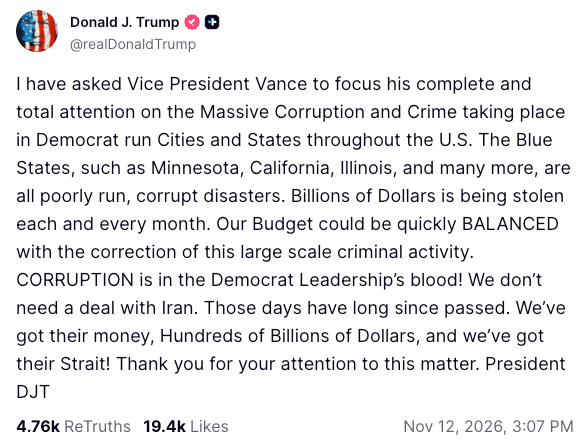
But Trump is now sending the opposite message entirely. "We don't need a deal with Iran. Those days are long gone," the president wrote. He added that the United States already holds, in his words, Iran's money — hundreds of billions of dollars — and controls the Strait of Hormuz. In doing so, Trump is signaling that from his perspective, American leverage gives Washington an advantage that does not require concessions or a new agreement.
The president also redirected Vance's attention to the domestic arena. He demanded that the vice president focus on what he described as massive corruption and crime in states and cities controlled by Democrats, including Minnesota, California, and Illinois. Trump claimed that billions of dollars are stolen every month and that addressing the phenomenon could quickly balance the American budget.
The timing is not accidental. Vance, who until recently was considered one of the central figures in efforts to end the confrontation with Iran, criticized the conduct of the war this week following the Republican defeat in the midterm elections. He questioned the price the United States paid for the campaign and even described previous advice to end the war as correct advice.
Within the American administration, then, the gap is sharpening between the diplomatic approach Vance promoted and the hard line presented by Trump and other senior officials in the administration. Secretary of State Marco Rubio also expressed support for continuing the siege on Iran, while Vance tried to advance a direct channel with the Iranian leadership.
Trump's announcement today places a heavy question mark on the continuation of the vice president's involvement in diplomatic efforts, and makes it clear that the president does not wish to present a deal with Iran as an American goal at this time.