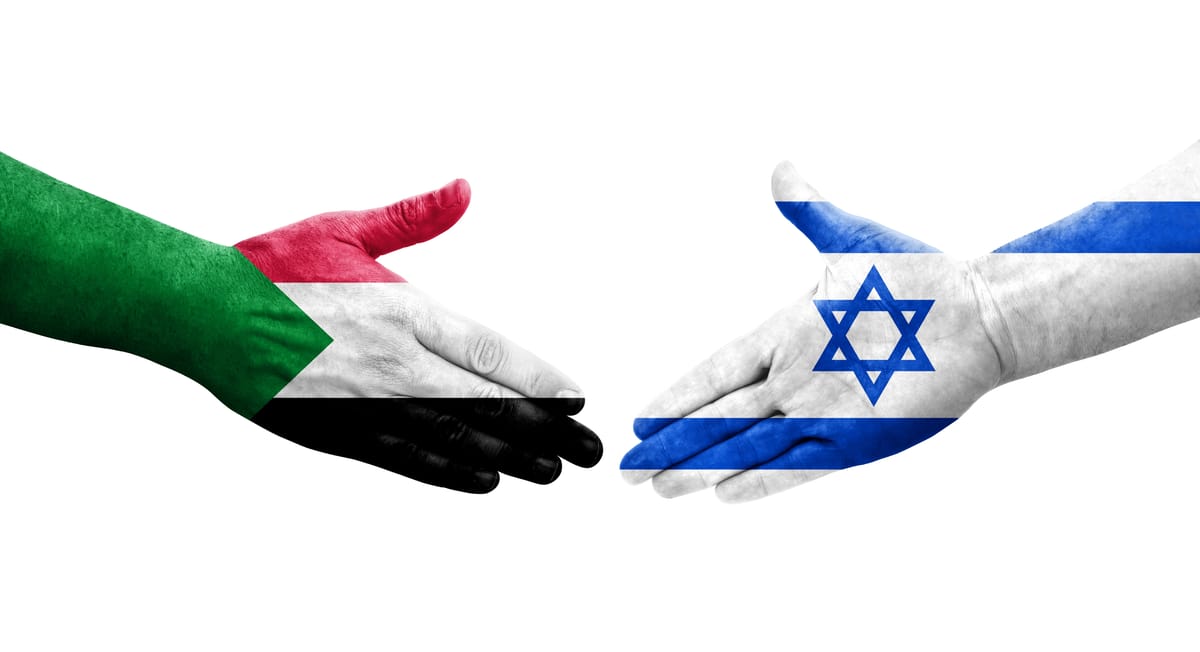
Of all the Abraham Accords signatories, Sudan was always the most improbable, the most contested, and the most fragile. Five years after the deal was announced to considerable fanfare, it has never been formally completed. And now, with Khartoum's military ruler deepening ties with Tehran while his army fights for survival, the question is no longer whether the Sudan-Israel normalization process is in crisis. It is whether it has already quietly died.
The origins of the problem are not hard to trace. Sudan's military had contacted Israel in defiance of the country's civilian transitional counterparts, who did not support normalization. Netanyahu's focus on gaining allies through the Abraham Accords seemingly blinded him to the instability of Sudan's internal politics. The deal was cut between generals, not governments, and it carried the fragility of that foundation from the start.
The official signing of a full normalization agreement was supposed to take place in Washington in November 2021. A military coup led by Burhan on October 25 of that year derailed that step entirely. The outbreak of war in April 2023, between Burhan's Sudanese Armed Forces and the paramilitary Rapid Support Forces led by General Mohamed Hamdan Dagalo, known as Hemedti, extinguished what remained of the hope for a civilian-led democratic transition that could have given the deal genuine legitimacy.
What followed was a slow unraveling that Washington and Jerusalem both preferred not to discuss too loudly. Burhan renewed diplomatic ties with Iran in July 2024, after they had been severed since 2016. Since then, his army has received Iranian military assistance, including drones, as it battles the RSF across a country the United Nations has described as the site of the world's worst humanitarian catastrophe.
The explanation offered by those close to Burhan is damning for Jerusalem. A source close to the Sudanese ruler told the Kan broadcaster that Sudan turned to Iran only after Israel failed to provide the military support Burhan had expected, saying that Sudan "was left without assistance and turned to Iran, which seized the opportunity after Sudan's friends abandoned it." The source added: "For the sake of Sudan's interests, we would even make a deal with the devil."
In other words, Israel had a window. It chose not to act. Iran did.
The contradiction at the heart of Burhan's position could not be starker. While presenting himself to Western audiences as a partner ready to open to Israel, he has simultaneously built a network extending toward Iran and empowered radical Islamist currents within Sudanese state institutions. Iran has supplied his army with Mohajer-6 drones, and intelligence assessments confirm the expansion of Iranian arms smuggling networks into Sudan despite international restrictions.
The U.S.-Iran war that began in February has made an already tangled situation more so. Sudan restored diplomatic ties with Iran and exchanged ambassadors in July 2024, ending eight years of rupture. Sudan's cooperation with Iran, and SAF's dependence on Iranian-supplied weaponry, now sits uneasily against the backdrop of a direct U.S.-Israeli military campaign against Tehran. Burhan has been walking a tightrope, warning Islamist factions publicly not to express solidarity with Iran while quietly depending on Iranian arms to hold his battlefield position.
Washington designated the Sudanese Muslim Brotherhood and the al-Baraa Bin Malik Brigade as Specially Designated Global Terrorists in March 2026, further tightening the noose around Burhan, who has depended on those very Islamist networks for manpower and political cover since the coup.
The normalization process itself has been reduced, in the words of one Washington-based analyst writing in the Jerusalem Post, to a political card rather than a genuine diplomatic project. Both Burhan and his rival Hemedti have waved normalization as proof of pragmatism and openness to Western partnerships, with each presenting himself as the reliable partner who will deliver the deal. The message from both sides of a catastrophic civil war is identical: "I am your man, I will deliver normalization." That neither man controls a legitimate government, and that between them they have produced one of the worst humanitarian disasters in the world, has not discouraged the pitch.
The man who actually signed the Abraham Accords on Sudan's behalf, former Justice Minister Nasredeen Abdulbari, now argues that the road to genuine normalization runs through Sudan's democratic forces, not the military rulers entrenched in Port Sudan. He contends that a short-sighted alliance with Sudan's military regime, which he describes as currently unconstitutional, illegitimate, and destabilizing, would not promote true security for Israel, Sudan, or the region.
The Red Sea dimension adds a layer of strategic urgency that neither Jerusalem nor Washington can afford to ignore. As the Strait of Hormuz crisis disrupted global shipping patterns, Port Sudan's role as a gateway for Gulf oil exports and South Sudanese oil transit has grown significantly, making the territory Burhan controls a node in a broader regional contest rather than simply a domestic asset. An Iranian-aligned Sudan with a Red Sea coastline is not a theoretical concern. It is a direction of travel.
For Israel, the lesson of Sudan may be the hardest kind: an opportunity squandered not through hostility but through inattention. The Abraham Accords were presented as a transformative realignment of the Middle East. In Sudan, that transformation was always conditional, always contested, and always one crisis away from collapse. That crisis has now arrived, in slow motion, with Iranian drones flying overhead.