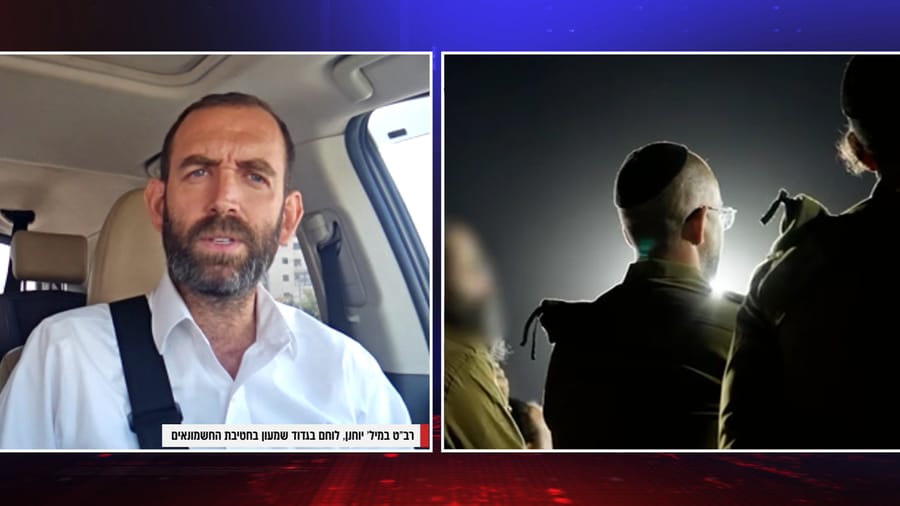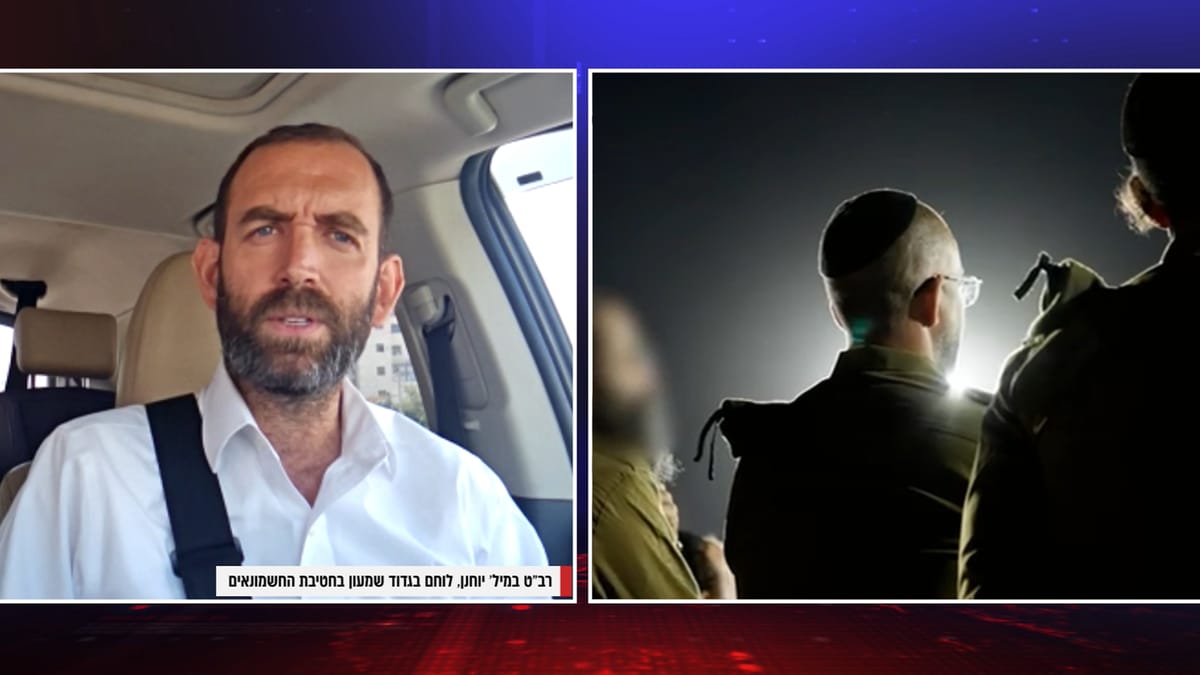
At 36 years old, Yochanan Chait recently completed a journey most men his age can scarcely imagine: he enlisted in the Israel Defense Forces, underwent full infantry combat training (Rovai 07) with the Hashmonaim Brigade, a unit designed to accommodate haredi religious observance, and is now preparing to deploy to northern Israel.
What makes his story particularly noteworthy is his refusal to present his path as a silver bullet for the IDF's chronic manpower shortage. Chait openly acknowledges that enlisting married men with children cannot serve as a broad solution to the military's need for thousands of additional soldiers and combat troops.
He describes the initiative as "a temporary measure," clarifying that from his perspective, it represents a targeted solution born from the specific needs of the Hashmonaim Brigade rather than a replicable model.
Six Months of Training, No Shortcuts
Chait enlisted after the Sukkot holiday and continued training until after Passover—a full six months of Rovai 07 infantry training, the same standard given to all infantry soldiers.
"It's half a year of complete training in every respect, without any compromises," he explains.
The challenge, he says, wasn't purely physical. While a 36-year-old body doesn't handle stress the way an 18-year-old's does, the primary difficulty was the price his family had to pay.
"I'm married with four children. It meant leaving them for nearly half a year. I came home on Shabbat, not always. The entire week I was in training."
He credits his wife with bearing the heaviest burden. "In terms of the family, the sacrifice was mainly my wife's, to her credit."
"This Isn't the Solution to the IDF's Shortage"
At a time when the IDF faces a significant manpower deficit and public discourse centers on haredi enlistment and expanding the pool of those serving, Chait refuses to present his personal story as a model that can be replicated across the community.
"I don't think this is a broad solution," he states. "This is something I believe they did specifically and narrowly for the Hashmonaim."
He adds that it's unclear whether similar tracks will continue in the future.
"I'm not sure they'll continue doing such training courses in Hashmonaim. I think this was a one-time thing."
So why did it happen? Chait explains that the Hashmonaim Brigade was established as a new unit and therefore needed to rapidly build a manpower infrastructure. He also estimates there was an attempt to create a foundation for the brigade's future reserve force.
"The Lack of Trust in the System Is Justified"
Alongside his own enlistment, Chait doesn't ignore the central problem accompanying discourse about haredi military service: lack of trust.
According to him, there's a growing willingness within haredi society to examine new pathways, but it's conditional on the IDF proving that the frameworks established are genuinely suitable for the haredi public and not merely presenting them as a numerical solution to the manpower crisis.
"There's tremendous distrust of the system, and justifiably so," he says. "The burden of proof is on the IDF."
This statement carries particular weight precisely because it comes from someone who has already completed the track himself. Chait isn't speaking about military service from a distance, but from within six months of intensive training and close familiarity with the system.
"Everyone understands the need, they just want to see the results," he adds.
What's the Cost of Enlisting at 36?
Chait admits that even after completing the training, it's difficult for him to give a simple answer to how someone his age manages a track originally designed for 18-year-olds.
"I myself am not sure how we survived it," he says.
But the question isn't only physical. For a married father of four, extended military service means leaving family routine, loss of income, and a complete upheaval of daily life.
In his case, he says, the family was a partner in the decision. "We explained to the children in the simplest way that we're part of the Jewish people."
He reports that his immediate circle responded primarily with support, and claims he identifies a growing public of haredi men who understand that the security reality requires a fresh examination of the service question.
Still, he doesn't paint a rosy picture. The willingness exists, he says, but the big question is whether the system will succeed in building frameworks that justify that trust.
Not Just a Fighter: His Role Alongside the Soldiers
After completing combat training, Chait wasn't assigned to a regular combat role. In his reserve service, he serves as a company rabbi (ram plugati), a position in which he accompanies soldiers spiritually.
He's expected to be alongside the battalion's soldiers, studying with them, delivering lessons, and conversing with them during service.
"When you have guys sitting in a defensive position in some remote village, where there's no day and no night, guard shifts at all hours, to try specifically in that place to keep them connected, that's a very big and important mission."
He's later expected to join the reserve battalion's operational activity in the northern sector, though at the time of the interview he didn't yet have a final answer regarding the deployment location.
"We Must Solve This"
At the end of the conversation, Chait returns to a point that perhaps troubles him no less than military service itself: the rift within Israeli society, and within the haredi community itself.
"I hope we merit true peace, internal peace within our people, to heal all the rifts here," he says.
According to him, current discourse is heading in a problematic direction. "I hope we can change the terminology a bit, the language and the discourse, and that we'll reach some understandings."
He doesn't present his enlistment as an answer to the larger debate about haredi service, nor does he claim such a track is suitable for everyone. On the contrary. His story reveals a more complex picture: there are haredim willing to enlist, but alongside that willingness exists a clear demand that the defense establishment prove it knows how to absorb them, maintain the frameworks built for them, and build trust.
"We must solve this matter," Chait concludes. "That's where our success as a people lies."