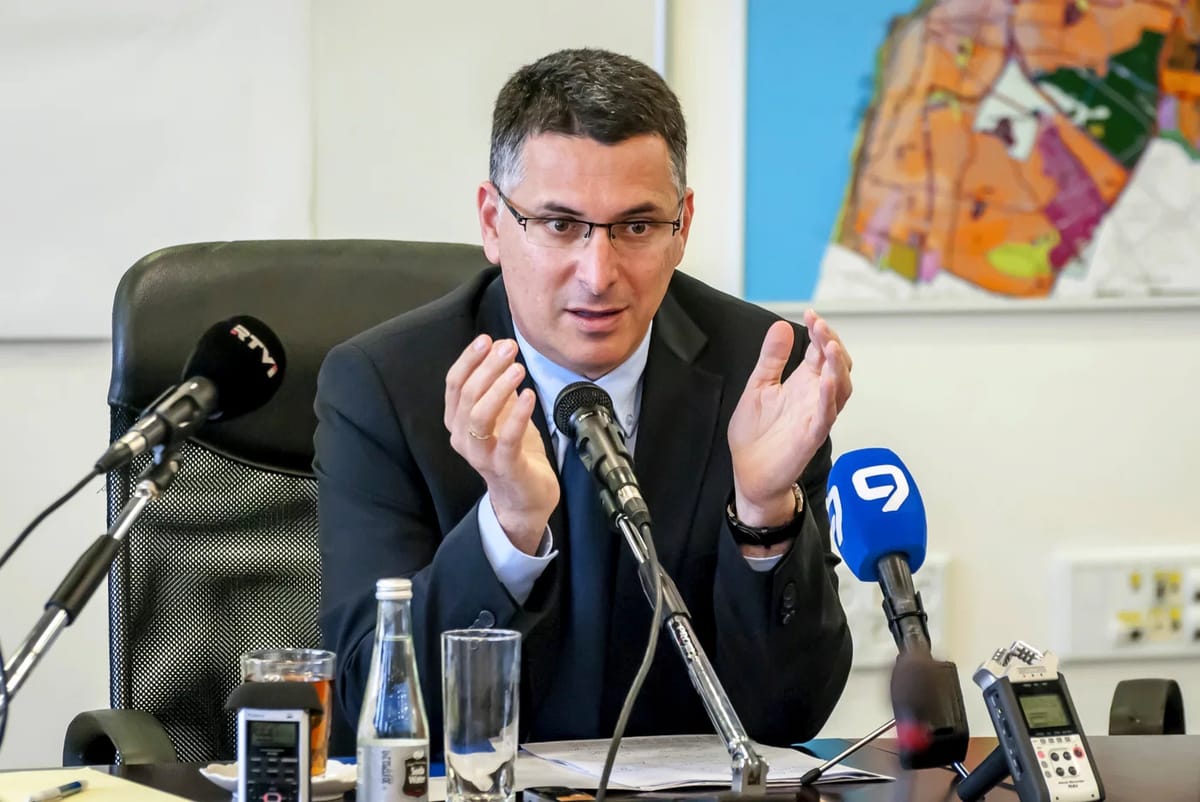
Israeli Foreign Minister Gideon Sa'ar announced a diplomatic boycott Thursday, declaring he will not engage with European Union Foreign Representative Kaja Kallas until she either retracts or explicitly confirms statements in which she allegedly called Israel an "apartheid regime."
Kallas responded with a carefully calibrated diplomatic message emphasizing dialogue and cooperation, but pointedly avoided addressing the specific apartheid accusation, a strategic silence that Saar immediately seized upon as an implicit admission.
"If you indeed said these vile and contemptible things, stand behind them," Saar wrote in a sharp follow-up. "If you didn't say them, deny it. As long as this cloud is not removed, my decision will stand."
The Diplomatic Standoff
The confrontation reflects a broader hardening of Israeli positions toward European criticism, particularly from Brussels, which has increasingly framed Israeli settlement policy as an obstacle to Palestinian peace and a violation of international law.
Kallas, seeking to defuse the tension, opened her response with warmth. "Dear Gideon," she wrote, emphasizing the EU's commitment to dialogue and constructive relations with Israel. She reiterated the EU's position on a two-state solution and condemned illegal Israeli settlements in the West Bank as obstacles to peace.
The response was calibrated to soothe without capitulating. It reaffirmed EU friendship while restating EU policy positions that Israel views as hostile. Notably, it made no attempt to address Saar's core demand: either confirming or denying that she called Israel an apartheid state.
Saar read that silence as a confession.
The Ultimatum
In his reply, Saar was blunt. He noted that Kallas had managed to avoid both denying the statement and condemning it, "which speaks for itself." He challenged her to either stand behind the words she allegedly spoke or explicitly deny having spoken them.
"The matter is simple," he wrote. "As long as this cloud is not removed, my decision will stand."
The decision in question is straightforward: Israel's foreign minister will not meet with or speak to the EU's chief diplomat until the apartheid allegation is resolved to his satisfaction.
The Broader Context
The confrontation sits within a larger pattern of Israeli-EU tensions. The EU has consistently criticized Israeli settlements, supported Palestinian rights, and raised concerns about Israeli military operations. For Israel, these positions represent a form of delegitimization, a framing of Israeli actions as inherently illegitimate rather than as rational security responses.
The specific accusation of apartheid is particularly inflammatory. It invokes the system of racial segregation that defined South Africa for decades and carries implications of systematic discrimination and oppression. For Kallas to be accused of making such a comparison, even if disputed, became politically damaging enough to trigger an official diplomatic freeze.
Kallas's Defensive Response
Kallas's response was notably defensive in structure. Rather than directly address the apartheid allegation, she emphasized the positive relationship between the EU and Israel, the EU's commitment to dialogue, and the EU's official position that a two-state solution is the path forward.
She did not, however, deny making the apartheid statement. She did not condemn it as a mischaracterization. She simply did not address it at all, a calculated omission that Saar treated as confirmation.
The Impasse
The confrontation now sits in a diplomatic void. Saar has made clear that dialogue cannot resume until Kallas either owns the statement or repudiates it. Kallas has declined to do either, instead reframing the conversation around broader EU-Israel relations and shared commitment to peace.
For now, the Israeli foreign minister's decision stands: no dialogue, no meetings, no engagement. The EU's chief diplomat has chosen a path of diplomatic accommodation that Israeli leadership interprets as evasion and implicit guilt.
Whether that impasse can be bridged depends on whether Kallas or her team chooses to break the silence with either clarity or denial. So far, neither has arrived.