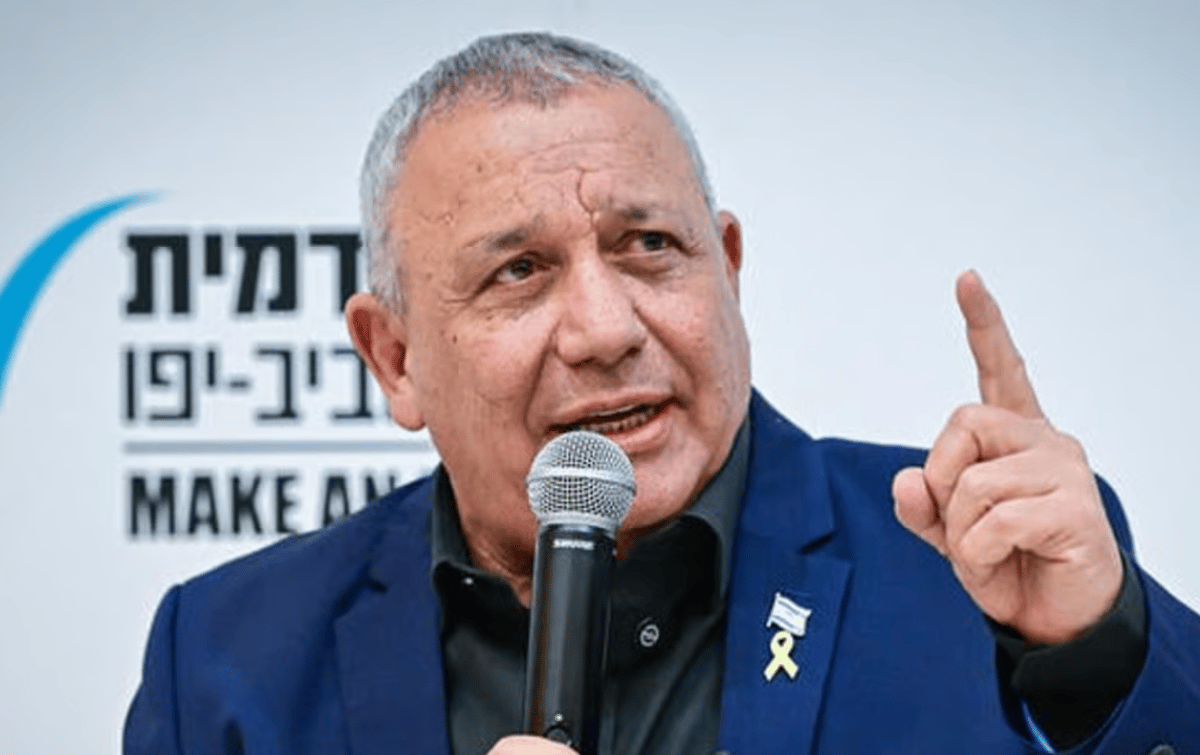
For years, Eisenkot was effectively Benny Gantz’s number two. Yet after separating himself politically from his former patron, he began to acquire a public identity of his own, and with it, an unexpected degree of popularity.
Until recently, as Israel moved closer to another election, Eisenkot was still treated as a marginal candidate. It was far from certain that a party under his leadership could win more than ten seats. But Israeli politics has always been especially receptive to “atmosphere parties”: movements built less on durable institutions or coherent programs than on a temporary public mood. Political figures who appear to come from nowhere can suddenly rise to the center of national attention.
Eisenkot now appears to be undergoing precisely such a transformation.
He is increasingly presented not merely as another candidate, but as the central figure around whom the anti-Netanyahu political camp may have to reorganize itself. Polls have placed him ahead of Benjamin Netanyahu in certain electoral scenarios. Naftali Bennett and Yair Lapid, each of whom imagined himself as the natural leader of the post-Netanyahu era, now appear to be competing for a place within a political framework dominated by Eisenkot. Bennett, in particular, may find that Eisenkot’s rise has deprived him of the political space required for a serious comeback.
The prediction markets may soon reflect the same conclusion: that Eisenkot is no longer simply a potential coalition partner, but a plausible candidate to lead Israel.
Yet the source of his appeal remains difficult to define.
Eisenkot represents something unusual, and perhaps troubling. The death of his son during the war undeniably gave him enormous moral and emotional standing within Israeli society. His personal loss became inseparable from his public identity. It granted him an authority that was not produced by ideology, political achievement, or electoral struggle, but by sacrifice.
His decision to bring relatives of other war victims into his political movement raises similar questions. Their presence carries genuine moral weight. Yet it also forces us to ask what political representation now means. Do bereaved families possess a distinct political authority because of what they have endured? Does suffering itself constitute a mandate? And can personal sacrifice substitute for a political program?
These questions extend far beyond Eisenkot himself. Israeli politics has gradually moved away from ideology and toward representation. Parties increasingly seek legitimacy by embodying social groups, identities, grievances, traumas, and symbolic experiences rather than by advancing a clearly defined vision of the state.
This transition did not begin today. It can be traced, at least in part, to the political revolution of the 1970s and Menachem Begin’s rise to power. Begin’s victory gave political representation to communities that had felt excluded by the old Labor establishment. That transformation was democratic, necessary, and historically significant—but it also marked the beginning of a political language in which the question of who is represented could become more important than the question of what ideas are being advanced.
Representation gradually began to replace ideology.
Perhaps that is not entirely irrational. Israelis may simply be tired of grand ideological systems. Most Jewish Israelis are already Zionists. Most are broadly national in outlook. Most retain some form of Jewish collective identity. They may no longer feel the need for parties to explain these basic commitments to them.
What they seek instead are values, symbols, and recognizable human figures: responsibility, sacrifice, restraint, patriotism, competence, and personal decency. Eisenkot appears to embody many of these qualities. His quietness distinguishes him from Israel’s theatrical political culture. His grief connects him to the national trauma. His military background offers the image of experience, while his reserved manner suggests that he is not desperate for power.
But symbols are not a substitute for political substance.
What is Eisenkot’s economic worldview? What is his vision for the Israeli-Palestinian conflict? How does he understand the relationship between the judiciary and the elected government? What is his position on religion and state, the future of the territories, the structure of the military, or Israel’s relationship with the United States?
At present, there is no convincing answer to the question of what Eisenkotism might actually mean. Perhaps the only person capable of answering it is Eisenkot himself.
Still, his lack of ideological grandiosity may be part of the attraction. Israelis are not necessarily searching for another messiah. After years of political promises, personality cults, permanent emergencies, and leaders who describe every election as a final battle for the country’s soul, they may be searching for someone who refuses to present himself as a savior.
That, in fact, is precisely what Eisenkot tells them: Israel does not need a messiah.
The question is whether it needs something more than a representative.