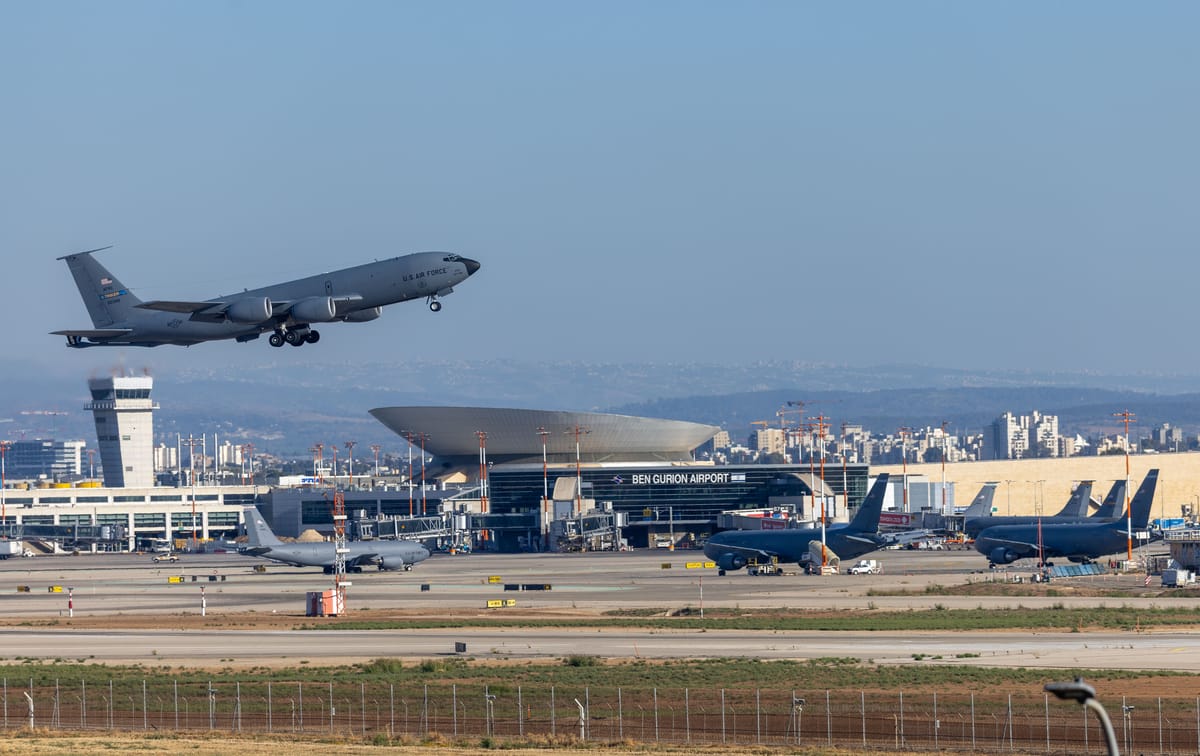
A partial U.S. military drawdown at Israel's main international airport is underway, with Washington preparing to relocate roughly 20 percent of its aerial refueling fleet from Ben Gurion Airport following the emerging U.S.-Iran deal, as Israeli aviation authorities warn that the massive American military footprint is pushing the country toward a summer travel crisis of historic proportions.
In the coming days, the U.S. is expected to relocate about 20 percent of its 72 aircraft stationed at Ben Gurion Airport, according to Hebrew media reports, following the emerging deal between Washington and Tehran to end their war. The majority of the aircraft being moved are expected to be transferred to Israeli Air Force bases, while others will be relocated to European bases. The remaining 80 percent of the U.S. military fleet will stay on standby to maintain rapid deployment capabilities.
The partial pullout comes after weeks of mounting pressure from Israeli aviation authorities and government ministers who warned the American military presence had pushed the country's main gateway to its operational limits.
Transportation Minister Miri Regev sent an urgent letter to Prime Minister Benjamin Netanyahu warning that unless many of the U.S. aircraft are relocated immediately, some 2.4 million plane tickets scheduled for the peak summer months and holiday season could be canceled, causing what she called a "direct economic loss of billions of shekels to airlines, the tourism industry, and the economy as a whole."
Regev cautioned that the situation would "severely damage Israel's credibility as an aviation destination and may put off airlines that have only recently returned to flying to Israel following the April ceasefire."
An Airport at Its Limits
The scale of the American military presence at Ben Gurion has been extraordinary by any measure. At peak deployment, 94 U.S. Air Force refueling aircraft were parked at Ben Gurion, representing nearly one-third of the United States' entire refueling aircraft fleet.
In May, the Israel Airports Authority reported that Ben Gurion was operating at one-third of its capacity due to the U.S. refueling aircraft. Director General Sharon Kedmi stated that 70 percent of activities at the airport were restricted due to the space and resources occupied by American military operations. "We are only utilizing one-third of the airport's operational capacity," he said. "We are at the limit of our capabilities." The authority said it had suffered losses of 700 million shekels, approximately $248 million, in two months alone, with the figure potentially escalating to billions if the situation continued.
Even following the partial relocation of U.S. aircraft, only 65 parking spaces out of the 99 designated for civilian passenger aircraft are currently available. The minimum required for July flight operations is at least 80. For August, a complete evacuation of all 99 civilian parking spaces will be needed to meet expected passenger traffic.
The congestion has also delayed foreign airlines' return and pushed up airfares. Air France has continued to cancel flights through June, British Airways has canceled services through October, and Delta has pushed back its return to September.
The Broader Picture
Ahead of the U.S.-Israel war with Iran, which broke out on February 28, local airlines moved their fleets out of the country to prevent them from being targeted. American refueling tankers then arrived as part of the U.S. military buildup. Since the ceasefire in early April and the reopening of Ben Gurion to civilian traffic, Israeli carriers El Al, Arkia, and Israir have been unable to return their full fleets because of the parking congestion caused by the U.S. tankers.
A full U.S. withdrawal from Ben Gurion remains contingent on a complete truce with Iran. Under the plan, all remaining U.S. aircraft would depart within 72 hours of a ceasefire agreement being signed, repositioned to nearby standby bases and ready to return should hostilities resume. With the formal U.S.-Iran agreement expected to be signed in Switzerland on July 19, Israeli aviation officials are watching the diplomatic calendar as closely as the departure schedule.