Get our mobile app
Download on the App StoreGet it on Google Play

Flydubai attack

How passengers survived 14,000-foot dive

Flight-tracking data reveals the Boeing 737 MAX dropped 4.3 kilometres in under half a minute during the cockpit struggle, yet basic physics kept passengers in their seats. 

The rescue FlyDubai aircraft after landing in Israel

Flight-tracking data released this week lays bare the scale of danger aboard Flydubai flight FZ1073 from Dubai to Tel Aviv. During the violent struggle in the cockpit, the Boeing 737 MAX 8 entered a steep, extreme dive: it dropped from approximately 30,875 feet to 16,750 feet in just 29 seconds, a loss of more than 4.3 kilometres of altitude in under half a minute.

The average rate of descent stood at around 29,000 feet per minute, peaking at approximately 32,600 feet per minute, alongside a high ground speed that reached 598 knots (roughly 1,107 km/h). Photographs taken immediately after the emergency landing in Tabuk, Saudi Arabia, also revealed severe damage to the aircraft's rudder structure.


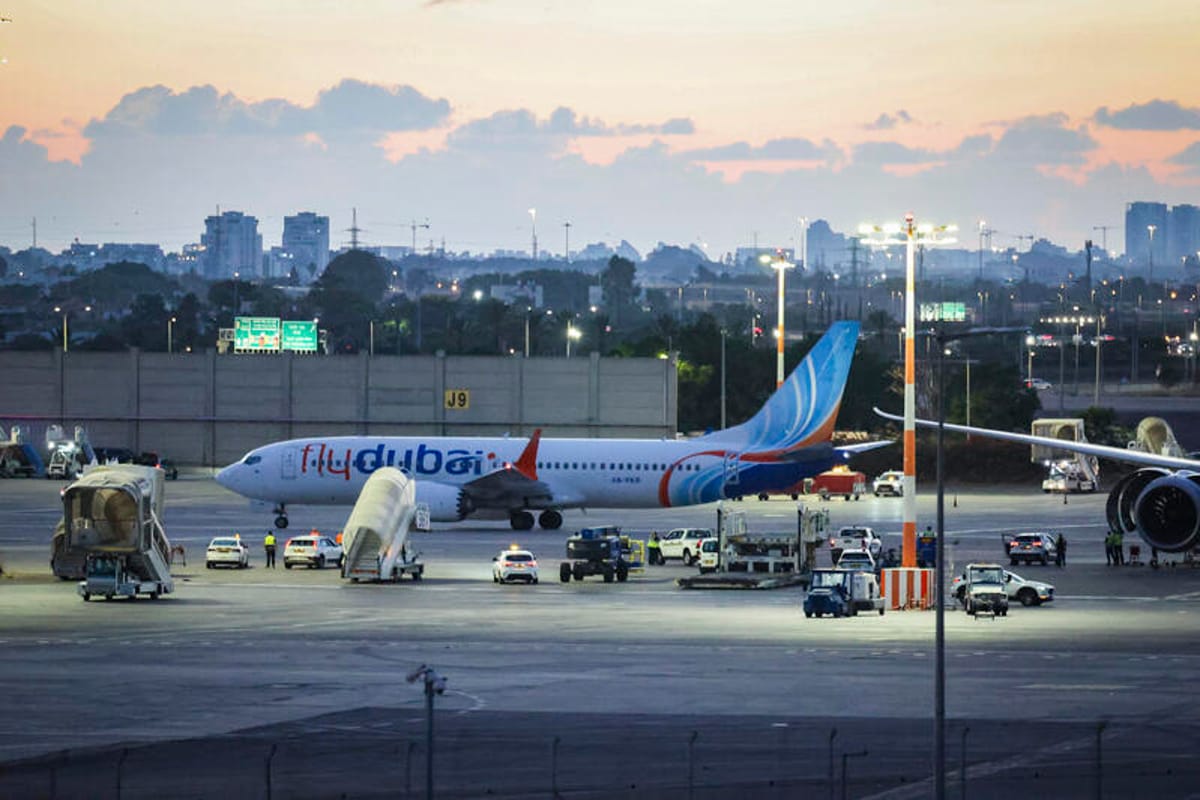
Landing scenes at Ben Gurion Airport
Landing scenes at Ben Gurion Airport (Photo: Avshalom Sassoni/Flash90)

Why passengers were not thrown to the ceiling

How is it possible that people inside the cabin were not hurled violently toward the ceiling during such a steep plunge?

The answer lies in basic aviation physics. The aircraft did not "fall" like a stone in free fall relative to the passengers, because it was already travelling forward at tremendous speed. The steep descent occurred when the entire flight path tilted downward at a sharp angle of around 30 degrees. Since the passengers, the seats and the aircraft itself were all moving together as a single unit in the same forward motion, there was no free fall relative to the interior of the cabin.

The more alarming and dangerous phase for passengers occurred precisely when exiting the dive, when the crew and the brave passengers who overpowered the attacker succeeded in levelling the aircraft again. The abrupt transition from a steep descent path to balanced flight generates "positive G forces", which build up pressure and press passengers into their seats with a force mimicking several times their normal body weight. This is why tightly fastened seat belts save lives in extreme situations of this kind.

From the struggle aboard the aircraft
From the struggle aboard the aircraft (Photo: social media)

The severe damage observed on the aircraft's tail raises questions about control capability. Aviation experts clarify that while the rudder is essential for coordinating turns and crosswinds, it is not the only means of operating the aircraft. Pilots can use ailerons and spoilers to roll the plane, and even employ differential thrust between the engines to steer the flight path, a highly complex and dangerous task, which ultimately ended in a safe, life-saving landing in Tabuk.

Prime Minister Benjamin Netanyahu spoke with Captain Sedat Yachar, the Indian pilot who subdued the attacker, and formally invited him to light a torch on Independence Day. "You are a hero for Israel, India and the entire world," Netanyahu told the pilot during the moving conversation.

Meanwhile, an Israeli investigative team arrived in the United Arab Emirates to question the Omani pilot, after he was transferred there from Saudi Arabia. According to information that has emerged, Israel received the crew and passenger manifest for the flight in advance, but didn't carry out a no comprehensive intelligence check.

Ready for more?

Join our newsletter to receive updates on new articles and exclusive content.

We respect your privacy and will never share your information.

Enjoyed this article?

Yes
No
Follow Us:

Unmissable content


Loading comments...

Also of Interest