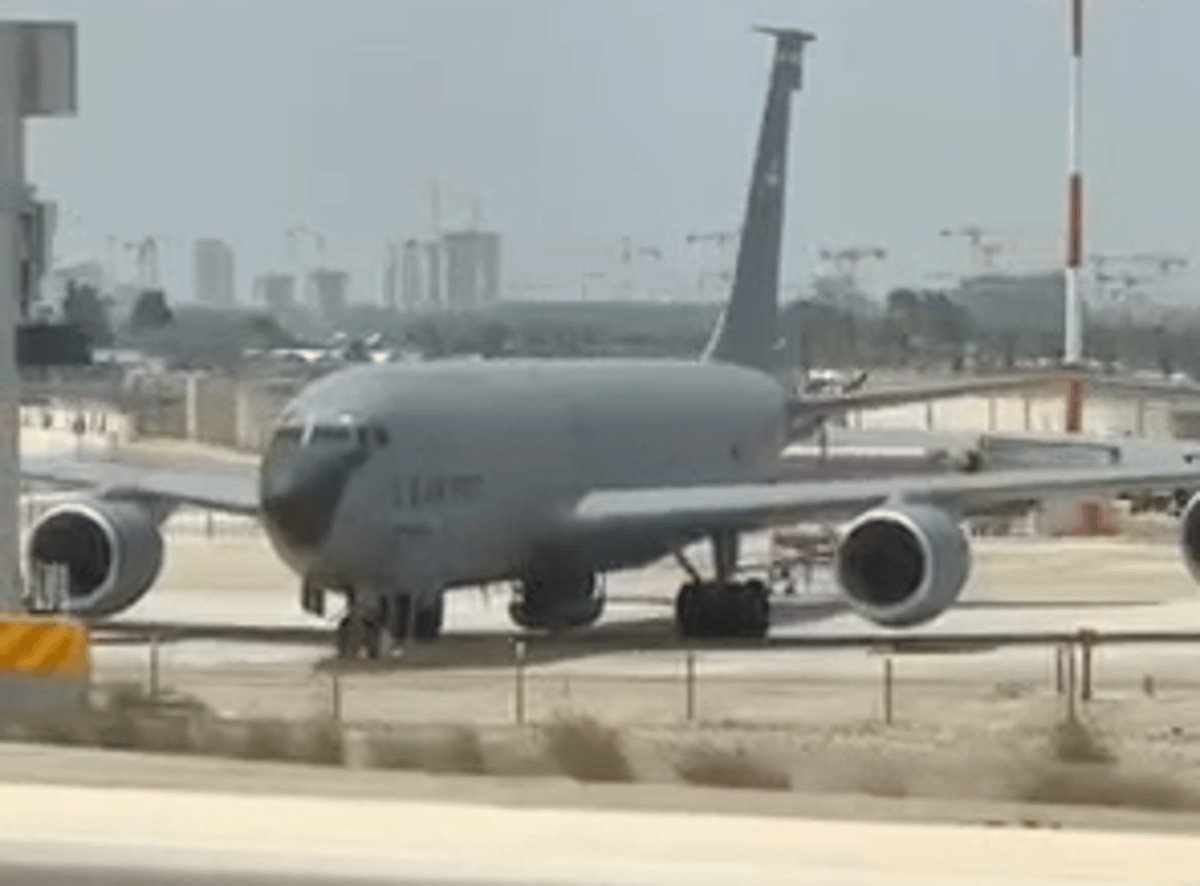
The US military has asked to remain at Ben Gurion Airport and even expand its footprint there in preparation for emergency scenarios involving Iran, according to a report by Walla. The request will now be brought before Israel's senior political leadership for a decision.
The report comes amid an ongoing tug of war between Israeli aviation authorities and the American military over space at the country's main international gateway. Dozens of US refueling tankers have been stationed at Ben Gurion for months as part of Washington's regional buildup, and Israeli officials have repeatedly warned that the military presence has choked civilian capacity during the peak summer travel season, with one airline executive testifying that his carrier's overnight parking allotment had been cut from seventeen aircraft to four.
Under an earlier arrangement, the US had committed to drawing down to twenty tankers at the airport, with Transportation Minister Miri Regev insisting that any additional aircraft be redirected to Israeli military bases instead. That drawdown had briefly eased pressure on commercial schedules. But the renewed exchange of strikes between the United States and Iran in recent days appears to have reversed the trend, with several tankers already returned to Ben Gurion and American officials now pushing not merely to halt the withdrawal but to grow the deployment further.
The timing lines up with an intensifying week of hostilities. US Central Command has carried out consecutive rounds of strikes against Iranian targets, including, for the first time in this round of the conflict, sites near Tehran, while Iran has retaliated with attacks on American positions in Kuwait, Bahrain, and Jordan. The Wall Street Journal has reported separately that President Trump is weighing a broader escalation that could include ground operations to seize Iranian islands near the Strait of Hormuz.
Israeli aviation officials have cautioned that a significant expansion of the American presence at Ben Gurion could force further reductions in takeoff and landing slots for commercial carriers, at a cost the Israel Airports Authority has previously estimated in the hundreds of millions of shekels.
It has also put up to 50,000 tickets in danger, and many Israelis might soon have to re-think their summer travel plans.
The Ministry of Transportation, for its part, had committed as part of the original relocation agreement to make the airport available to the US military again if operational needs required it, a clause that now appears to be coming into play.
No final decision has been made. The request is expected to be weighed by Israel's political echelon in the coming days against the backdrop of the wider military escalation with Iran