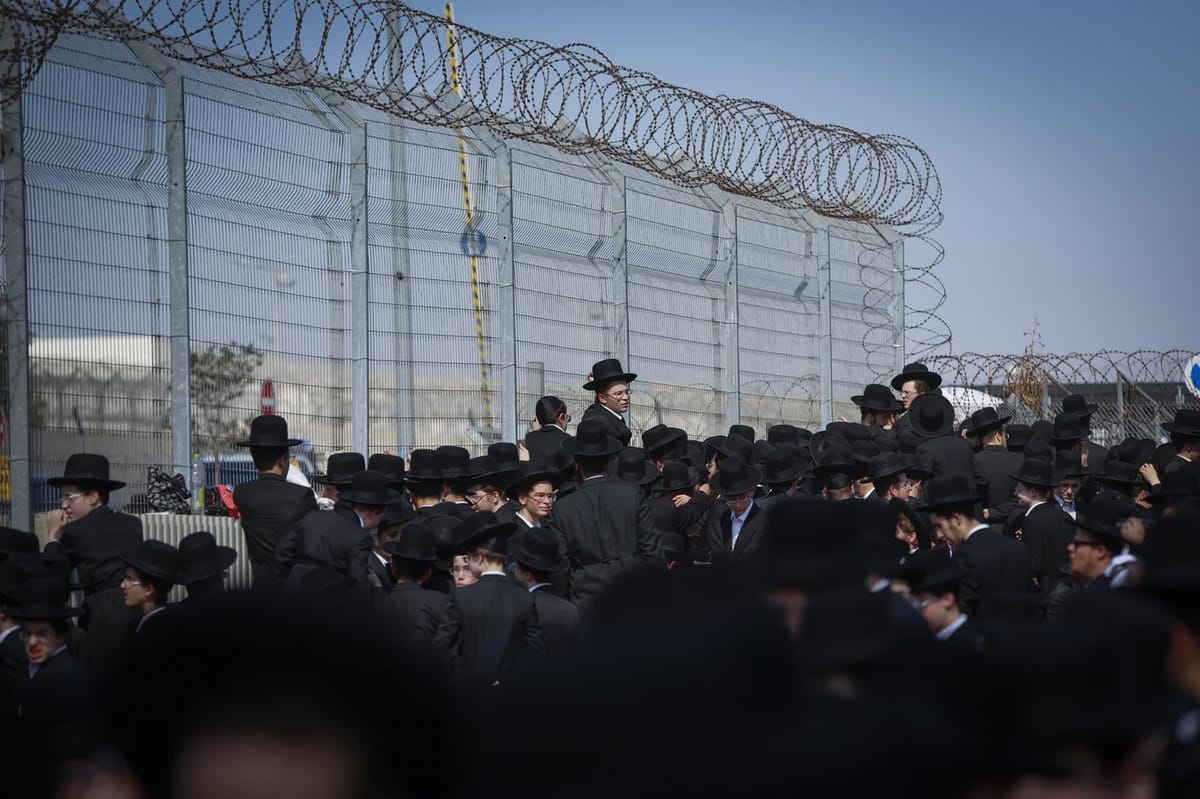
The Knesset's Foreign Affairs and Defense Committee has completed drafting the final version of a bill that would fully freeze arrest, investigation, and criminal enforcement proceedings against yeshiva students and kollel scholars, with the official text released Monday ahead of a voting marathon set to begin Tuesday.
The bill adds an entire new chapter to the existing Security Service Law governing the integration of yeshiva students, granting draft eligible yeshiva students immunity from arrest, investigation, or enforcement measures. The measure is structured as a temporary order that would take effect immediately and remain in force until the 20th of Kislev 5787, corresponding to November 30, 2026. Its stated purpose is to bring about a complete freeze in the wave of arrests and sanctions against the Haredi public, rooted in formal legislative recognition of the supreme importance of Torah study.
The bill establishes, for the first time, a comprehensive legal protection framework for yeshiva students and kollel scholars whose Torah study is their vocation, against the backdrop of the expiration of previous arrangements and rising public tension, allowing them to continue their studies without fear of criminal pursuit or police and military raids.
Under the finalized text, a yeshiva student eligible for protection from criminal proceedings is defined as someone studying regularly at a yeshiva or kollel who is not engaged in any occupation beyond his religious studies. The required study quota for receiving this status stands at a minimum of 45 weekly study hours at an institution defined as a yeshiva, and at least 40 weekly study hours at an institution defined as a kollel, with the Defense Minister determining what constitutes accepted and legitimate vacation periods that do not affect this status.
To activate the immunity, a student must submit a written declaration affirming that he meets the conditions, while the head of the yeshiva is separately required to submit his own affidavit confirming the accuracy of the declaration, along with a commitment to report to the army by the 14th of each calendar month if the student has left his studies. The law also toughens penalties for institutions that falsify data, stipulating that a yeshiva head who has been fined or sanctioned for false reporting concerning five or more students will lose the ability to sign declarations on behalf of his students altogether.
The new law establishes a dedicated mechanism and instructs the Chief of the General Staff to set up, within seven days, a special three member military committee responsible for reviewing requests to freeze criminal proceedings. The committee will be headed by a lieutenant colonel appointed by the Military Advocate General, alongside two majors appointed by the head of the Manpower Directorate. The committee will have broad authority to demand and receive information from any relevant government body in order to verify the accuracy of the reports it receives. From the day the law takes effect, any yeshiva student will be able to submit an online request to freeze proceedings against him, and while his case is being reviewed by the committee and until a final ruling, an absolute prohibition on his arrest will apply, even if an indictment has already been filed against him or a final conviction has been handed down for failing to report, with legal proceedings and enforcement of any judgment halted immediately. Students will have a window of only 30 days from the law's effective date to submit these requests to the army.
Alongside the broad protections, the law includes strict oversight provisions intended to prevent abuse of the new arrangement. The Defense Minister will compile an official list of recognized yeshivas, taking into account the recommendation of the Yeshiva Committee of the Land of Israel, to be published openly on the Manpower Directorate's website and at recruitment offices. Special inspectors and examiners will be authorized to enforce oversight on the ground, with the Defense Minister permitted to draw on the experienced inspection mechanism of the Ministry of Education. Inspectors will be required to conduct surprise inspections at every yeshiva on the list once every three months.
The most significant deterrent clause in the text states that if an inspector identifies repeated absenteeism of 20 percent or more among a yeshiva's registered students, the head of the yeshiva will receive a warning. Should the absenteeism continue, the entire institution will be removed from the list of recognized yeshivas, and its students will lose their immunity unless they promptly register at an alternative yeshiva that adheres to the rules. The Defense Ministry will also be required to report to the Knesset's Foreign Affairs and Defense Committee once every three months on the number of inspectors, the inspections carried out, and their results.
The final text now heads to the full Knesset for the voting marathon scheduled to begin Tuesday.