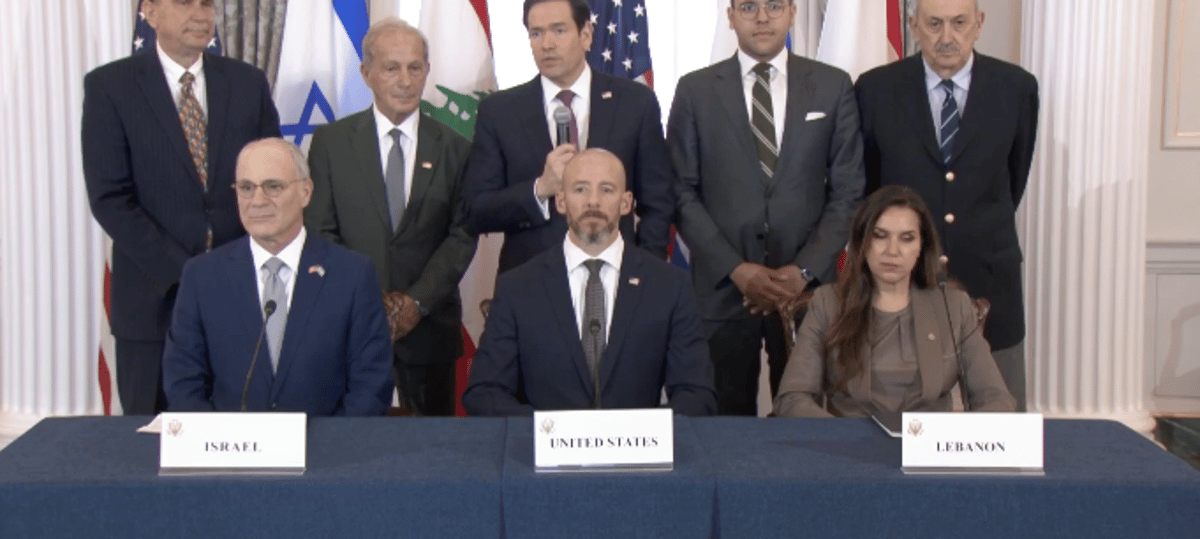
The U.S. State Department released the full text of the trilateral framework agreement signed Friday in Washington between Israel, Lebanon, and the United States. The document, signed in three original copies in English, lays out the architecture of what both sides describe as a path toward comprehensive peace. Here is what it contains.
The core commitment
Israel and Lebanon declare their intent to conclusively end the conflict between them and formally conclude any state of war. Both governments affirm the right of each state to exist in peace as sovereign neighbors, and commit to resolving all outstanding issues through direct bilateral negotiations facilitated by the United States.
Disarmament first, withdrawal second
The agreement establishes a phased, conditions-based process: the Lebanese Armed Forces (LAF) will gradually reassume effective sovereignty over all Lebanese territory, but only in parallel with the verified disarmament and dismantlement of all non-state armed groups — meaning Hezbollah. IDF redeployment out of Lebanon is explicitly conditioned on the completion of that disarmament. A security annex, to be drafted with full U.S. support, will detail the specific steps, security arrangements, and verification mechanisms.
The pilot zones
Two initial pilot zones have already been agreed upon between the IDF and the Lebanese Armed Forces. In those areas, once disarmament of non-state armed groups is verified as complete, the Lebanese army will assume full security responsibility, international reconstruction support will begin, and Lebanese civilians will be able to return safely. Additional pilot zones will be determined by mutual agreement.
Lebanon's explicit commitments
Lebanon commits to rebuilding the state's monopoly on the use of force, achieving complete and verified disarmament of all non-state armed groups, and ensuring those groups have no military or security role and no armed presence anywhere in Lebanese territory. Lebanon also explicitly rejects any claim by any country or non-state actor to use force on its behalf without its express authorization, a direct, if diplomatically worded, repudiation of Hezbollah's self-appointed role as Lebanon's defender.
Israel's position
Israel states that its military actions in Lebanon are solely a consequence of the attacks and hostile intent of non-state armed groups, particularly Hezbollah, and declares it has no territorial ambitions in Lebanon. Israel affirms that full disarmament of those groups would eliminate any future need for IDF military action or presence there.
Financing and reconstruction
Lebanon and the United States commit to blocking funds from reaching any entity affiliated with non-state armed groups, and Lebanon explicitly pledges that reconstruction money will not flow to Hezbollah or connected organizations. The U.S. commits to mobilizing international partners for Lebanese reconstruction, economic recovery, and humanitarian assistance — with all new American aid strictly conditioned on verifiable milestones and full transparency.
What comes next
Upon signing, both countries are to establish working groups to draft a full, comprehensive peace and security agreement, alongside parallel tracks of direct engagement facilitated by Washington. Both governments pledge to proceed in good faith until lasting peace is achieved.
The agreement also commits both sides to cease hostile actions in international political and legal forums, and to work toward the return of remains and release of detainees.