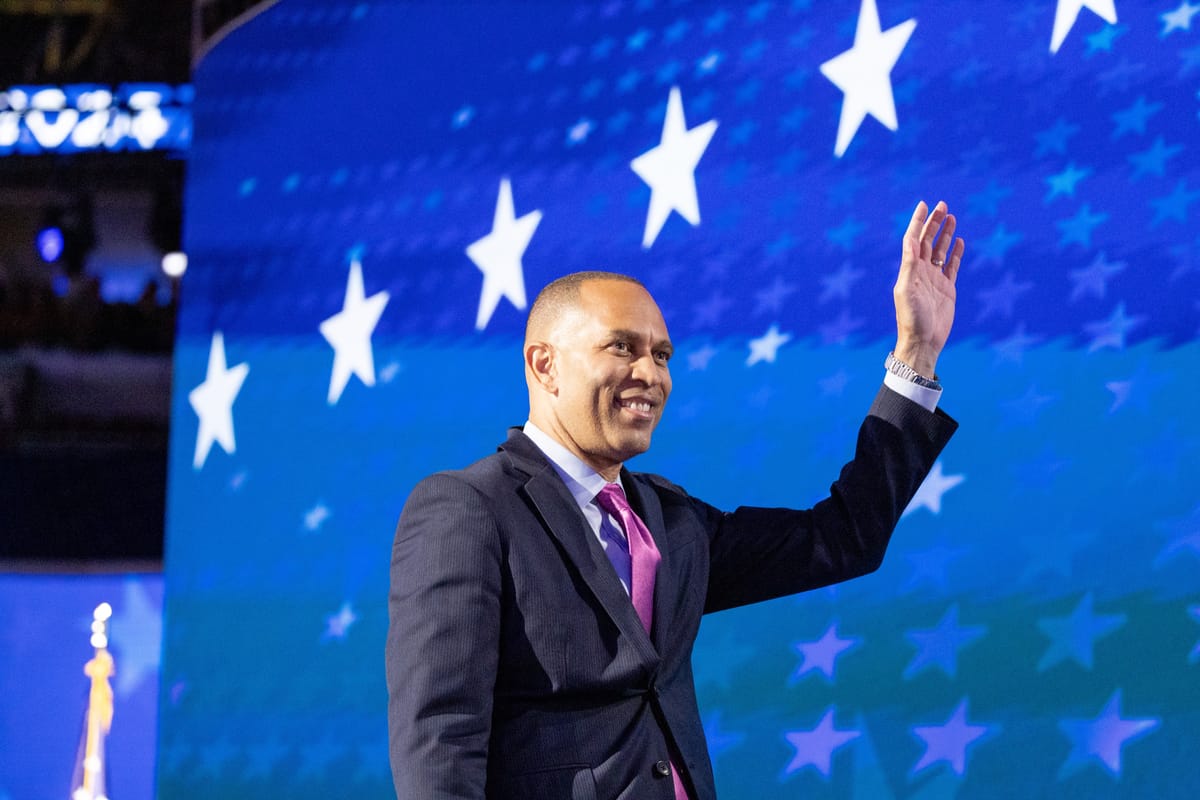
The political upheaval in Washington is poised to place Hakeem Jeffries in one of the most powerful positions in American government. The House Democratic leader is expected to be elected Speaker when the new Congress convenes in January 2027, becoming the first African American to hold the post in US history.
For Israel, he is a familiar figure: for years, Jeffries was considered one of the most prominent Israel supporters in the Democratic leadership. He opposed the BDS movement, backed the preservation of military aid, and repeatedly emphasised Israel's right to exist as a Jewish and democratic state.
Yet as the Gaza war has dragged on, his tone has shifted. He continues to support Israel's right to exist and defend itself, but has begun voicing sharper criticism of government policy. Last summer, he called for a "significant reset" in relations between the two countries.
Years of support for Israel
Jeffries, a congressman from New York, visited Israel before he was even elected to Congress in 2008. He later joined additional delegations, met with government and security officials, and deepened his ties with the American Jewish community.
In 2019, he backed a House resolution opposing the boycott movement against Israel, and in public speeches emphasised that Israel needs military strength to defend itself in a complex regional environment.
Even during the controversy over Israel's judicial reform in 2023, Jeffries refrained from joining calls to punish Israel. On a visit to the country leading a delegation of more than twenty Democratic congressmen, he met with Benjamin Netanyahu and made clear that Israel's internal political dispute should not harm security cooperation between the two countries.
After the Hamas attack on 7 October, he stood firmly with Israel. He recognised its right to defend itself and act against Hamas, which he defined as a terrorist organisation, and stressed that the American commitment to Israel's security is strong. At the same time, he called for the return of the hostages and for increased humanitarian aid to Gaza's residents.
Criticism of Netanyahu grows sharper
As the war lengthened, Jeffries's tone changed. He continued to support Israel's right to exist and defend itself, but began voicing harsher criticism of government policy. He backed a ceasefire, promoted the two-state solution, and pushed for increased humanitarian aid.
In October 2025, he even endorsed Zohran Mamdani, the candidate for New York City mayor, despite controversy over his statements on Israel. Jeffries demanded that Mamdani clarify his positions on antisemitism and phrases like "globalise the intifada", but ultimately decided to support him after he pledged to ensure the security of all the city's residents, including Jews.
Another turning point came in July 2026, when Jeffries opposed a proposal to cut some $3.3 billion from military aid to Israel. Though he refused to back the move, in a letter to his party colleagues he presented sharp criticism of the Netanyahu government's policy and called for a "significant reset" in relations between the two countries.
Jeffries accused Israel's right-wing government of isolating the country internationally and damaging its standing in the United States. He demanded a halt to settlement expansion in Judea and Samaria, sanctions on settlers involved in violence, and progress toward establishing a Palestinian state.
The future of military aid also came up in his letter. Jeffries noted that the current agreement, signed during the Obama administration, expires in 2028, and argued that Israel, as a country with an advanced economy, is capable of funding a larger share of its security needs. He called for examining a new model of security cooperation, while preserving Israel's qualitative military edge over Iran and other threats.
What does Israel face under his leadership?
The post of House Speaker grants its holder significant influence over the legislative agenda, votes on budget matters, and oversight of the American administration. If Jeffries is elected, his positions will carry practical weight in relations between Washington and Jerusalem.
He stands between two camps in his party: on one side, he opposes cutting military aid and severing ties with Israel; on the other, he demands significant change in the Netanyahu government's policy and American support for establishing a Palestinian state.
For Israel, then, this is a leader who has demonstrated commitment to its security over many years, but no longer offers unconditional backing to the Netanyahu government. The central question will be whether under his leadership the traditional bipartisan support for Israel is preserved, or whether his demand for a "reset" in relations becomes the practical policy of the House of Representatives.