
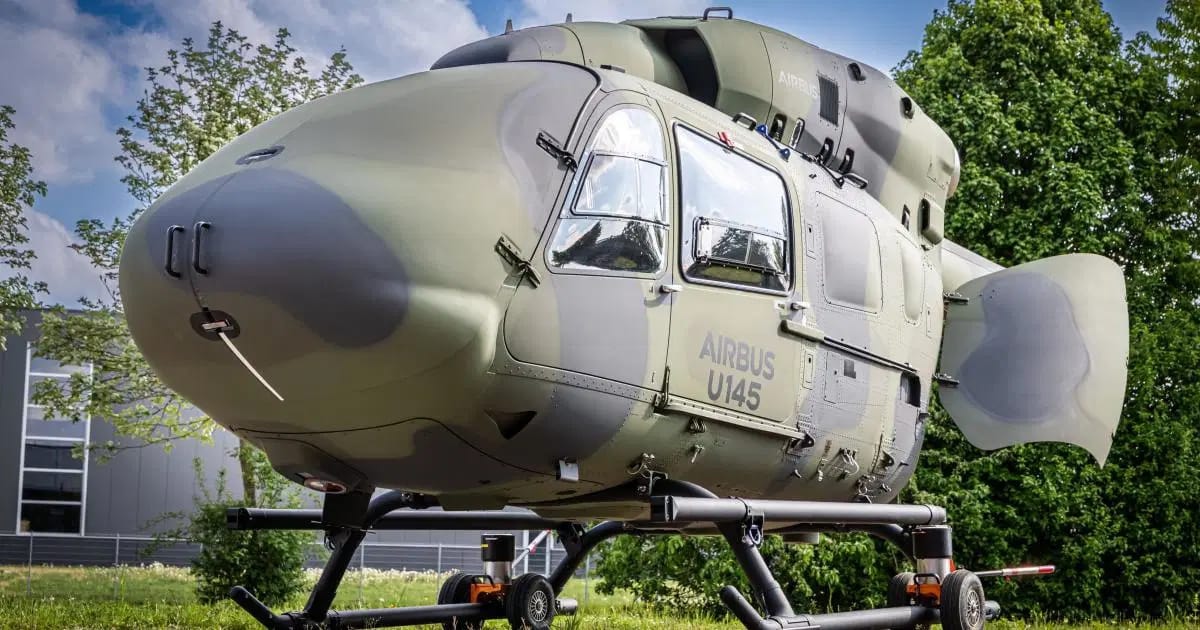
At the ILA Berlin Air Show 2026, Airbus Helicopters revealed one of the aviation industry's most intriguing recent developments: the U145, a fully autonomous and unmanned variant of its widely recognized H145 helicopter.
The unveiling highlights a growing global shift toward crewless flight systems built upon established, combat-proven aircraft platforms.
Maximizing Cargo Space by Eliminating the Cockpit
While the U145 retains the mechanical and aerodynamic foundation of the H145, a twin-engine helicopter in widespread service worldwide—it introduces a fundamental design overhaul by completely eliminating the traditional cockpit. In its place, Airbus has integrated an advanced sensor suite and artificial intelligence systems designed to enable full autonomy.
Removing the cockpit space creates significantly more room for cargo. The redesign features a front-opening "clamshell" door, a folding loading platform, and a specialized cargo floor, transforming the interior into a unified, open bay optimized for logistics.
With a maximum takeoff weight of approximately 3.8 tons, Airbus is positioning the aircraft as a heavy-duty logistical platform capable of transporting equipment to hazardous or hard-to-reach areas safely.
Versatile Mission Capabilities and Strategic Partnerships
Airbus notes that the operational potential for the U145 extends far beyond simple cargo transport. The unmanned helicopter is designed to support a wide range of civilian and defense operations, including:
- Natural disaster relief and humanitarian aidMedical evacuations (MEDEVAC)
- Aerial firefightingIntelligence, surveillance, and reconnaissance (ISR) missions
In military frameworks, the U145 is being developed to integrate into advanced combat networks. Airbus is currently partnering with European defense firm MBDA to explore "drone mothership" capabilities, which would allow the U145 to transport, deploy, and manage drone swarms or aerial weapon systems mid-flight.
A Growing Ecosystem of Autonomous Flight
The U145 project builds upon Airbus's prior experience with unmanned rotary systems, including the VSR700 program, which was based on the Cabri G2 light helicopter. In the United States, Airbus is also advancing the MQ-72C project—an autonomous variant of the Lakota helicopter—in collaboration with defense technology firms Shield AI and L3Harris.
According to Bruno Even, CEO of Airbus Helicopters, the company aims to foster a broad ecosystem of autonomous systems within Europe by collaborating with leading artificial intelligence and remote-control technology developers.
A first prototype is scheduled to take its maiden flight by late 2026 with a safety pilot on board, with full operational entry into service projected for the beginning of the next decade.Ultimately, this development mirrors trends seen in ground transportation, where autonomous systems are rapidly advancing.
In the aerial combat arena, the push to develop unmanned platforms is driven by a strategic imperative to minimize soldier casualties as much as possible Especially after the downing of the American helicopter over the Strait of Hormuz, and marking a broader transition of the international battlefield toward smart, network-centric warfare.