
In Christianity, the gospel begins with a fundamental premise of human insufficiency: you are not inherently good until you come to believe in a Jewish man named Jesus, later described in the New Testament as the 'Messiah' and 'Son of Man,' and eventually crowned by the Church as Lord. By default, you are viewed as estranged from goodness, because you have not embraced the gospel—an omission considered your fault. Though born spiritually flawed (with sin), you are believed to possess the capacity to listen. Only by surrendering that capacity, choosing to hear and submit to the gospel, can true goodness be attained.
There is no act that can override this theological architecture. And this is the essential 'flaw' in Christian logic which led to a need in the Reformation.
The Reformation didn’t reject the theological architecture outright, but it asked the key question: Who gave the Church the monopoly to judge how one should receive the gospel? And who says its methods of verification and ordination are even grounded in it to begin with?
Hence, how do we even know that the church can promise salvation from sin?
Given the lack of scripture-based-rules and relying on eating flesh and blood to achieve salvation - this was a legitimate challenge.
From that question, the Church split in two directions.
Martin Luther claimed that we are indeed limited beings, born in sin, and that Catholic theology was largely valid, we are saved from sin by grace, scripture, and faith - and cannot ever affirm, at least from a political/legal level, whether we are the one's chosen to lead the community away from evil.
At the very least, Luther knew, the Church should not claim a monopoly on distributing tickets to salvation.
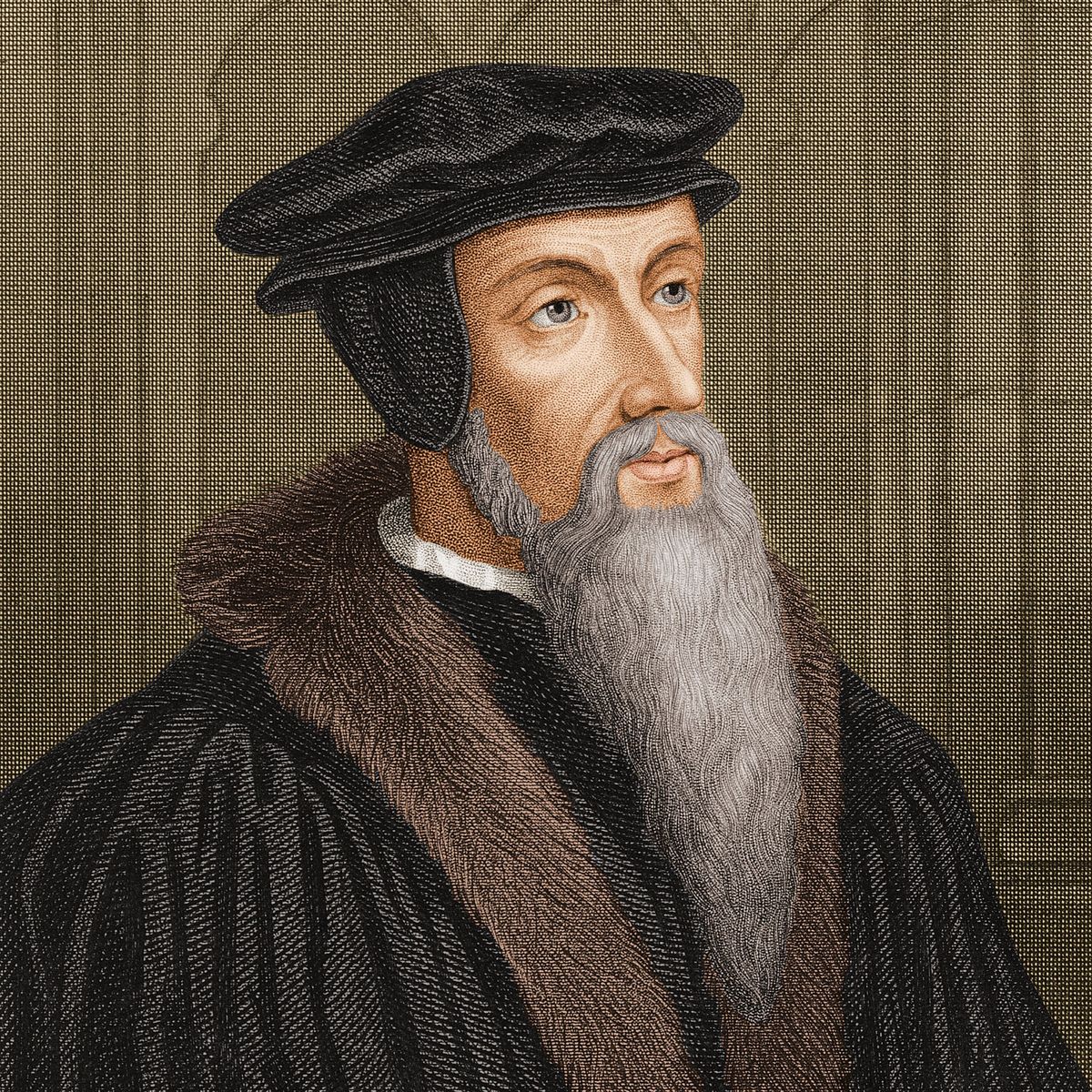
Calvinism had to go further, not only being saved by sin, but discovering who is chosen to lead the believers in this earthly realm, was needed.
This need was not strictly theological; it rose from a vacuum. Thus, Calvin tried to bring God into government without the church.
Thus, the need to create a category for being chosen post-church monopoly, was actually not as "secular" as some may argue but came to bring forth a more encompassing criteria of choice and religious action, which can have implications on the conduct of earthly matters in the realm of the community.
If salvation is for true believers, how can we verify who truly believes, and who deserves to lead us believers, and by what metric? Especially without a centralized (Catholic) structure of affirmation?
Here, the liberal property-based view was born, in contrast to the Catholic view which sought universal formal unity by basing salvation on sacraments. Calvinism, seeing the fruits of one's work as a testimony to his righteousness allowed for an open playing field, from which leadership would naturally emerge.
Today’s liberalism, paradoxically, is increasingly Catholic, and has been since the 19th century, due to its socialistic nature, it is less meritocratic and less property based.
And while Luther dismantled the Church’s monopoly on salvation from sin, Calvin went further, he questioned whether faith alone was sufficient to manage man in the world, he broadened the necessary context, through which the believer can ensure a life of salvation, in a post ecumenical world.
Since faith itself lacks objective verification, The New Testament’s legalistic structure is insufficient; and since Catholics used feelings of animosity, especially toward Jews, to discern good from evil, we must ""become Jews"" in ourselves, and create some practical metric through which we discern good from evil, measure the quality of leadership, and get a better understanding of what a righteous man worthy of communal leadership really is.
The Calvinist doesn’t need the Jews, he relies on internal parameters, especially the New Testament verse about judging by one’s fruits, to discern friend from foe within the theological-political order.
In the old system, those outside the Church were evil, and those inside, automatically good - and the church by affirming this, can keep itself as "the good" "in power". Calvinism created a division based on objective metrics, not about who is near or far from the church itself.
Thus, dehumanizing Jews became less necessary as a theological-political tool. Instead of using Jews as external proof of Christian truth, internal Christian conduct now defined worth.
True, the materialistic tendency of Calvinism, as a measure of justice, led to capitalism, but alternative methods could arise and lead to their own interpretations of scripture and justice as Calvin pioneered.
This is why historically Protestants were often less antisemitic than Catholics, and why Lutherans, lacking a robust political theology, continued to view Jews as a foreign essence that is judged to assist within creating a good and bad category for the Christian framework.
Calvinism challenged Christians to look inward without needing the Jews. It engaged in the same inner reflection that Jesus himself called the Jews to undertake.
The shift allowed Christians in Holland, England and the colonies, to move away from relying on Jews as symbolic affirmers. For Protestants, divine election could now be validated through meritocracy, rather than through external scapegoating.
In this sense, modern liberalism, when functioning as meritocratic, is Protestant.
Now, as the structure of Protestantism collapses, driven largely by demographic decline and moral decay, we witness a regression toward scapegoating the Jew, and criticizing the fruits of Protestantism is they are portrayed through the liberal and capitalist mindset.
But one can never take away the fact that Calvinism tried to bring God closer to the lives of Christians, without enslaving them to an unknown external power-structure.
It saw in the material as what affirms the spiritual, one cannot say that the Catholic Church offered anything better...
Today we see a problem, how are we preserving faith, community and heritage across generations.
Undeniably, the Catholic structure managed to function for a thousand years, though those were, for the most part, a rather miserable thousand years, except perhaps their end. The Protestant framework, in contrast, managed to thrive for about 450 years. There’s no doubt that the 450 Protestant years were far more successful than the thousand Catholic ones.
But even the Protestant era seems to be reaching its end. Now, many Neo-Catholics, along with Christian nationalists, accuse the Jews of engineering the secularization which is leading to this fall.
They are so hot and heavy about blaming the Jews, that they Join Islamists and Communists to do so.
They claim it’s all some form of a covert attempt by Jews to penetrate society at the expense of its Christian foundations, thereby undermining Christianity from within.
In fact, Protestant freedoms, for enabling that Jewish takeover.
The accusation is that Jews weaken society deliberately, simply in order to survive as a non-Christian sect, and that the Protestants are too gullible to realize this.
Yet if that were truly the case, how do we explain the success of Calvinist societies, which not only allowed Jews in, but invited them, and flourished for centuries?
How come these failures are only coming out now? How come Calvinist countries flourished for 400 years with jews? How come the following is happening now, exactly when America has more Catholics than Anglo-Protestants?
Clearly, for the Christian if he believes he cannot sustain his faith and community over time outside of the Catholic structure, and outside of its call to tag the "Jew" as some demon, as the Church did - there must be a problem...
Can he be committed to his own belief system without needing an external category like “the Jew” to define himself?
Can he know that he is truly saved, without having to have the Jew being damned?
Calvin showed it's possible.
One could say that if the New Testament allowed non-Jews to discover the one God, and subsequently to perceive representations of good and evil through the very Jews who bequeathed the belief in divine unity, then the Protestants were the first to demonstrate that Christians could derive absolute moral value without relying on the Jews as a representation.
It was actually the Protestants who released themselves from the Jewish demon, by not needing him as some "other", to define themselves, Like the church always needs.
The Anglo Protestants became their own type of Jews. In the sense of community builders in the image of the Lord, that can self-affirm.
It was such a significant move, that nothing other than Hitler, Stalin, and Napoleon could truly destabilize the Anglo Protestant hegemony.
That theological move may be the foundation of Western meritocratic liberalism. And it needs be done.
And could be that this is what many Catholics hate so much, about their Protestant brothers, that they realized, that to be chosen, means making a Jewish move of self-determination in fact, outside of the church.
In breaking with the binary of good and evil rooted in Catholic logic, Calvinism made space for seeking God, it showed there's no need to reduce and define oneself by demonizing Jews, and it did that, by being a form of social organization, which is close to the biblical one.
It's true, the Jews and the time of the Bible lived under God, and there is no reason why America should not live under God, there is no reason not to have such a covenant, and this should be discussed within the context of our constitution an our rights.
When Radical Neo-Catholics today express anger over the fact that Hitler has been turned into a secular Satan, and the Jews into the ultimate victim, replacing Jesus, they are, in truth, angry about the failure of their own theology.
It was their theology that became secularized National-Socialism in Bavaria and throughout the catholic south of Germany and eventually morphed into a new, antisemitic religion, one that, it must be said, developed under the auspices of the Vatican and the Pope. Also in Italy, Spain, Portugal and so many other fascist dictatorships.
The question of antisemitism has less to do with Jews themselves and more to do with the nature and structure of Christianity, and the capacity for introspection and self-awareness in the pursuit of salvation.
Protestants were not free of antisemitism, but they needed it less. Calvinism internalized the challenge of legitimacy and salvation. Catholics externalized it. In our time, liberalism, when it abandons merit and objectivity, risks returning to its Catholic, monopolistic past.
When neo-Catholics rage against modern liberalism and claim that Jews are behind it, they must confront the fact that its centralized and totalizing structure (So non-liberal) originates from their own Church. They’re simply bitter that modern liberalism lacks the monarchism and absolutism that once sustained the illusion of freedom within enslavement, back when they held total power.
They must also recognize that its inquisitorial tendencies, and its obsessive search for Jews, stem from the same roots. They are not angry at the Protestants or Jews who secularized America; they are angry that this mirror of secularism appears not only Jewish, but unmistakably Catholic just as much as it is "Jewish" or "Protestant", in its authoritarianism.
And with that, it may once again resurrect the urge for external enemies. We would do well to remember how dangerous that architecture can become.